In the race to build better AI products, companies often focus on algorithms, data, and infrastructure as the keys to winning. But there’s a factor that consistently determines which AI companies pull ahead and which ones fall behind: talent.
Technology can be licensed. Infrastructure can be rented. Data pipelines can be built with enough time and money. But the people who design, build, refine, and scale AI systems that’s something competitors can’t simply copy. In 2026, as AI capabilities become more accessible across industries, talent has become the true differentiator.
At Vailexa, we work with AI-driven companies that understand this shift. Here’s why talent has become the single biggest competitive advantage in AI and what companies need to do to build and protect it.
1. AI Models Are Only as Good as the People Building Them
Off-the-shelf AI tools and open-source models have made basic AI capabilities widely accessible. This has leveled the playing field in some ways but it’s also raised the bar for what actually creates differentiation.
The companies that pull ahead aren’t necessarily the ones with access to the best models. They’re the ones with talent skilled enough to fine-tune, adapt, and apply those models in ways that solve real business problems better than competitors. Two companies can use the same foundational technology and get completely different results based purely on the expertise of their teams.
2. Great Talent Moves Faster
Speed matters enormously in AI development. The ability to iterate quickly, test hypotheses, and adjust based on real-world results often determines whether a company captures a market opportunity or misses it entirely.
Experienced AI professionals bring pattern recognition, technical intuition, and problem-solving speed that less experienced teams simply can’t match. This speed advantage compounds over time faster iteration cycles lead to better products, which lead to stronger market positioning.
3. Talent Shapes Strategic Direction, Not Just Execution
In many companies, technical talent is viewed purely as an execution resource people who build what leadership decides. In strong AI companies, this dynamic often works differently.
Experienced AI professionals frequently identify opportunities, risks, and technical possibilities that shape business strategy itself. A skilled AI team doesn’t just execute a roadmap; they help write it. Companies that treat AI talent as strategic partners, rather than just technical resources, consistently make better product and business decisions.
4. The War for AI Talent Makes Retention as Important as Hiring
Given how competitive AI hiring has become, attracting talent is only half the challenge. Retaining that talent is just as critical and just as difficult. AI professionals who feel under-resourced, undervalued, or disconnected from meaningful work are quick to leave for better opportunities. Losing a key AI team member doesn’t just create a hiring gap; it often means losing institutional knowledge, delaying projects, and, in some cases, giving competitors an opening.
Companies that build strong retention strategies through meaningful work, growth opportunities, and competitive compensation protect their competitive advantage far more effectively than companies focused solely on hiring.
5. Team Composition Impacts Innovation Capacity
A single brilliant AI hire can add value, but sustainable innovation requires a well-rounded team. The strongest AI organizations combine deep technical expertise with product thinking, business acumen, and domain knowledge.
Companies that build diverse, well-structured AI teams rather than hiring in a reactive, piecemeal way consistently produce better outcomes. Talent strategy, in this sense, isn’t just about individual hires; it’s about deliberately architecting a team capable of sustained innovation.
6. Talent Quality Directly Impacts Customer Trust
As AI becomes more embedded in products and decision-making, the quality, safety, and reliability of AI systems has a direct impact on customer trust. Skilled AI professionals bring the judgment needed to build systems responsibly understanding limitations, mitigating bias, and communicating risk clearly.
Companies with strong AI talent are better positioned to build products that customers and stakeholders trust, which becomes a meaningful competitive advantage as AI adoption scales.
Building a Talent-First AI Strategy
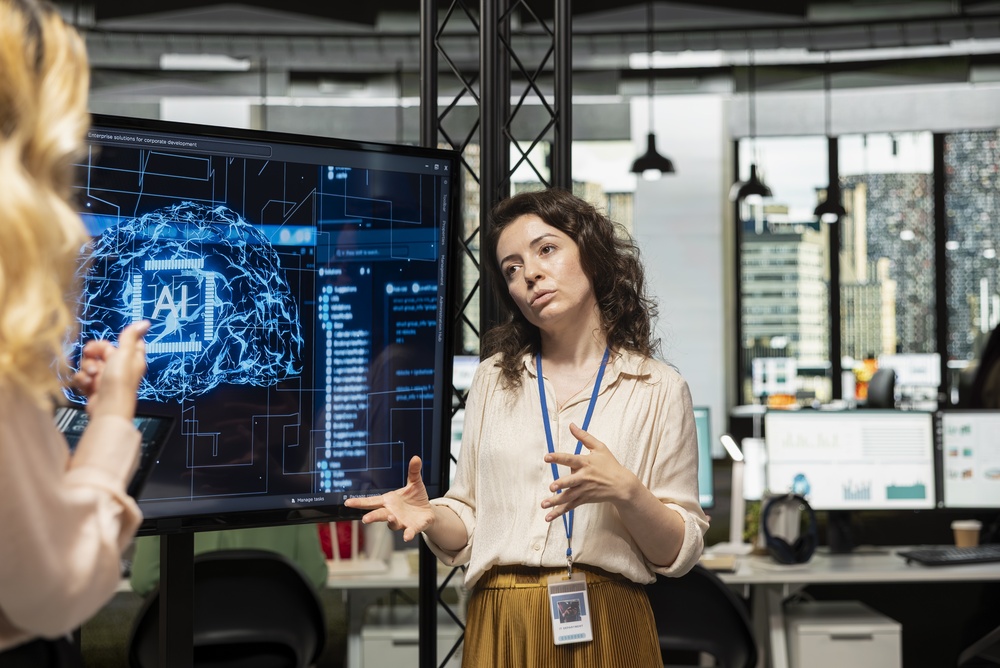
Given how central talent is to competitive advantage, companies need to treat talent strategy as a core business priority, not a peripheral HR function. This means:
- Investing in specialized sourcing to find candidates with genuine, applicable AI expertise
- Moving quickly in a hiring market where top talent has multiple options
- Building retention strategies that go beyond compensation alone
- Structuring teams deliberately, balancing technical depth with business and product fluency
- Partnering with experts who understand how to evaluate and attract AI talent effectively
How Vailexa Helps AI Companies Build Their Greatest Advantage
At Vailexa, we help AI-driven companies treat talent as the strategic asset it truly is. Our approach includes:
- Precision sourcing that identifies candidates with real, applicable AI experience not just résumé keywords
- Speed-optimized hiring processes built for a competitive, fast-moving talent market
- Flexible engagement models, from full-time hires to fractional and project-based talent
- Long-term workforce planning that helps you build well-structured, sustainable AI teams
In an environment where technology is increasingly accessible, talent remains the one advantage competitors truly can’t replicate. Companies that recognize this and invest accordingly are the ones best positioned to lead in 2026 and beyond.

Frequently Asked Questions
Because technology and tools are increasingly accessible to everyone, the real differentiator becomes how effectively a team can apply, adapt, and refine that technology to solve real problems.
Skilled AI professionals often identify opportunities, risks, and possibilities that shape product and business decisions, making them valuable strategic contributors beyond pure execution.
Losing experienced AI talent means losing institutional knowledge and slowing down projects, which can quickly erode a company’s competitive position in a fast-moving market.
A well-rounded team combining technical expertise, product thinking, and business acumen consistently drives stronger, more sustainable innovation than isolated technical hires.
By treating talent acquisition and retention as core business priorities, using specialized sourcing methods, and partnering with experts who understand how to evaluate and attract top AI talent.