Most organizations hire security talent the same way they respond to incidents: after something goes wrong. A breach, a failed audit, or a key resignation triggers an urgent search, and the role sits open for months while risk quietly grows.
There is a better way. Cybersecurity workforce planning means deciding today which skills you will need in one, two, and three years, and building a pipeline to deliver them before the gap becomes a crisis. In this guide, Vailexa shares a practical framework for planning your security workforce through 2029, drawn from our work helping organizations hire, scale, and globalize their technical teams.
Why the Next Three Years Demand a Plan
The security talent you need in 2029 will look different from the team you have today. Four forces are driving that shift.
AI is reshaping security roles. AI tools are automating routine alert triage and log analysis. At the same time, they are creating demand for new skills such as AI security, model risk assessment, and detection engineering for AI-powered attacks.
The skills gap is not closing quickly. Experienced security professionals remain scarce, and competition for senior talent is intense. Organizations that wait until they need someone will pay more and wait longer.
Regulation keeps expanding. New data protection, AI, and cyber-resilience rules are increasing demand for governance, risk, and compliance (GRC) specialists who can translate regulation into controls.
Cloud and hybrid environments keep growing. As infrastructure moves further into multi-cloud and SaaS, cloud security engineering and identity expertise become core requirements rather than niche skills.
A Five-Step Framework for Cybersecurity Workforce Planning

- Align with business strategy. Start with where the business is going, not with your current org chart. Are you entering new markets, launching digital products, moving to the cloud, or pursuing an acquisition? Each of these changes your risk profile and the skills you need.
- Audit your current capabilities. Map every security role and the skills each person brings. Identify single points of failure, such as one engineer who understands your entire cloud setup, and note who may be close to leaving or retiring.
- Forecast future demand. Translate business plans and threat trends into specific roles and skills for each of the next three years. Be concrete: “two cloud security engineers by mid-2027” is a plan, while “more cloud skills” is a wish.
- Identify the gaps. Compare current capabilities with future demand. Rank each gap by business risk and by how hard it will be to fill, so you tackle the most critical and slowest-to-hire roles first.
- Choose a sourcing strategy for each gap. Decide whether to develop, hire, contract, or source globally, then review the plan every six months as conditions change.
Build, Buy, Borrow, or Bridge: Choosing the Right Talent Model
No single sourcing method can fill every gap. The strongest workforce plans combine four models.
| Model | What it means | Best for | Watch out for |
| Build | Upskill and reskill existing employees | IT staff moving into security; growing future leaders | Takes time; needs training budget and mentorship |
| Buy | Hire permanent talent | Core, long-term roles such as security architects and team leads | Long time-to-hire in a scarce market |
| Borrow | Engage contract, interim, or fractional experts | Projects, audits, urgent gaps, interim CISO cover | Knowledge can leave when the contract ends |
| Bridge | Source talent from global markets | Scaling teams, 24/7 coverage, hard-to-find specialties | Compliance, payroll, and time-zone complexity |
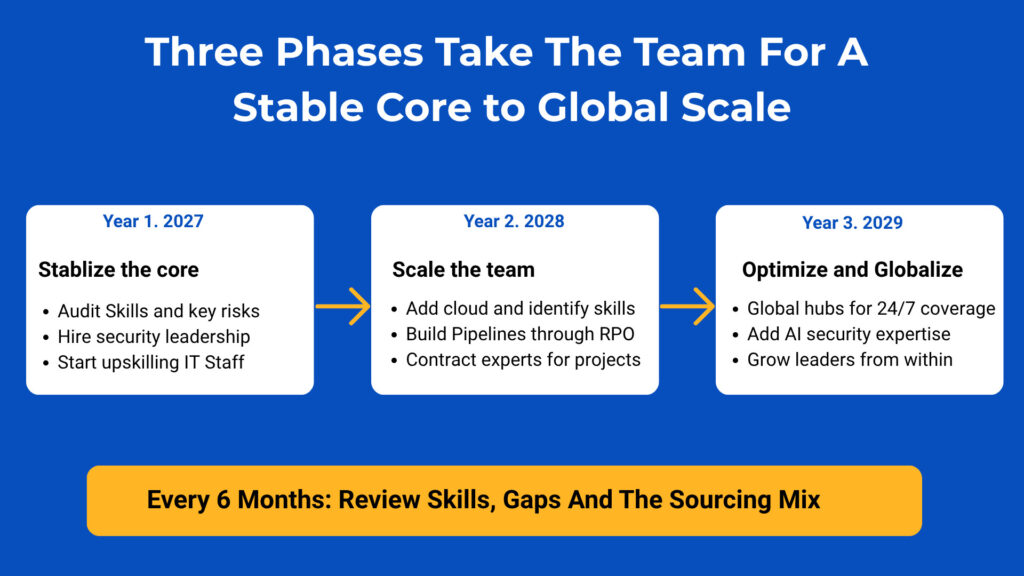
A common pattern is to buy leadership and core architecture roles, build analysts from within, borrow specialists for projects, and bridge to global talent for scale and round-the-clock coverage. Recruitment Process Outsourcing (RPO) ties these together by giving you one consistent hiring engine across every model.
Your Three-Year Roadmap at a Glance
Five Workforce Planning Mistakes to Avoid
- Planning by headcount alone. Ten analysts with the same skills will not cover cloud, identity, and GRC. Plan for skills, not just numbers.
- Ignoring retention. Every security professional who leaves takes institutional knowledge with them. Career paths, training budgets, and manageable on-call loads are part of the plan.
- Treating hiring as an annual event. Security hiring cycles are long. Build a warm talent pipeline year-round so you are not starting from zero.
- Writing unrealistic job descriptions. Asking for a decade of experience in tools that are five years old filters out strong candidates. Focus on the outcomes the role must deliver.
- Setting the plan and forgetting it. Threats, technologies, and business priorities change. A three-year plan should be a living document, reviewed at least twice a year.
Frequently Asked Questions
It is the process of forecasting the security skills and roles your organization will need in the future, comparing them with your current team, and creating a plan to close the gaps through hiring, upskilling, contracting, or global sourcing.
Senior security roles can take months to fill, and building skills internally takes even longer. A three-year horizon gives you time to develop people, build pipelines, and hire ahead of demand, while still being short enough to adjust as threats change.
Prioritize roles that are both business-critical and hard to fill. For many organizations, that means cloud security engineers, identity and access specialists, GRC professionals, and experienced security leaders.
RPO gives you a dedicated, scalable recruitment engine that understands security roles. It helps you forecast hiring needs, build talent pipelines in advance, improve time-to-hire, and maintain consistent quality as you scale.
Yes, when done carefully. Global hiring widens your talent pool, can reduce costs, and makes 24/7 coverage across time zones possible. It does require careful handling of employment law, data protection, and secure onboarding, which is where an experienced global recruitment partner adds value.