
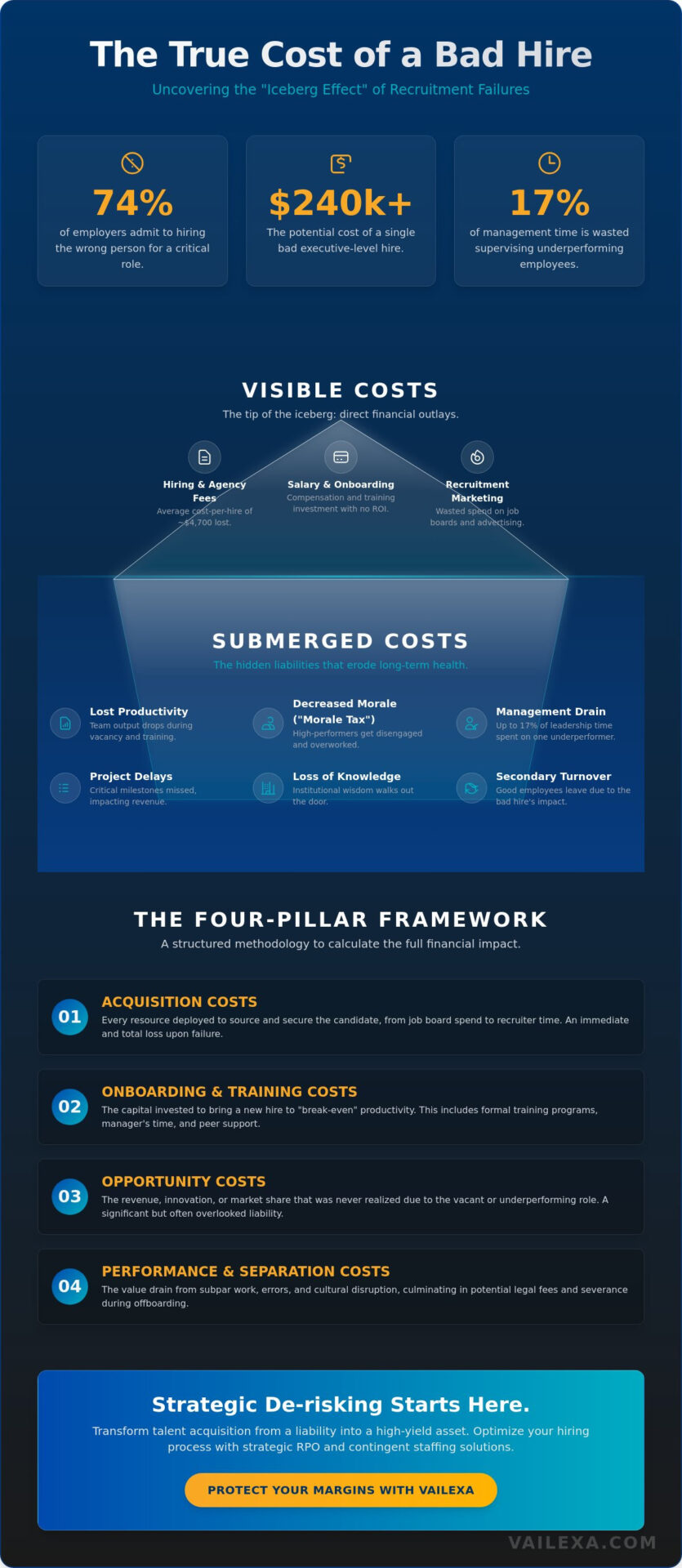
Nearly 74% of employers admit to hiring the wrong person for a critical role, yet few can articulate the precise damage to their bottom line beyond a vacant position. While the average loss for a mid-level role sits around $17,000, executive-level missteps can escalate to $240,000 or more according to CareerBuilder research. You likely already feel the strain of budget leakage and the invisible drain on team morale that follows a recruitment misalignment. Utilizing a robust cost of a bad hire calculator is no longer just an HR exercise; it’s a financial necessity for any organization aiming to protect its margins and maintain operational excellence.
We understand that justifying recruitment process outsourcing or executive search fees requires more than intuition; it demands a defensible, data-driven narrative that aligns HR objectives with the expectations of the Finance department. This article will help you quantify the “iceberg effect” of hiring failures, ranging from lost productivity to the 17% of management time spent on underperformers as reported by Gartner. We’ll provide a strategic framework to transform your talent acquisition into a high-yield asset, ensuring every permanent recruitment or contingent staffing decision is backed by a rigorous analysis of ROI.
Key Takeaways
- Uncover the “Iceberg Effect” of recruitment by identifying submerged liabilities that extend far beyond simple salary losses and direct hiring fees.
- Utilize a professional cost of a bad hire calculator to generate defensible data that aligns your talent strategy with CFO-level financial priorities.
- Learn to quantify the “Morale Tax,” a hidden operational cost that triggers secondary turnover among your high-performing legacy staff.
- Apply a four-pillar methodology to track every dollar invested from the initial executive search to the moment a new hire achieves full productivity.
- Explore how Recruitment Process Outsourcing (RPO) and contingent staffing models provide a strategic buffer against the risks of recruitment misalignment.
The Economic Weight of Misalignment: Why Every Bad Hire is a Strategic Setback
Strategic alignment is the pulse of a high-performing organization. When a new hire lacks the required technical precision or cultural synergy, the resulting friction creates a cascade of operational failures. We define a bad hire as a fundamental breakdown in this alignment. It’s a strategic setback that ripples through your department, eroding the foundation of your workforce planning and stalling your momentum. Viewing recruitment as a simple administrative task is a risk few can afford in a volatile market.
In a competitive 2026 talent landscape, the financial stakes have reached a critical threshold. Recent data from the Society for Human Resource Management (SHRM) suggests that replacing an employee can cost anywhere from 50% to 200% of their annual salary. For specialized technical roles, these figures climb significantly higher. This reality is why a sophisticated cost of a bad hire calculator is an essential tool for the modern executive. It moves recruitment from a line-item expense to its rightful place as a strategic capital investment. By quantifying these risks, you can transform your hiring process into a high-yield asset.
The “Iceberg Effect” describes the deceptive nature of these losses. While the tip of the iceberg represents obvious expenses, the massive, submerged portion contains the liabilities that truly damage a company’s long-term health. Understanding this distinction is the first step toward reclaiming your recruitment ROI.
The Visible Costs: Direct Financial Outlays
These are the expenses your finance team tracks easily. They represent the immediate outflow of capital required to rectify a hiring error. Key visible costs include advertising fees, premium job board subscriptions, and the administrative processing costs associated with the failed search. According to 2026 industry benchmarks, the average cost-per-hire is approximately $4,700. When that investment fails to yield a productive employee, that capital is effectively liquidated without a return on investment. If you utilize external agencies, those fees also vanish, compounding the initial loss.
The Submerged Costs: Operational and Strategic Erosion
The true weight of a hiring mistake lies beneath the surface. These costs are often harder to quantify but carry a more significant impact on your competitive advantage. High employee turnover costs include the disruption of project timelines and the loss of momentum on critical departmental milestones. When a manager spends up to 17% of their time correcting the performance of an underachiever, the entire team’s productivity suffers. This leadership drain prevents senior stakeholders from focusing on high-level growth initiatives. Additionally, the loss of institutional knowledge during a turnover cycle creates a void that takes months to fill. Using a cost of a bad hire calculator helps bring these hidden erosions into the light, allowing for a more accurate financial defense of your hiring budget.
The Four-Pillar Framework for Calculating Recruitment ROI
Moving beyond the “iceberg” analogy requires a structured methodology to capture every dollar lost to recruitment misalignment. A high-yield cost of a bad hire calculator doesn’t just look at the exit; it examines the entire lifecycle of the failed placement. We categorize these liabilities into four distinct pillars to ensure your financial defense is both comprehensive and bulletproof. Each pillar represents a stage where capital is either optimized or eroded.
Pillar 1 focuses on Acquisition Costs. This includes every resource deployed to find and secure the individual, from job board advertising spend to the average cost per hire which industry benchmarks currently place near $4,700. Pillar 2 covers Onboarding and Training. This is the capital investment required to bring a new team member to “break-even” productivity. When a hire fails, this investment is effectively a total loss. Pillar 3 addresses Opportunity Costs, representing the innovation or revenue that never materialized because the role was occupied by an underperformer. Finally, Pillar 4 examines Cultural Impact, which tracks the ripple effect on team morale and the risk of secondary turnover among your top performers.
Calculating the Productivity Gap
The “Ramp-up” period varies by seniority, but it’s rarely shorter than three to six months for technical roles. During this time, the organization pays a full salary for partial output. A bad hire extends this gap indefinitely. Beyond their own lack of results, an unqualified individual forces high-performing peers to spend their own bandwidth on “re-work” and error correction. This creates a hidden tax on your most valuable assets, slowing down the entire department’s velocity. For those managing complex projects, strategic workforce planning becomes the primary defense against these productivity drains.
The Specialized Talent Premium in AI and Data
In specialized sectors like AI and data analytics, the cost of a bad hire isn’t just higher; it’s exponential. Bad hires in AI staffing solutions often cost 2-3x more than generalist roles due to the rarity of the skillset and the high salaries involved. An unqualified engineer can introduce “technical debt” into your codebase that takes months to untangle. More critically, the risk of data privacy or compliance errors can lead to regulatory fines that dwarf the original recruitment budget. Using a specialized cost of a bad hire calculator for these roles ensures you account for the specific technical and legal liabilities inherent in high-stakes talent acquisition.
Step-by-Step: Using the Cost of a Bad Hire Methodology
While automated tools offer convenience, a manual, transparent audit provides the granular clarity required for executive-level decision-making. Relying on a black-box cost of a bad hire calculator can sometimes obscure the specific operational variables unique to your organization. By following a structured, step-by-step methodology, you can build a defensible financial model that resonates with both HR and Finance leadership. This process transforms abstract turnover concerns into a concrete ledger of strategic setbacks.
- Step 1: Aggregate Direct Recruitment Expenses. Total all out-of-pocket costs from the initial search, including specialized job board fees, external sourcing tools, and any administrative processing costs.
- Step 2: Calculate Total Compensation Paid. Sum the gross salary, benefits, and payroll taxes paid to the individual during their tenure. The U.S. Department of Labor suggests the cost of a bad hire is at least 30% of the employee’s first-year earnings, providing a solid baseline for this calculation.
- Step 3: Estimate the Managerial Burden. Quantify the leadership hours redirected toward performance remediation. Research from Gartner indicates that managers spend up to 17% of their time managing underperformers; calculate this by applying the manager’s hourly rate to the duration of the hire’s employment.
- Step 4: Factor in Replacement and Vacancy Gaps. Account for the cost of launching a new search and the revenue lost during the period the position remains unfilled.
- Step 5: Apply the Cultural Multiplier. For leadership or high-impact technical roles, multiply the subtotal by a factor of 1.5x to 2x to account for the “Morale Tax” and team disruption.
The Core Formula for Recruitment Auditing
The foundational equation for auditing recruitment failures is: (Acquisition + Salary + Training + Opportunity Cost) x Cultural Multiplier. This formula remains consistent, though the variables shift based on seniority. For an entry-level role, the multiplier might stay near 1.0, whereas an executive search failure requires a 2.0 multiplier to account for the massive strategic ripple effects. Using this cost of a bad hire calculator framework allows you to refine your internal ROI benchmarks with high search accuracy and precision.
Benchmarking Against Industry Standards
Once you’ve established your internal figure, compare it against global talent solutions benchmarks to identify where your process is leaking value. If your costs consistently exceed industry averages, it’s a clear signal to advocate for more robust strategic workforce planning. Integrating advanced techniques like talent mapping can drastically reduce the probability of a mismatch by identifying high-alignment candidates long before a vacancy even exists. This proactive approach ensures your recruitment budget functions as a high-yield investment rather than a recurring expense.
Intangible Liabilities: The Cultural and Operational Cost of Turnover
While direct financial outlays are quantifiable, the most pervasive damage from a recruitment error often occurs within the invisible fabric of your company culture. These intangible liabilities represent a systematic erosion of your organizational standards. According to a LinkedIn survey, 85% of HR professionals report that a single bad hire negatively impacts team morale and overall productivity. This “Morale Tax” isn’t just a sentiment; it’s a measurable drag on your operational velocity. When you input data into a cost of a bad hire calculator, you must account for the fact that a misaligned individual often forces your highest performers to over-compensate, leading to burnout and resentment.
The impact extends beyond internal dynamics and begins to bleed into your external relationships. Customer satisfaction is frequently a casualty of hiring misalignment, as project delivery delays or poor service quality alienate long-term clients. These submerged liabilities can eventually result in lost contracts or diminished market share, costs that are rarely captured in a standard ledger but are devastating to your annual growth. Maintaining high talent density is the only way to safeguard your competitive advantage against these operational erosions.
The Contagion Effect on High Performers
Top talent thrives in environments defined by excellence and shared ambition. When an underperformer is introduced, the resulting friction often triggers a “contagion effect” of secondary turnover. High-performing employees don’t just leave for higher compensation; they leave because they refuse to tolerate the technical debt or increased workload introduced by a hiring mistake. Calculating the cost of this secondary turnover is essential for any comprehensive recruitment audit. This isn’t about replacing one person; it’s about the loss of institutional knowledge and the breakdown of team psychological safety. Without a precise cost of a bad hire calculator approach, you risk overlooking the fact that one bad hire can effectively dismantle a high-functioning department.
Erosion of the Employer Brand
Your employer value proposition (EVP) is a delicate asset that takes years to build and only months to degrade. Frequent turnover in critical roles creates a visible pattern on platforms like Glassdoor and LinkedIn, signaling instability to the global talent market. This perceived volatility forces you to pay a “Risk Premium,” a higher salary offer required just to convince top-tier candidates to join a high-turnover environment. Mitigating this brand damage requires more than reactive hiring; it demands specialized executive search methodologies that prioritize cultural alignment as heavily as technical skill. To ensure your next leadership placement strengthens rather than weakens your brand, consider the long-term benefits of permanent recruitment strategies that prioritize high-precision alignment.
Strategic De-risking: Optimizing Talent Acquisition with Vailexa
Identifying the financial damage of a recruitment error is only the first step in a broader maturity model for talent acquisition. While a cost of a bad hire calculator provides the necessary data to justify change, the ultimate goal is to architect a system that prevents these liabilities from entering your ledger in the first place. Transforming these potential losses into a high-yield strategic asset requires a partnership that balances data-driven precision with industry-leading expertise. At Vailexa, we position ourselves as the visionary architect of your workforce, ensuring that every placement is a building block for long-term stability.
Our Recruitment Process Outsourcing (RPO) and AI staffing solutions are designed to eliminate the guesswork inherent in traditional hiring. By leveraging advanced data analytics and a rigorous screening methodology, we guarantee a higher quality of hire that aligns with your specific technical requirements and cultural DNA. This approach doesn’t just fill seats; it builds high-performance teams that drive innovation and maintain the talent density required for global competition. We move your organization beyond the “panic hire” syndrome and into a state of disciplined, strategic growth.
Contingent Staffing as a Risk Mitigation Tool
One of the most effective ways to de-risk your recruitment strategy is through a “try-before-you-buy” model. Utilizing contingent staffing offers the ultimate flexibility for scaling teams without the immediate financial liability of a permanent commitment. This model allows you to assess a candidate’s performance, cultural fit, and technical precision in a real-world environment before finalizing a long-term contract. It’s a pragmatic solution for navigating complex projects or volatile market conditions, providing access to global talent solutions without the overhead of local entities. By shifting the initial risk to a workforce solutions provider, you protect your departmental budget from the catastrophic multipliers identified in your cost of a bad hire calculator.
The Vailexa Advantage: Precision-Driven Recruitment
Precision in recruitment is achieved through meticulous preparation rather than reactive searching. Our methodology prioritizes talent mapping and high-search accuracy to identify top-tier professionals who aren’t just looking for a job, but are the right strategic fit for your organization’s future. Through integrated strategic workforce planning, we help you anticipate talent gaps months before they impact your operations, ensuring that your recruitment pipeline is always robust and reliable. We’re committed to quality and organizational standards, acting as both a visionary guide and a practical executor of your talent strategy. To begin your transition from recruitment as an expense to recruitment as a strategic investment, audit your recruitment ROI with a Vailexa consultation today.
Advancing Your Organization Through Data-Driven Talent Strategy
Quantifying the financial impact of a mismatch is the foundational step toward reclaiming your competitive edge. By acknowledging the submerged liabilities of hiring failures and applying a rigorous four-pillar framework, you ensure that every talent acquisition decision is backed by a defensible dollar figure. A high-yield cost of a bad hire calculator provides the transparency needed to justify sophisticated investments in recruitment process outsourcing or specialized search functions. This methodology transforms your hiring process from a reactive expense into a high-yield strategic asset.
Vailexa acts as a strategic partner to Fortune 500 enterprises, offering global workforce solutions that span 50+ countries. Our specialized expertise in AI and data analytics staffing ensures that even your most complex technical requirements are met with precision and cultural alignment. It’s time to stop reacting to turnover and start architecting a resilient workforce built for long-term stability. Your organization deserves a hiring process that functions as a driver of growth rather than a recurring cost. Excellence is a choice fueled by data.
Download our Strategic Recruitment ROI Template
Frequently Asked Questions
How much does a bad hire actually cost an organization in 2026?
The total financial impact varies by seniority, but the Society for Human Resource Management (SHRM) suggests replacement costs range from 50% to 200% of an annual salary. For mid-market roles, CareerBuilder data indicates an average loss of $17,000 per incident. Executive-level failures are far more damaging; these missteps often exceed $240,000 once you factor in strategic disruption and search fees.
What are the three biggest hidden costs of a bad hire?
The primary hidden liabilities include the “Morale Tax” on high performers, the drain on leadership bandwidth, and the erosion of customer trust. Research from Gartner highlights that managers lose up to 17% of their time correcting performance issues. These submerged costs often dwarf visible expenses like job board fees or initial training outlays, creating a long-term drag on operational velocity.
Can a bad hire cost calculator work for remote or global teams?
A specialized cost of a bad hire calculator is highly effective for global teams when it accounts for regional variations in visa processing and relocation. In high-growth regions, the financial impact is often amplified by housing allowances and legal compliance fees. Global talent solutions providers use these metrics to justify the higher precision of centralized, high-search-accuracy recruitment models.
How do you calculate the opportunity cost of a vacant position?
You calculate this by dividing the total annual revenue generated by a department by the number of employees, then multiplying that daily rate by the number of days the role remains open. This figure represents the innovation and productivity that never materialized during the vacancy. It serves as a critical baseline for justifying the speed and efficiency of permanent recruitment or contingent staffing interventions.
What is the difference between direct and indirect hiring costs?
Direct costs are tangible financial outlays such as advertising fees, background checks, and cost of a bad hire calculator implementation fees. Indirect costs represent the “soft” losses like reduced team velocity and the loss of institutional knowledge. While direct costs are easier to track on a standard ledger, indirect costs represent the true strategic erosion of an organization’s talent density.
How can Recruitment Process Outsourcing (RPO) reduce the cost of a bad hire?
RPO reduces these costs by implementing a rigorous, data-driven screening process that ensures a higher quality of hire from the outset. By utilizing advanced talent mapping and AI-driven assessments, RPO providers minimize the probability of cultural or technical misalignment. This proactive methodology shifts the focus from reactive replacement to long-term strategic workforce planning and organizational stability.
Does the cost of a bad hire vary by industry, such as AI or Data Science?
The financial impact is significantly higher in specialized sectors like AI staffing solutions due to the scarcity of the skillset and the potential for technical debt. An unqualified data scientist can introduce errors into core algorithms that take months for senior engineers to untangle. These specialized roles often carry a 2x to 3x cost multiplier compared to generalist administrative positions.
What is the “Cultural Multiplier” in recruitment cost analysis?
The Cultural Multiplier is a numerical factor, typically between 1.5 and 2.0, applied to the subtotal of hiring costs to account for team disruption. It acknowledges that a bad hire in a leadership role has a far greater ripple effect than an individual contributor error. This multiplier helps finance and HR teams align on the true strategic weight of a high-stakes executive search.