
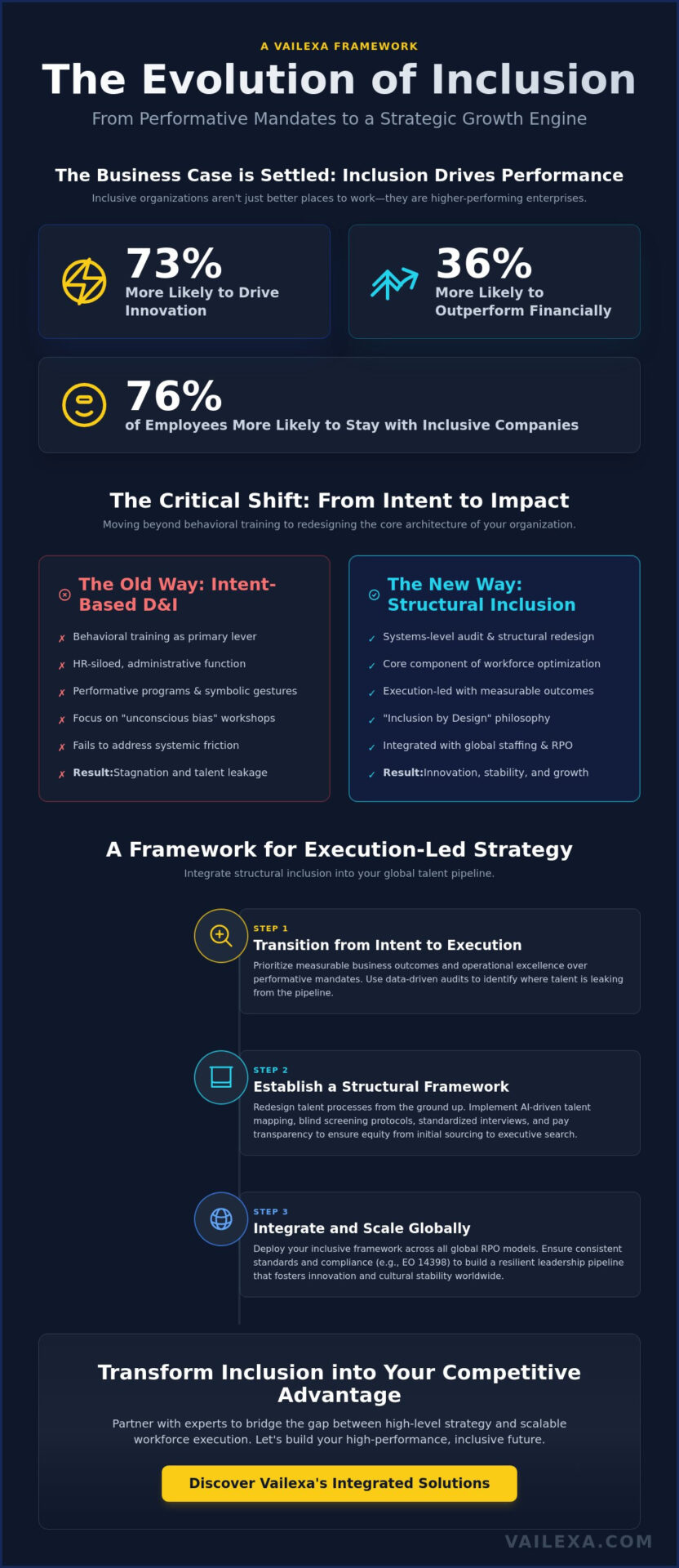
Inclusive organizations are 73% more likely to drive innovation and 36% more likely to outperform their peers financially. In a global market currently navigating the implementation of Executive Order 14398, these figures represent more than social progress; they’re the indicators of a high-performance enterprise. Achieving these results requires moving beyond the traditional HR silo. It demands sophisticated diversity and inclusion consulting that bridges the gap between high-level strategy and disciplined execution.
You’ve likely felt the frustration of managing performative programs that fail to solve talent shortages in specialized fields like AI and Data Science. It’s difficult to maintain excellence when inclusion standards fluctuate across international borders. We’ll show you how to transform these hurdles into a strategic blueprint for growth. This guide provides a framework to integrate structural inclusion into your global staffing and RPO models, ensuring your leadership pipeline drives both innovation and long-term stability.
Key Takeaways
- Transition from intent-based mandates to execution-led strategies that prioritize measurable business outcomes and operational excellence.
- Establish a framework for structural inclusion by redesigning talent processes to ensure equity from initial mapping through to executive search.
- Partner with expert diversity and inclusion consulting to bridge the gap between high-level strategic vision and practical, scalable workforce execution.
- Deploy AI-driven staffing solutions and advanced talent mapping to uncover high-potential candidates within non-traditional talent pools.
- Integrate inclusion principles into global RPO models to build a resilient leadership pipeline that fosters innovation and cultural stability.
The Evolution of Diversity and Inclusion Consulting in 2026
The corporate world has reached a definitive turning point. By mid-2026, the era of “intent-based” programs has officially closed, replaced by a rigorous, execution-led model. Global enterprises no longer view Diversity, Equity, and Inclusion (DEI) as a separate administrative function. Instead, it’s a core component of structural workforce optimization. This transition is driven by a sophisticated approach to diversity and inclusion consulting that prioritizes measurable impact over symbolic gestures. High-level strategic partners are now expected to deliver more than just slide decks; they must provide the data-driven insights necessary to identify hidden talent gaps and align inclusive leadership with broader ESG and corporate governance goals.
From HR Initiative to Strategic Business Imperative
In 2026, the business case is settled. Diverse teams are 73% more likely to drive innovation, a critical advantage in AI-driven environments where varied perspectives prevent algorithmic bias and foster creative problem-solving. This isn’t just about internal culture. It’s about customer resonance. As global markets expand, organizations with inclusive agility are better positioned to understand and capture diverse consumer segments. Top-tier talent, particularly in data analytics and AI staffing, now filters employers based on their ability to foster a truly inclusive environment. They don’t just want a job; they want to work for a partner that treats inclusion as a discipline of excellence.
The 2026 Global Landscape: Navigating Complexity
Operating a global enterprise requires managing a fragmented regulatory environment. From the implementation of Executive Order 14398 for federal contractors to regional laws like Florida’s Senate Bill 1134, the legal landscape is more complex than ever. Maintaining consistent standards across international offices requires robust global workforce solutions. Organizations that rely on a diverse, distributed workforce gain a distinct “Global Agility” advantage. By integrating strategic workforce planning with talent mapping, companies can ensure their inclusion standards remain high while remaining compliant with local mandates. This level of precision is what separates market leaders from those struggling with performative relics of the past.
Structural vs. Behavioral Inclusion: The Framework for Impact
Many organizations mistakenly prioritize behavioral training, such as unconscious bias workshops, as their primary lever for change. While these initiatives raise awareness, they often fail to yield long-term results because the underlying systems remain biased. True impact requires a shift toward structural inclusion. This involves auditing every phase of the employee journey to ensure that equity is baked into the organizational architecture. Effective diversity and inclusion consulting identifies these systemic friction points, moving beyond “PowerPoint D&I” to create a resilient, high-performance environment. When systems are designed to be inclusive, they naturally support the behavioral shifts that leaders want to see.
Achieving a strategic advantage depends on “Inclusion by Design.” This philosophy treats inclusion as a technical requirement rather than a social preference. By measuring the ‘Inclusion Gap’ through proprietary benchmarks, enterprises can pinpoint exactly where talent is leaking from the pipeline. Since 76% of employees are more likely to stay with companies that possess strong DEI initiatives, closing this gap is essential for stability. In 2026, data-driven audits allow us to see if the barriers are in the sourcing phase, the promotion cycle, or the executive search process, providing a clear roadmap for structural repair.
Building Equitable Talent Structures
Transformation begins with the mechanics of recruitment. Removing coded language from job descriptions and refining talent mapping processes ensures a broader reach into non-traditional pools. Implementing standardized interview frameworks and “blind” screening protocols reduces the influence of affinity bias. Additionally, pay transparency has emerged as a non-negotiable standard. Clear pay structures don’t just ensure compliance with international directives; they build the foundational trust necessary for long-term retention. To see how these structures integrate with your hiring goals, consider exploring our strategic workforce planning services.
Fostering Inclusive Leadership Behaviors
Structural changes provide the foundation, but leaders must be equipped to operate within them. The “Inclusive Leader” profile in 2026 is defined by empathy, cultural intelligence, and a genuine curiosity for different perspectives. Leaders must now manage distributed and hybrid teams across varied time zones and cultural norms. To ensure these behaviors take root, forward-thinking enterprises are linking D&I outcomes directly to executive compensation. When inclusion becomes a performance metric rather than a suggestion, it gains the same operational weight as revenue or market share. This accountability model ensures that the human element of business growth is nurtured alongside technical excellence.
Why Strategy Alone Fails: The Consulting vs. Execution Gap
Strategy is a map, but execution is the engine. Many global enterprises invest heavily in diversity and inclusion consulting only to find their ambitious goals stalled at the implementation phase. This “PowerPoint D&I” trap occurs when high-level advisors deliver theoretical frameworks without understanding the granular realities of the talent market. In 2026, where specialized talent in AI and Data Science is exceptionally scarce, a strategy that doesn’t account for real-world sourcing is destined to fail. Bridging this gap requires a shift from standalone advice to an integrated model that pairs strategic vision with the technical muscle of global staffing.
The disconnect often stems from a lack of evaluation metrics that link consultancy to actual hires. Research on best practices in DEI consulting suggests that without clear operational alignment, even the most well-intentioned programs struggle to move beyond the awareness stage. When a consulting firm doesn’t understand the specific nuances of your technical requirements, their recommendations often lack the precision needed to fill high-stakes roles. Success in 2026 demands a partner that can both design the blueprint and manage the construction of the workforce.
The Problem with Standalone Consulting
Traditional consultants frequently operate in a vacuum, detached from the daily pressures of talent acquisition. They might suggest aggressive diversity targets for a machine learning team without realizing that the current candidate pool in that specific niche is historically homogeneous. This “one-size-fits-all” approach ignores the complexities of specialized industries. It’s not enough to have a goal; you must have a viable path to reach it. When external advisors lack deep industry knowledge, their frameworks become hurdles rather than helpers, leading to frustration and missed milestones.
Bridging the Gap with Workforce Solutions
Integrated providers solve this by embedding inclusion principles directly into their Recruitment Process Outsourcing (RPO) workflows. Instead of treating D&I as a separate project, it becomes a standard operating procedure for every requisition. This approach allows for real-time adjustments. If a particular sourcing channel isn’t yielding diverse results, the data is immediately available to pivot the strategy. Contingent staffing also plays a vital role here, acting as a sandbox to test and scale inclusive models before they’re rolled out across the permanent workforce. By combining talent mapping with strategic consulting, organizations ensure that their “Diversity Goals” are grounded in the actual availability of global talent.
Building the Inclusive Pipeline: AI, Data, and Talent Mapping
Execution requires more than a vision; it requires a precise mechanism for discovery. As the global DEI Consulting Market is projected to grow to USD 4.49 billion by 2035, the most successful enterprises are already using diversity and inclusion consulting to build pipelines that are both high-performing and structurally equitable. Traditional sourcing methods often overlook high-potential candidates because they rely on narrow, historical definitions of “top-tier” talent. By leveraging advanced data analytics staffing, organizations can identify non-traditional talent pools and close the innovation gap. This isn’t just a cultural preference; it’s a data-driven necessity for firms competing in specialized sectors like AI and Big Data.
We utilize a rigorous 5-step process for inclusive talent mapping that ensures no stone is left unturned. First, we redefine success benchmarks beyond traditional credentials. Second, we deploy AI-driven tools to uncover transferable skills. Third, we map global talent hubs that are often ignored by competitors. Fourth, we implement personalized engagement strategies for passive candidates. Finally, we conduct a granular audit of the recruitment funnel to eliminate systemic drop-off points. With over 4 million people reaching retirement age annually through 2027, this methodical approach transforms diversity and inclusion consulting into an essential tool for mitigating institutional knowledge loss.
Inclusive Talent Mapping for High-Tech Roles
The “Tech Diversity Myth” suggests that diverse talent is simply unavailable in fields like machine learning or data science. Our experience proves otherwise. By expanding searches beyond the usual elite universities and focusing on “Talent Density,” we find experts who possess the technical rigor and unique perspectives necessary for breakthrough innovation. Our AI staffing solutions use predictive modeling to identify candidates whose skill sets align with future technological needs, even if they’ve followed non-linear career paths. This strategy builds a more resilient workforce that’s capable of navigating the complexities of a global market.
Mitigating Bias in AI-Driven Recruitment
Technology is a powerful tool, but it isn’t inherently neutral. Auditing recruitment algorithms for systemic bias is a critical priority for any modern enterprise. We advocate for a “Human-in-the-loop” model where AI handles the heavy lifting of data processing while seasoned experts provide the cultural nuance and ethical oversight. This balance ensures that your talent mapping efforts remain compliant with global data privacy standards while actively promoting equity. By combining machine intelligence with human judgment, we help you build a pipeline that is as fair as it is efficient. To start optimizing your technical pipeline, explore our AI staffing solutions today.
Vailexa’s Integrated D&I Consulting and Global Staffing Model
Vailexa represents the intersection of visionary architecture and disciplined execution. While many firms provide theoretical advice, we provide the high-performing workforce that brings that advice to life. Our diversity and inclusion consulting isn’t a standalone service; it’s the foundational intelligence that powers our global talent solutions. We bridge the consulting gap by ensuring that every strategic recommendation is backed by our proven capacity to source, hire, and retain. In a global market projected to reach USD 4.49 billion by 2035, organizations need more than a plan. They need a partner that can operationalize inclusion across every level of the enterprise.
Our “Inclusive RPO” model is designed for rapid scalability and long-term stability. It’s not enough to fill a single requisition. You need a resilient system that consistently delivers diverse talent across international borders. We specialize in AI staffing solutions and data analytics staffing, sectors where the “talent scarcity” excuse is often used to justify a lack of progress. By applying a structural lens to these high-tech niches, we help you build teams that are 73% more likely to drive innovation and 36% more likely to outperform their peers financially. We don’t just find candidates; we build the inclusive engines of your future growth.
Confidentiality and precision define our executive search process and talent mapping capabilities. We recognize that the “Inclusive Leader” of 2026 must be an architect of cultural intelligence. Our proprietary mapping process identifies leaders who possess the empathy and curiosity required to manage distributed, hybrid teams in a shifting legal environment. This level of detail ensures that your leadership pipeline is as diverse as the global markets you serve, providing a clear path for succession and knowledge transfer as 4 million workers reach retirement age annually through 2027.
The Vailexa Advantage: From Blueprint to Hire
We begin every partnership with customized D&I audits that move beyond surface-level checklists to establish a rigorous performance benchmark. From this baseline, our strategic workforce planning aligns your long-term headcount needs with your structural inclusion goals. Whether you require contingent staffing for a specific project or permanent recruitment for a new global office, our workforce solutions are tailored to your specific organizational standards. We ensure that every hire is a building block in a larger, cohesive argument for strategic excellence.
Partnering for Long-Term Organizational Excellence
Success in 2026 requires a partner dedicated to your long-term stability and business growth. We’ve seen global workforces transformed when inclusion is treated as a disciplined business driver rather than a corporate mandate. By integrating these principles into the entire employee lifecycle, we help you secure the 86% of Gen Z workers who prioritize DEI when choosing their long-term employers. We invite you to elevate your workforce with Vailexa’s D&I consulting and global staffing solutions and discover how structural inclusion drives measurable innovation.
Architecting the Future of the Inclusive Enterprise
The landscape of 2026 demands a definitive departure from performative mandates. We’ve explored how structural inclusion, rather than behavioral training alone, creates the framework for lasting impact. By bridging the gap between high-level strategy and daily recruitment execution, organizations can finally turn diversity into a measurable performance driver. This transition requires a sophisticated approach to diversity and inclusion consulting that’s rooted in data and global market intelligence.
Vailexa stands ready as your strategic partner in this transformation. With specialized expertise in AI and data analytics staffing and a proven track record in structural D&I, we empower enterprises to lead with precision. Our global workforce solutions span 50+ markets, ensuring your standards remain consistent while your innovation accelerates. It’s time to move beyond the blueprint and start building. Schedule a Strategic Workforce Consultation with Vailexa today to secure your competitive advantage and foster a culture of excellence.
Frequently Asked Questions
What is diversity and inclusion consulting, and why is it important in 2026?
Diversity and inclusion consulting is a strategic partnership that aligns an organization’s workforce demographics with its innovation and growth objectives. In 2026, this is critical because inclusive organizations are 73% more likely to drive innovation and significantly outperform their competitors financially. It provides the expertise needed to navigate a complex regulatory environment, including new federal mandates and regional compliance laws, while ensuring long term organizational stability.
How do D&I consulting firms measure the success of an inclusion program?
Success is measured through a combination of quantitative benchmarks and qualitative insights that track structural progress. Key metrics include retention rates among diverse talent pools, promotion equity across different demographics, and the direct impact on financial performance. Firms also analyze decision making speed and innovation output, as inclusive teams are up to 50% more likely to make better decisions than homogeneous ones.
Can D&I consulting help with executive search and C-suite recruitment?
Yes, strategic consulting ensures that leadership pipelines are built on cultural intelligence and equitable talent mapping. By auditing the executive search process, consultants help identify high potential leaders who possess the empathy and curiosity required to manage distributed global teams. This approach is vital for filling the leadership gap created as 4 million people reach retirement age annually through at least 2027.
What is the difference between behavioral and structural inclusion in consulting?
Behavioral inclusion focuses on individual mindset shifts and unconscious bias training, whereas structural inclusion redesigns the organizational architecture itself. Most effective diversity and inclusion consulting now prioritizes structural changes, such as auditing pay structures and recruitment workflows. Behavioral shifts are difficult to sustain if the underlying systems, like job descriptions or interview frameworks, remain inherently biased.
How does AI staffing support diversity and inclusion goals?
AI staffing solutions use predictive modeling to identify transferable skills in non-traditional talent pools that human recruiters might overlook. These tools remove initial screening bias by focusing on objective data points and technical competency. When integrated into a broader workforce strategy, AI helps build a resilient pipeline of experts in specialized fields like data science and machine learning without compromising on equity.
Is diversity and inclusion consulting suitable for startups or only large enterprises?
Consulting is essential for organizations of all sizes, though the application varies based on scale. For startups, it establishes an “Inclusion by Design” foundation that prevents the need for costly structural repairs as the company grows. Large enterprises utilize it to maintain consistent standards across global offices, ensuring that their inclusion efforts drive innovation and meet regional regulatory requirements effectively.
How do global workforce solutions ensure D&I compliance across different countries?
Global workforce solutions integrate regional legal requirements, such as the EU Pay Transparency Directive, into a unified organizational strategy. These solutions allow enterprises to maintain high inclusion standards while navigating specific local laws like Florida’s Senate Bill 1134. By using a centralized talent model, firms can certify that their recruitment and retention practices meet the highest ethical and legal standards worldwide.
What should we look for when choosing a D&I consulting partner?
You should prioritize a partner that offers both high level strategic vision and the technical power to execute hiring. A credible diversity and inclusion consulting partner must demonstrate specialized expertise in your specific industry, such as AI or data analytics staffing. They should provide a clear, data driven methodology for linking inclusion outcomes to measurable business performance and executive accountability models. For a deeper look at how to architect a bias-free recruitment engine, explore our comprehensive guide on inclusive hiring practices for global enterprises in 2026.