
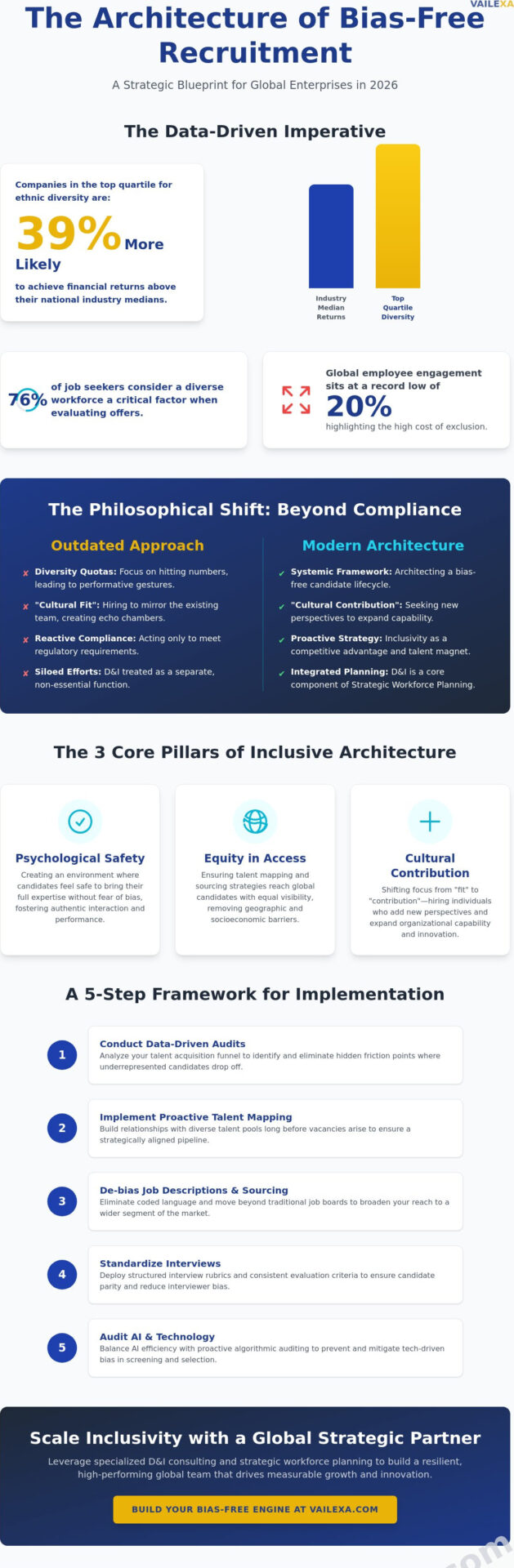
Companies in the top quartile for ethnic diversity are 39% more likely to achieve financial returns above their national industry medians. This isn’t a coincidence; it’s a direct result of mature inclusive hiring practices that prioritize talent density over performative metrics. You’ve likely noticed that the demand for niche tech talent remains fierce, while the regulatory environment grows increasingly complex. With the proposed rescinding of EEO-1 reporting requirements in the United States, the responsibility for tracking workforce demographics has shifted squarely onto the shoulders of the enterprise, making internal data precision more critical than ever.
It’s frustrating to watch elite talent slip through the cracks of legacy systems or to see high turnover rates within underrepresented groups. You understand that a truly global enterprise requires a sophisticated, data-driven approach to diversity that transcends simple compliance. This guide provides the strategic blueprint you need to architect a bias-free recruitment engine that attracts elite talent and drives measurable growth. We’ll examine how to leverage Strategic Workforce Planning and D&I Consulting to build a scalable framework for global inclusivity, ensuring your employer brand remains a magnet for the world’s best minds.
Key Takeaways
- Shift your recruitment philosophy from traditional diversity quotas toward a systemic architecture that removes barriers across the entire candidate lifecycle.
- Identify hidden friction points in your talent acquisition funnel by conducting rigorous data-driven audits and leveraging strategic talent mapping.
- Navigate the complexities of modern recruitment by balancing AI efficiency with proactive algorithmic auditing to prevent tech-driven bias.
- Deploy a standardized five-step framework designed to eliminate coded language and ensure candidate parity through structured interview rubrics.
- Learn how to scale inclusive hiring practices across global markets by integrating specialized D&I consulting into your long-term workforce strategy.
What is Inclusive Hiring in 2026? Moving Beyond Compliance
In 2026, inclusive hiring practices have evolved from a reactive compliance exercise into a sophisticated business architecture. It’s no longer enough to aim for diversity quotas. Those outdated models often lead to performative gestures that fail to address systemic barriers. Instead, modern enterprises are adopting a rigorous methodology that removes friction throughout the entire candidate lifecycle. By establishing robust frameworks for diversity, equity, and inclusion, organizations can move beyond surface-level metrics to build a truly resilient workforce.
This shift is driven by a global talent scarcity that has made inclusivity a non-negotiable survival trait. When global employee engagement sits at a record low of 20%, as reported by Gallup in 2026, the cost of exclusion is too high to ignore. Professional diversity and inclusion consulting has become a vital component of strategic workforce planning. It helps leaders transition from “checking boxes” to architecting ecosystems where elite talent from every background can thrive. This is about precision, not just participation.
The Core Pillars of Inclusive Architecture
Strategic recruitment now rests on three foundational pillars. First, psychological safety must be treated as a high-performance recruitment tool. Candidates need to feel they can bring their full expertise to the table without fear of bias. Second, equity in access ensures that your talent mapping reaches global candidates with equal visibility, regardless of their geographic or socioeconomic starting point. Finally, we’ve seen a definitive shift from “cultural fit” to “cultural contribution.” Instead of hiring people who mirror your existing team, you’re looking for individuals who add new perspectives and expand your organizational capability.
Why Global Enterprises Must Adapt Now
The data is clear. Companies in the top quartile for ethnic diversity are 39% more likely to see financial returns above their national industry medians. This isn’t just about ethics; it’s about competitive advantage. As Gen Z and Gen Alpha dominate the 2026 workforce, their expectations are uncompromising. In fact, 76% of job seekers consider a diverse workforce a critical factor when evaluating offers. If your global talent solutions ignore intersectionality, you risk alienating the very talent required to drive innovation. Building a bias-free engine is the only way to secure long-term stability in an increasingly volatile market.
The Architecture of Bias-Free Recruitment: Where to Start
Architecting a bias-free recruitment engine begins with a clinical examination of your existing talent acquisition funnel. Most organizations harbor hidden friction points where elite talent is unintentionally filtered out before a human recruiter even views a profile. These leaks often occur during the initial screening phase or within rigid job requirements that favor traditional career paths over actual competency. To rectify this, leading DEI consulting firms now emphasize the necessity of data-driven audits that pinpoint exactly where underrepresented candidates drop off. This analytical rigor ensures that your strategy is built on facts rather than assumptions.
Transitioning from reactive hiring to proactive talent mapping allows your organization to build relationships with diverse talent pools long before a vacancy arises. This forward-thinking approach ensures that your pipeline isn’t just full, but strategically aligned with your long-term growth objectives. Establishing clear, non-negotiable inclusive KPIs for your recruitment teams is essential for maintaining this momentum. These metrics should move beyond simple headcounts to measure the diversity of candidate shortlists and the equity of offer acceptance rates across different demographics. When you hold your teams accountable to these standards, inclusivity becomes a measurable business outcome.
De-biasing the Sourcing Strategy
Traditional job boards often act as echo chambers, limiting your reach to a narrow segment of the market. To access neurodiverse and non-traditional talent, you must diversify your sourcing channels and engage with specialized communities. Implementing blind sourcing techniques helps your team focus on core competencies rather than pedigree or previous employer names. Research into inclusive hiring best practices highlights that even small adjustments, such as using gender-neutral language in high-level executive search, can significantly expand the depth of your applicant pool. By removing gender-coded adjectives like “dominant” or “nurturing,” you signal a culture of meritocracy that resonates with high-performing global leaders.
Building Inclusive Employer Brands
Your employer brand is the primary signal you send to the global talent market. In 2026, candidates easily distinguish between authentic storytelling and performative diversity. Instead of stock photography, showcase real narratives from your employee resource groups (ERGs) to demonstrate how inclusive hiring practices translate into a lived experience. Highlighting accessibility and remote-first flexibility is particularly effective for reaching a global audience, as it removes physical and geographic barriers that often hinder underrepresented groups. When your marketing reflects a genuine commitment to equity, you don’t just attract talent; you build a community of contributors who are invested in your collective success.
AI Staffing vs. Human Bias: The 2026 Efficiency Debate
The central paradox of modern recruitment lies in the tension between technological speed and human equity. As we move through 2026, the primary question for executive leadership isn’t whether to use AI, but how to deploy it without compromising inclusive hiring practices. While automated systems offer the promise of removing subjective “gut feeling” biases, they risk codifying historical prejudices if the underlying models aren’t rigorously scrutinized. This has led to the rise of algorithmic auditing as a mandatory strategic pillar for global enterprises. You must ensure your recruitment tech is a bridge to talent, not a digital barrier.
The regulatory landscape has already shifted to enforce this transparency. Effective October 1, 2025, the California Civil Rights Council revised regulations specifically to address automated decision systems in employment. Furthermore, as of January 1, 2026, Illinois requires employers to provide formal notification when AI is utilized in the hiring process. These legal mandates align with foundational research on inclusive recruiting, which emphasizes that technology should supplement, not replace, human-centric empathy and contextual judgment. Vailexa integrates AI staffing solutions by prioritizing these ethical guardrails, ensuring that efficiency never comes at the cost of equity.
The Pros and Cons of AI in Inclusive Hiring
AI excels at processing vast datasets to identify core competencies, effectively neutralizing the unconscious human bias that often occurs during initial CV screening. It allows for a pure focus on skills rather than pedigree. However, the danger remains that AI might replicate historical hiring prejudices if trained on non-diverse data. The 2026 industry standard has shifted toward Explainable AI (XAI). This approach demands that every automated recommendation be backed by a transparent logic trail, allowing recruitment teams to understand exactly why a candidate was surfaced or sidelined. It’s about moving from a “black box” to a glass box.
Implementing Bias-Aware AI Solutions
Building a bias-aware engine requires training models on diverse, global datasets to ensure equitable outcomes across all demographics. Strategic leaders are also using AI to identify “skills-gap” opportunities, highlighting underrepresented candidates who possess the necessary aptitude but may lack traditional credentials. Despite these advancements, human-in-the-loop (HITL) verification remains essential for final shortlisting. This ensures that the nuance of human potential is never lost to an algorithm. By balancing Vailexa’s AI staffing solutions with expert human oversight, your organization can achieve both the scale of automation and the precision of inclusive excellence.
The 5-Step Framework for Implementing Inclusive Practices
Implementing inclusive hiring practices requires more than a high-level policy statement; it demands a disciplined, five-step execution framework. This structured approach moves your organization from abstract goals to repeatable excellence. By treating each stage of the recruitment lifecycle as a precision-engineered component, you eliminate the variability that allows bias to take root. Global enterprises that fail to codify these steps often find their DEI efforts stalled by inconsistent application across different regions. A truly global framework ensures that your standards for excellence remain uncompromised, whether you’re hiring in London, Singapore, or San Francisco.
Step 1 & 2: Sourcing and Standardisation
Step 3, 4 & 5: Selection and Retention
Diversifying your interview panel is a critical safeguard against the “like hires like” tendency that stifles innovation. A multi-perspective panel challenges unconscious assumptions and ensures that cultural contribution remains the primary driver of selection. When you reach the offer stage, inclusive management becomes a matter of financial equity. Effective January 1, 2026, California’s Senate Bill 642 expands the Equal Pay Act to include benefits in the definition of wages. You must handle salary negotiations with radical transparency to close gender and ethnicity pay gaps before they start. This proactive stance on pay equity is a powerful tool for strengthening your employer brand and attracting elite global talent.
This commitment to equity must also extend to your flexible workforce. Integrating inclusivity into contingent staffing ensures that every contributor, regardless of contract type, feels a sense of belonging. The final step is onboarding for belonging, where the first 90 days are designed to support long-term retention through mentorship and clear pathways for advancement. Use data-driven insights to measure the success of your framework, tracking how diverse hires progress through your organization over time. If you’re ready to modernize your talent engine, consult with Vailexa for a comprehensive audit of your global talent solutions.
Scaling Inclusivity with Vailexa: Your Global Strategic Partner
Vailexa doesn’t just manage recruitment; we architect it. Our Diversity & Inclusion (D&I) Consulting services shift the narrative from compliance to competitive advantage, transforming recruitment from a traditional cost center into a high-performance value driver. By treating inclusive hiring practices as a strategic asset, we help global enterprises unlock the financial outperformance linked to diverse leadership teams. Our Recruitment Process Outsourcing (RPO) models demonstrate that a commitment to inclusivity is operational as much as it’s ethical. Organizations utilizing our inclusive RPO frameworks have achieved 30% higher retention rates by ensuring every hire aligns with both technical requirements and cultural contribution.
This level of precision is especially critical at the C-suite level. We integrate these principles into our executive search processes, ensuring your leadership pipeline reflects the global markets you serve. As a comprehensive workforce solutions provider, we bridge the gap between high-level strategy and granular execution. We provide the stability and search accuracy required for transformative growth, ensuring that your most senior appointments are secured through a lens of equity and excellence.
Customised Global Talent Solutions
Success in EMEA requires a different regulatory lens than success in APAC or the Americas. We tailor our global talent solutions to meet local legal requirements, such as the expanding pay transparency laws and AI regulations mentioned earlier in this guide. Our talent mapping capabilities allow us to uncover hidden pools of diverse experts who often remain invisible to traditional sourcing methods. Whether you require contingent staffing for a specific project or a confidential executive search for a key leadership role, we provide a unified approach to excellence across all borders. This global perspective ensures that your inclusivity goals aren’t hindered by geographic silos.
The Future of Your Workforce Starts Here
2026 marks the definitive end of performative DEI. It’s the year to move from “talk” to “technique.” The complexity of the modern talent landscape, from algorithmic bias to shifting labor rights, demands a partner that acts as both a visionary architect and a reliable guardian of your organizational standards. Inclusive excellence isn’t just a goal anymore; it’s the foundation of your future workforce. Strategic partnership is the key to mastering this complexity and securing a resilient, high-performing team. Consult with Vailexa on your inclusive hiring strategy to begin building your bias-free recruitment engine today.
Architecting Your Future: The Path to Inclusive Excellence
The transition toward the 2026 talent landscape requires a definitive move from reactive compliance to a proactive, systemic architecture. Precision is the new standard for global leaders who recognize that talent density is directly linked to organizational resilience. By embedding inclusive hiring practices into the core of your strategic workforce planning, you ensure that every hire contributes to a culture of innovation and high performance. You’ve explored how the balance of AI-driven efficiency and human-centric empathy creates a recruitment engine that remains both scalable and equitable across international borders.
Scaling these efforts requires a partner who possesses the global reach and local D&I expertise to navigate complex regulatory environments. As a strategic partner to Fortune 500 enterprises, Vailexa provides AI-driven talent solutions fortified by rigorous bias-mitigation audits. We help you move beyond the limitations of traditional sourcing to secure elite talent that drives measurable growth. Partner with Vailexa to build your inclusive global workforce and redefine what’s possible for your organization. The future of leadership is inclusive, and your path to excellence is ready to be built.
Frequently Asked Questions
What are the most effective inclusive hiring practices for 2026?
The most effective inclusive hiring practices in 2026 prioritize skills-based assessments and structured interview rubrics over traditional pedigree checks. Organizations are moving toward “blind sourcing” and clinical audits of job descriptions to remove coded language that inadvertently signals exclusion. These methods ensure that every candidate is evaluated against objective performance criteria, reducing the influence of unconscious human bias during the initial screening phases.
How can AI staffing solutions help reduce recruitment bias?
AI staffing solutions reduce bias by automating the initial candidate screening process to focus exclusively on core competencies rather than demographic markers or prestige indicators. To be effective, these systems must utilize Explainable AI (XAI) frameworks that provide transparent logic for every recommendation. This allows human recruiters to verify that the technology isn’t replicating historical prejudices found in legacy datasets, ensuring a more equitable talent pipeline.
Does inclusive hiring actually improve business performance and ROI?
Inclusive hiring directly correlates with financial outperformance; companies in the top quartile for ethnic diversity are 39% more likely to exceed industry medians. Beyond immediate revenue, these practices drive measurable ROI by improving employee engagement and reducing the high costs associated with turnover. High-performing teams benefit from a broader range of perspectives, which accelerates innovation and problem-solving in complex global markets.
What is the difference between diversity hiring and inclusive hiring?
Diversity hiring focuses on representation and the composition of the workforce, whereas inclusive hiring addresses the systemic architecture of the recruitment process itself. Inclusion ensures that barriers are removed at every stage of the candidate lifecycle, from sourcing to onboarding. While diversity is a measurable outcome, inclusion is the methodology that makes that outcome sustainable and equitable for all participants in the workforce.
How do we measure the success of our inclusive hiring initiatives?
Success is measured through a combination of retention data, shortlist diversity ratios, and rigorous pay equity audits. Leading enterprises track how diverse talent progresses through the organization over time rather than focusing solely on initial headcount. By analyzing the “drop-off” rates in the recruitment funnel, teams can identify specific friction points and refine their inclusive hiring practices for better long-term organizational outcomes.
Can inclusive hiring practices be scaled for global, cross-border recruitment?
What role does executive search play in building an inclusive culture?
Executive search acts as the primary catalyst for cultural transformation by ensuring that leadership pipelines reflect a commitment to broad perspectives and diverse expertise. When the C-suite is built through an inclusive lens, it signals a genuine meritocracy to the rest of the organization. This top-down alignment is essential for embedding inclusivity into long-term strategic workforce planning and the overall employer brand.
How do we avoid performative DEI in our recruitment marketing?
Organizations avoid performative DEI by replacing stock imagery and vague mission statements with authentic storytelling from actual employee resource groups (ERGs). Your recruitment marketing should highlight concrete policy changes, such as remote-first flexibility and transparent salary ranges, rather than surface-level slogans. Transparency in your diversity data and a commitment to continuous auditing prove that your inclusivity efforts are rooted in operational reality. For a deeper examination of how to move beyond optics and create structural change, explore our guide on building an inclusive culture that drives genuine integration and long-term retention.