
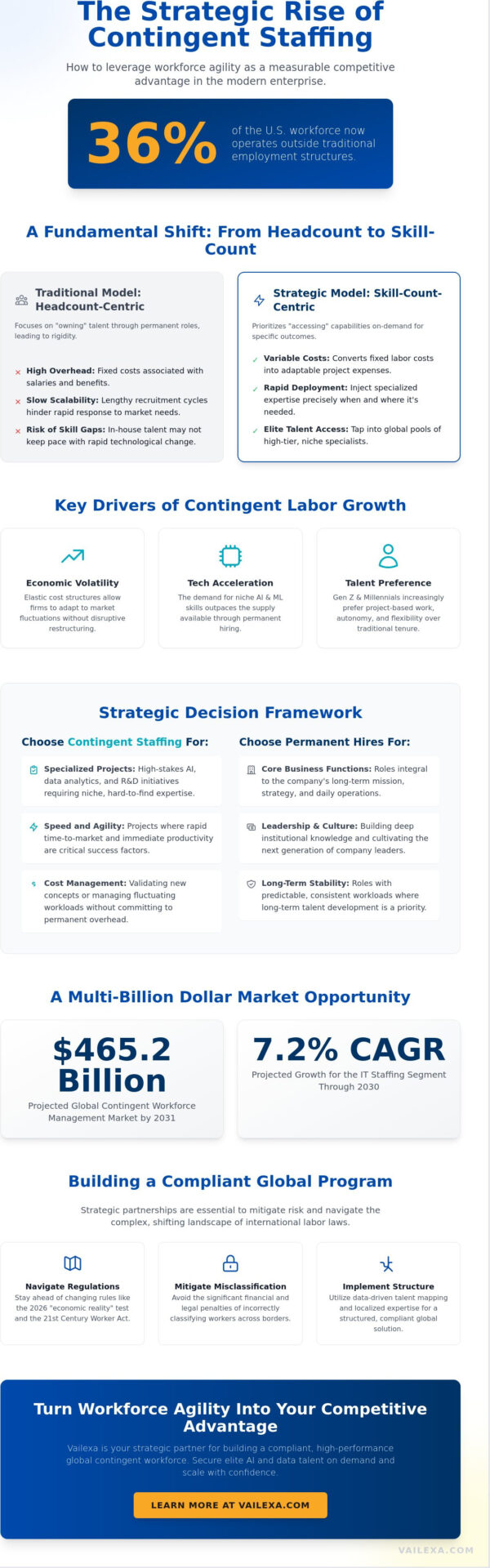
With 36% of the U.S. workforce now operating outside traditional employment structures, the era of the permanent-only enterprise has officially ended. You likely recognize that securing elite AI and data talent for high-stakes projects is no longer just a recruitment challenge; it’s a strategic bottleneck. This pressure is compounded by a shifting regulatory environment, where the 2026 “economic reality” test and the 21st Century Worker Act have made global compliance feel like a moving target. It’s difficult to scale when you’re navigating the fog of hidden costs and misclassification risks.
This article shows you how to leverage contingent staffing as a sophisticated lever for global scalability and operational resilience. You’ll discover how to integrate high-level technical expertise into your organization without the burden of permanent overhead. We provide a rigorous framework for choosing between permanent and flexible hires, a roadmap for maintaining compliance across international borders, and a strategy for securing specialized AI and machine learning skills on demand. This guide offers the blueprint to turn workforce agility into a measurable competitive advantage.
Key Takeaways
- Transition from a traditional headcount model to a skill-centric approach that prioritizes immediate project outcomes and organizational flexibility.
- Secure elite technical expertise in high-growth sectors by leveraging specialized talent pools for your most critical AI and data analytics initiatives.
- Apply a rigorous strategic framework to determine when contingent staffing offers a superior total cost of ownership and faster time-to-productivity than permanent hires.
- Mitigate global compliance risks by implementing structured workforce solutions that navigate complex international labor laws and worker classification standards.
- Align your talent acquisition with long-term business goals through data-driven talent mapping and localized expertise in diverse global markets.
The Evolution of Contingent Staffing: Beyond the Gig Economy
The traditional perception of non-permanent labor has undergone a radical transformation. While legacy models often viewed temporary workers as administrative stopgaps for seasonal surges, the sophisticated enterprise of 2026 views these professionals as essential architects of growth. This modern ecosystem encompasses a diverse spectrum of talent, including high-tier freelancers, Statement of Work (SOW) consultants, and interim executives who provide decisive leadership during organizational transitions. By moving beyond the narrow confines of the gig economy, organizations now utilize contingent work structures to inject precision expertise into complex, time-sensitive initiatives.
The Shift from Tactical to Strategic Staffing
Modern contingent staffing has evolved from a tactical necessity into a pillar of corporate strategy. Organizations no longer seek mere “temps” to fill desks; they engage subject matter experts to lead digital transformations and solve intricate architectural problems. The widening global skills gap has accelerated this trend, making it nearly impossible for permanent recruitment to keep pace with the speed of technological change. The 2026 contingent workforce serves as a high-precision strategic asset that enables enterprises to achieve rapid scalability and technical dominance without the inertia of permanent overhead.
Key Drivers of Contingent Labor Growth
Several critical factors propel the adoption of flexible labor models. Economic volatility requires elastic cost structures that can adapt to market fluctuations without the trauma of large-scale restructuring. Simultaneously, the rapid acceleration of technologies like AI and machine learning creates a demand for niche expertise that is often too scarce to maintain on a permanent basis. Finally, the preferences of Gen Z and Millennial professionals for project-based autonomy have created a robust supply of high-tier talent that favors flexibility over traditional tenure. This convergence of economic necessity and talent preference makes the move toward contingent staffing an inevitability for market leaders. For a deeper understanding of the mechanics behind these flexible models, exploring how does contingent staffing work in the 2026 enterprise landscape provides a comprehensive strategic blueprint.
Accessing Specialized Talent: AI and Data Analytics Staffing
AI and data analytics initiatives represent the vanguard of modern corporate strategy. These high-stakes projects often require intense, specialized bursts of labor rather than permanent, long-term headcount. By utilizing contingent staffing, enterprises can execute rapid prototyping and research and development phases without the inertia of permanent commitment. This model allows for the immediate injection of niche skills to validate a concept before scaling. It’s a method that turns talent acquisition from a fixed cost into a variable, high-performance engine that accelerates time-to-market.
The current reality of talent scarcity in emerging technologies makes traditional hiring cycles increasingly obsolete. With the IT staffing segment projected to grow at a compound annual growth rate of 7.2% through 2030, the competition for data engineering and machine learning expertise has reached a fever pitch. Organizations expanding their contingent workforce globally gain a significant advantage by tapping into borderless talent pools. This global reach ensures that specialized ML and data engineering skill sets are available on demand, regardless of local market limitations or regional shortages.
Staffing for High-Impact AI Projects
Success in artificial intelligence requires more than just general programming knowledge. It demands a precise blend of roles, including Data Scientists, AI Ethics Consultants, and Prompt Engineers who can optimize large language model outputs. Generic recruitment often fails here because it lacks the depth of technical vetting required for these specialized domains. A portfolio-based assessment is essential to verify that a candidate can deliver tangible results in a production environment. For organizations seeking to dominate this space, exploring AI Staffing Solutions provides a direct path to verified, high-caliber experts who can hit the ground running.
Data Analytics as a Service
Contingent professionals are uniquely positioned to bridge the gap between legacy systems and modern data architecture. They build the scalable data pipelines and visualization hubs that turn raw information into actionable intelligence. This project-based approach to contingent staffing ensures that your infrastructure stays current without requiring a permanent team to manage every iteration or minor update. While speed is vital, security remains paramount. Effective management of technical contingent labor involves rigorous IP protection and data security protocols to safeguard your most valuable digital assets. Partnering with a seasoned workforce solutions provider ensures these safeguards are integrated into every contract and project scope.
Contingent vs. Permanent Staffing: A Strategic Decision Framework
Choosing between a fixed headcount and a flexible workforce is no longer a simple matter of budget allocation; it’s a pivot point for organizational agility. Decision-makers must evaluate the Total Cost of Ownership (TCO) beyond the base salary. While the average cost to hire a new permanent employee has risen to $4,700 in 2026, specialized or executive placements often exceed $28,000 per hire. These figures don’t account for the long-term carry of benefits, payroll taxes, and the potential risk of turnover. In contrast, contingent staffing transforms these fixed liabilities into variable expenses, allowing firms to scale with surgical precision. For example, to optimize back-office costs, many leaders explore Bookkeeper services through specialized remote recruitment agencies.
A sophisticated framework prioritizes permanent hires for roles that safeguard core competencies and institutional knowledge. These positions form the cultural bedrock of the enterprise, ensuring continuity and long-term alignment. However, for project-specific expertise or rapid market expansion, the independence of a contingent model is often superior. It allows an organization to remain lean while maintaining the capacity to strike when opportunities arise. Relying on U.S. contingent workforce data reveals that nearly 36% of the workforce now operates in this flexible capacity, proving that the “Core and Periphery” model is the new standard for resilient corporations. Organizations still asking how does contingent staffing work within a hybrid workforce model will find that a structured approach to engagement is the key to balancing agility with institutional stability.
Financial and Operational Trade-offs
Financial leadership must weigh direct compensation against the inherent value of flexibility. Permanent recruitment carries significant indirect costs, including onboarding cycles and the financial friction of termination. Contingent models typically involve a markup ranging from 35% to 41% for mid-level roles, yet they provide a vital financial hedge against market downturns. This elasticity ensures that a company doesn’t find itself overstaffed during a contraction. By maintaining a hybrid workforce, you protect your primary talent while utilizing contractors to absorb the volatility of shifting project demands.
The Speed Advantage
Speed is the ultimate currency in a competitive landscape. Traditional hiring processes are often too slow to meet the demands of urgent technical initiatives, leading to missed milestones and lost revenue. Contingent staffing drastically reduces the time to productivity by leveraging established networks of pre-vetted professionals. These experts are accustomed to rapid integration, often delivering value within days rather than the months required for a permanent hire to fully ramp up. When long-term stability is the goal, a robust strategy for Permanent Recruitment remains essential; however, for immediate impact and specialized execution, the speed of the contingent model is unmatched. For organizations that must also secure transformational leadership, understanding the executive search process for C-suite excellence in 2026 ensures that your most critical leadership roles are filled with the same rigor and precision.
Building a Compliant Global Contingent Labor Program
Strategic talent mapping identifies where high-value skills reside, but compliance ensures you can actually engage them. It’s not enough to find a data scientist in Berlin or a prompt engineer in Bangalore; you must navigate the tax and labor implications of those specific regions. This is where strategic workforce planning becomes indispensable. It allows you to align your global reach with local legal standards, protecting the enterprise from co-employment risks that often plague less structured programs. By building a roadmap for compliant engagement, you transform potential legal liabilities into a streamlined engine for scalability.
Mitigating Global Compliance Risks
Avoiding co-employment risks requires a clear separation between the management of permanent staff and contingent professionals. This distinction is particularly critical under GDPR and other international data privacy laws, where remote access to sensitive systems must be tightly controlled and documented. Regular compliance audits serve as the primary defensive barrier against the financial and reputational fallout of worker misclassification. These audits verify that every contract reflects the actual nature of the work performed, ensuring that your organization stays ahead of shifting regulatory requirements across all operating territories.
D&I in the Contingent Workforce
One of the most overlooked aspects of workforce agility is the integration of diversity into the flexible talent stream. Many organizations treat D&I as a metric for permanent employees only, yet project-based teams often drive the most visible innovation within the enterprise. By embedding Diversity & Inclusion Consulting into your contingent hiring process, you ensure that your most critical projects benefit from a wide range of perspectives and experiences. This approach doesn’t just fulfill a corporate responsibility; it directly enhances the creative output of every technical sprint and development cycle. To secure a compliant and diverse global workforce, partner with an expert workforce solutions provider today.
Vailexa: Your Strategic Partner for Global Workforce Solutions
Vailexa operates as more than a service provider; we function as a high-level strategic partner for organizations navigating the complexities of the 2026 talent landscape. Our methodology relies on data-driven talent mapping to ensure every contingent staffing placement aligns with your broader corporate objectives. By integrating deep industry knowledge with a meticulous eye for detail, we provide the stability and precision required to manage a modern workforce effectively. We don’t just fill seats. We architect high-performance teams that drive measurable results and sustainable growth.
Navigating complex labor markets requires a blend of global reach and localized insight. We guide our partners through the intricate requirements of international law; this ensures that your expansion into new territories is both rapid and secure. This commitment to quality transforms the traditional procurement process into a disciplined execution of growth. By moving from a vendor relationship to a strategic partnership, you gain access to long-term workforce planning that anticipates market shifts before they occur. Our expertise allows you to transform your talent acquisition into a persistent competitive advantage.
Our Approach to Specialized Staffing
Accessing elite AI and data analytics talent requires a specialized approach that generalist agencies cannot replicate. We’ve built a rigorous sourcing process that identifies top-tier professionals capable of driving immediate innovation. Whether you’re a high-growth startup or a Fortune 500 enterprise, our scalable models adapt to your specific operational needs. Effective Strategic Workforce Planning ensures that your talent pipeline remains robust, allowing you to focus on high-level execution while we handle the complexities of acquisition. Our contingent staffing solutions provide the niche expertise required for the AI-driven enterprise, ensuring your R&D projects never lose momentum.
The Path to Global Agility
Achieving true global agility involves more than just filling roles; it requires a consultative commitment to diversity and compliance. We help you harness the power of Global Talent Solutions to build a workforce that is as diverse as it is technically proficient. Our approach ensures that your staffing program is not only compliant with the latest regulations but also optimized for long-term excellence. This journey toward organizational maturity starts with a single, decisive step. We invite you to elevate your workforce strategy with Vailexa and secure your position as a leader in the global economy.
Empowering Your Enterprise with Global Workforce Precision
The transition from traditional hiring to a dynamic, skill-centric model is no longer optional for leaders who prioritize market dominance. The ability to access specialized technical talent on demand while maintaining rigorous global compliance is the hallmark of a resilient organization. By adopting contingent staffing as a core strategic pillar, you ensure that your business remains responsive to technological shifts and economic fluctuations. This strategic agility allows you to scale with precision while mitigating the risks associated with a volatile global economy.
Vailexa stands ready to serve as your authoritative guide in this transformation. With a proven global reach across 50+ countries and deep-seated expertise in AI and data analytics staffing, we align your talent needs with your highest strategic goals. Our comprehensive RPO and D&I consulting capabilities provide the structure and insight necessary to build a truly inclusive, high-performance workforce. Take the decisive step toward operational excellence and secure a future defined by progress and growth.
Optimize your global talent strategy with Vailexa
Frequently Asked Questions
What is the difference between contingent staffing and temporary staffing?
Contingent staffing represents a strategic engagement of high-level experts, such as interim executives or SOW consultants, while temporary staffing typically refers to tactical, entry-level roles for seasonal needs. While both models are non-permanent, contingent labor focuses on delivering specialized skills and project-specific outcomes. This distinction is vital for enterprises that prioritize technical innovation and subject matter expertise over simple administrative support.
How does contingent staffing improve organizational agility?
Contingent staffing improves agility by converting fixed labor liabilities into variable expenses that scale according to your immediate project demands. This elasticity allows your organization to pivot rapidly in response to market volatility without the friction of permanent headcount commitments. By accessing pre-vetted talent on demand, you can launch critical initiatives faster and close skill gaps the moment they appear, maintaining a lean core with a high-performance periphery.
Is contingent staffing more expensive than permanent hiring in the long run?
It’s often more cost-effective when you evaluate the Total Cost of Ownership, which includes benefits, payroll taxes, and onboarding friction. While hourly rates for specialized contractors might appear higher, you only pay for the specific duration of the project. This approach avoids the long-term financial carry of permanent staff whose roles might become redundant as your technology evolves. It serves as a financial hedge, ensuring your budget stays aligned with active value creation.
What are the primary compliance risks associated with a contingent workforce?
The primary risks involve worker misclassification and co-employment liabilities, particularly under shifting regulations like the 2026 “economic reality” test. Failure to distinguish between employees and independent contractors can lead to significant penalties and back-tax obligations. Global operations also face diverse regional laws, such as IR35 in the UK. Managing these risks requires precise contract language and clear operational boundaries to ensure every engagement remains legally sound across all jurisdictions.
How can companies ensure quality when hiring contingent AI specialists?
Ensuring quality requires a rigorous vetting process that prioritizes portfolio-based assessments and proven project outcomes over traditional credentials. You should look for professionals who demonstrate a deep understanding of specific frameworks and ethical AI considerations. Partnering with a specialized provider ensures that candidates undergo technical screening before they ever reach your team. This methodology minimizes the risk of technical failure and ensures your AI initiatives deliver tangible business value from day one.
What role does a workforce solutions provider play in managing contingent labor?
A workforce solutions provider acts as a strategic architect, managing the entire talent lifecycle from initial mapping to compliant global onboarding. They mitigate your administrative burdens and provide the localized expertise necessary to navigate complex international labor markets. By centralizing management, they offer total visibility into the cost and quality of your non-permanent workforce. This partnership allows your internal teams to focus on core strategy while the provider ensures your talent pipeline remains robust.
Can contingent staffing support diversity and inclusion goals?
Yes, it can significantly advance D&I goals by expanding your search to borderless talent pools that offer a wider range of perspectives. Project-based roles allow you to intentionally source talent from underrepresented groups for high-impact technical initiatives. This approach ensures innovation isn’t limited by local demographics or traditional hiring biases. By integrating D&I consulting into your flexible staffing stream, you build more inclusive teams that reflect a global marketplace and drive superior creative outcomes.
How do I transition from a traditional hiring model to a contingent-first strategy?
Transitioning begins with a thorough audit of your current projects to identify roles better suited for flexible, skill-based engagement. You should establish a robust compliance framework and select a managed service provider to oversee operational complexities. Start with a pilot program in a specialized department, such as data analytics, to measure performance and refine your integration processes. This methodical shift ensures your organization builds the necessary infrastructure to support a high-agility, hybrid workforce model.