
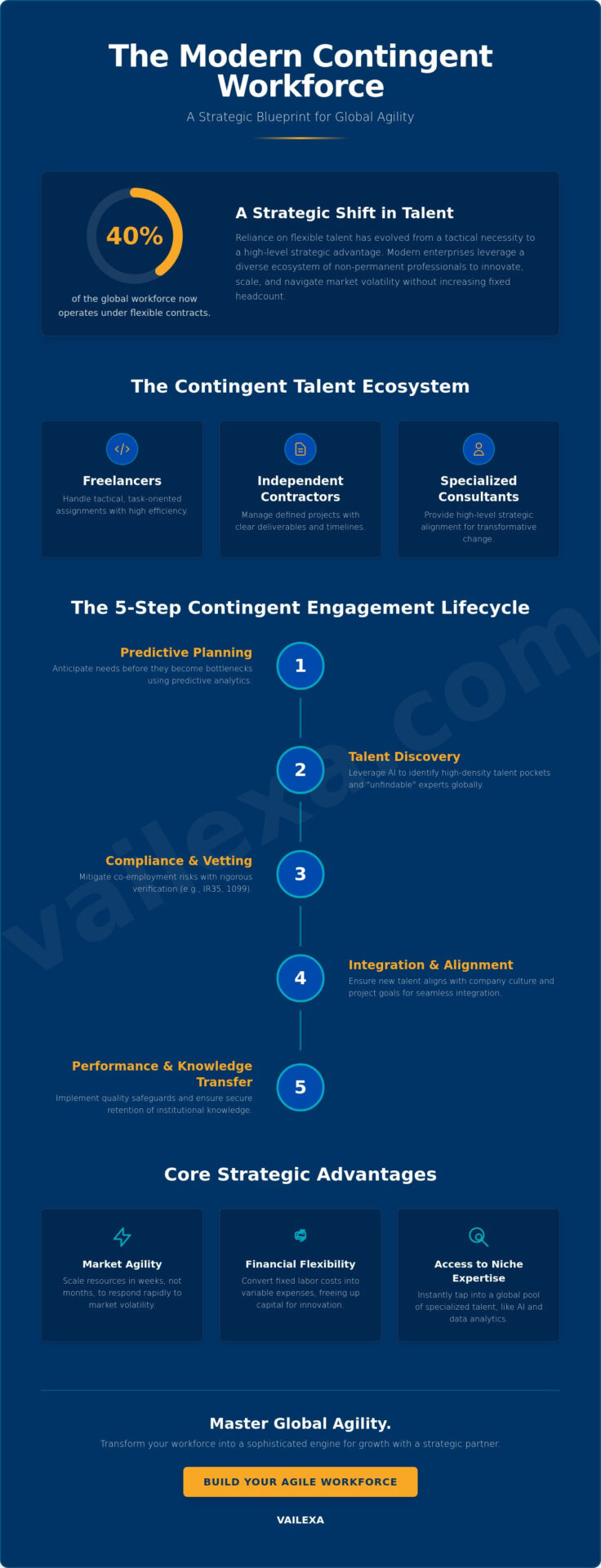
With 40% of the global workforce now operating under flexible contracts, the era of the “standard” employee is officially over. As we move through 2026, the reliance on flexible talent has shifted from a tactical necessity to a high-level strategic advantage. You’ve likely felt the friction of talent scarcity in specialized fields like AI or the administrative weight of managing compliance across jurisdictions like the UK, where IR35 thresholds recently changed. If you’re asking, how does contingent staffing work in this complex environment, you aren’t alone in seeking a more disciplined approach to organizational agility.
It’s a common frustration to see inconsistent output from gig workers while your legal team navigates shifting mandates. We’re here to provide a clear roadmap that transforms your workforce model into a sophisticated engine for growth. This blueprint unlocks the mechanics of high-performance staffing, offering a strategic plan to integrate specialized talent with precision and speed. You’ll discover how to leverage AI-driven insights and strategic workforce planning to build an agile, future-proof organization that thrives on global complexity without increasing your permanent headcount.
Key Takeaways
- Redefine non-permanent talent as a strategic asset by distinguishing between freelancers, independent contractors, and high-level specialized consultants.
- Navigate the five-step engagement framework to master how does contingent staffing work as a disciplined, outcome-oriented methodology for global growth.
- Adopt a “skill-first” approach to secure specialized AI and data analytics experts, prioritizing technical proficiency over traditional tenure.
- Quantify the value of external talent by calculating the total cost of ownership (TCO) while implementing rigorous quality and security safeguards.
- Leverage a comprehensive Global Talent Solution to maintain organizational agility and compliance across diverse international markets.
Defining the Modern Contingent Staffing Ecosystem
Modern enterprise growth depends on a fluid architectural design. Contingent staffing is no longer a secondary backup plan for seasonal peaks. It has become the primary engine for scaling in 2026. At its core, this model represents a strategic engagement of non-permanent, project-based talent designed to solve specific business challenges. Understanding how does contingent staffing work in the current market requires a shift in perspective. We must move from viewing external talent as a cost-saving measure to seeing it as a high-value lever for expert augmentation.
The foundational concept of contingent work has expanded far beyond traditional administrative support. Today, it encompasses a sophisticated hierarchy of professionals. Freelancers typically handle tactical, task-oriented assignments with high efficiency. Independent contractors manage defined projects with clear deliverables. Specialized consultants provide the high-level strategic alignment necessary for transformative change. This “Just-in-Time” talent philosophy allows global enterprises to maintain a lean core while surrounding themselves with an elastic ring of elite expertise.
The Core Components of a Contingent Workforce
A high-performing contingent ecosystem relies on precision and structure. It’s a disciplined arrangement where roles are clearly defined by their impact on the bottom line. Specialized contractors in AI or compliance now represent the fastest-growing segment of this workforce. To manage this complexity, sophisticated enterprises utilize a Managed Service Provider (MSP) to oversee the talent lifecycle and a Vendor Management System (VMS) to ensure data-driven transparency. This structured approach is why leading organizations are increasingly focused on Mastering Global Agility through integrated workforce solutions.
Strategic Drivers: Why Flexibility is the New Currency
Market volatility remains the only constant in 2026. The ability to scale up or pivot resources in weeks rather than months is a significant competitive advantage. When you analyze how does contingent staffing work from a financial perspective, the benefits are clear. Converting fixed labor costs into variable expenses provides the fiscal breathing room needed to innovate. Beyond the balance sheet, this model offers immediate access to niche expertise that is often unavailable in local permanent markets. Whether it’s a sudden need for data analytics staffing or a short-term requirement for diversity consulting, the contingent model ensures that talent scarcity never dictates the speed of your progress. To further enhance operational flexibility, you may discover SolaaS Limited and their tailored IT and telecommunications solutions for growing businesses.
The Lifecycle of a Contingent Engagement: A 5-Step Framework
Step 1 & 2: From Demand to Discovery
Traditional hiring often reacts to immediate gaps. In contrast, predictive workforce planning allows you to anticipate needs before they become bottlenecks. By leveraging AI staffing solutions, enterprises can now identify high-density talent pockets across the globe with surgical precision. This data-driven approach moves beyond simple resumes to find the “unfindable” expert who possesses niche technical skills. Talent mapping is the proactive identification of future skill requirements. It ensures that when a project launches, the right specialists are already within your reach, reducing the friction of the search process.
Step 3 & 4: Compliance and Cultural Alignment
Risk mitigation is the cornerstone of any global engagement. As jurisdictions tighten regulations, navigating IR35 in the UK or 1099 classifications in the US requires a disciplined hand. You must optimize your contingent workforce management by implementing rigorous vetting and compliance verification from the very start. This process protects your organization from legal co-employment risks while ensuring that external talent aligns with your internal standards of excellence.
Integration is just as vital as compliance. Rapid onboarding protocols minimize the time-to-productivity gap, allowing contractors to contribute to high-stakes projects immediately. Even temporary teams benefit from Diversity and Inclusion Consulting to ensure a wealth of perspectives is woven into every project. When you align external talent with your corporate culture, you create a seamless extension of your workforce. If you’re ready to evolve your approach, Strategic Workforce Planning can help you design these workflows with precision.
The final step involves performance management and structured offboarding. High-performance staffing doesn’t end when the contract expires. It requires a formal process to evaluate deliverables and close the knowledge loop. By capturing insights from departing experts, you retain the intellectual capital that drives long-term stability. This holistic view of the lifecycle is ultimately how does contingent staffing work to build a truly scalable enterprise that values both speed and depth.
Navigating Specialized Talent: AI and Data Analytics Staffing
The acceleration of artificial intelligence has fundamentally altered the talent acquisition playbook. In 2026, finding a machine learning engineer or a data architect requires more than a standard job posting. Specialized tech roles demand a “Skill-First” model that prioritizes technical proficiency over traditional tenure or prestigious degrees. When you examine how does contingent staffing work in this high-stakes environment, it becomes clear that a generalist approach often fails. You need a methodology that targets specific technical stacks and understands the nuances of algorithmic development.
Enterprises are currently facing a global scarcity of machine learning and data analytics experts. This shortage forces a shift toward global talent pools. Organizations expanding their contingent workforce globally find that specialized agencies are the only way to access pre-vetted, high-tier technical talent. These agencies don’t just provide resumes; they provide validated experts who can step into complex environments and deliver immediate value. This access is the difference between a project that stalls and one that disrupts the market.
The Anatomy of an AI Staffing Solution
Every AI initiative has a unique DNA. To succeed, you must identify the specific stack requirements, whether it’s TensorFlow, PyTorch, or specialized LLM fine-tuning. Many firms now utilize “Fractional Experts” for high-level data strategy. These are seasoned professionals who provide strategic oversight without the commitment of a full-time executive role. A global financial firm recently scaled their data team in 90 days by leveraging this fractional model to architect their cloud migration before bringing in tactical engineers to execute the build.
Ensuring Quality in High-Stakes Technical Hires
Resumes are often a poor indicator of technical ability in specialized fields. Quality assurance must involve rigorous technical testing and portfolio validation. It’s essential to work with domain-specific recruiters who “speak the language” of tech. They understand the difference between a data scientist who builds models and a data engineer who builds the pipelines. This deep understanding ensures a smoother handoff between contingent tech leads and permanent stakeholders. Understanding how does contingent staffing work for technical roles means recognizing that the integration of an external expert is a strategic transfer of knowledge, not just a temporary fix for a project deadline.
Mitigating Risks and Optimizing Contingent ROI
Maintaining excellence while scaling remains the primary challenge for executive leadership. When organizations ask how does contingent staffing work at peak efficiency, the answer lies in a robust risk mitigation strategy. It isn’t enough to simply find talent; you must protect your intellectual property and ensure every engagement delivers a measurable return. By architecting a framework that prioritizes security and financial clarity, you transform a flexible workforce from a potential liability into a high-performance engine for global growth.
Calculating the total cost of ownership (TCO) is essential for a true ROI analysis. While permanent hires carry fixed burdens like benefits, payroll taxes, and long-term overhead, contingent talent offers a variable cost structure that aligns with project milestones. This financial flexibility allows for smarter capital allocation. For a deeper analysis of how these two models compare across key financial and operational dimensions, explore our comprehensive guide on contingent vs permanent staff for global enterprises in 2026. Implementing robust IP protection and data security protocols is non-negotiable when engaging external experts. You must ensure that contractors operate within a secure digital perimeter, with access limited strictly to the data required for their specific project phase. To further de-risk the program, many enterprises utilize Recruitment Process Outsourcing (RPO) to centralize management and ensure consistent standards across the globe.
Classification and Compliance: A Global Checklist
Legal pitfalls like “misclassification” can derail even the most ambitious global expansion. Navigating the April 2026 IR35 threshold changes in the UK or the January 2026 statutory minimum wage increase to €13.90 in Germany requires constant vigilance. Utilizing “Employer of Record” (EOR) services provides a necessary buffer, handling the administrative complexities of local labor laws. Vailexa ensures 100% compliance across diverse international regulations, protecting your brand from the financial and reputational damage of non-compliance. A deep understanding of how does contingent staffing work involves more than just hiring; it requires a rigorous commitment to legal precision.
Measuring What Matters: Contingent Workforce Analytics
Data-driven insights are the only way to refine a workforce strategy over time. You must track specific metrics to understand the health of your program. Tracking “Time to Fill” measures the speed of talent acquisition for critical roles, while “Quality of Hire” evaluates the actual impact of the contractor on project outcomes. Monitoring “Retention to Project End” ensures stability until your strategic objective is met. Using these analytics allows you to refine your talent mapping process, ensuring that future engagements are even more precise. Contingent ROI is maximized when speed meets technical precision. If you’re ready to secure your technical future, explore our AI Staffing Solutions to bridge the gap between risk and results.
Scaling with Agility: Integrating Vailexa’s Global Model
Strategic vision only delivers value when it’s met with flawless execution. For global enterprises, the gap between identifying a strategic need and deploying a specialized solution is often where competitive advantage is lost. Vailexa bridges this divide by providing a Global Talent Solution that spans continents and industries with surgical precision. Understanding how does contingent staffing work at this level requires moving past transactional hiring and embracing a model that’s as dynamic as the 2026 economic landscape. One-size-fits-all approaches fail because they ignore the nuances of local labor markets and the unique technical requirements of high-stakes projects.
Transitioning from reactive hiring to a proactive workforce strategy is the hallmark of a mature organization. Instead of scrambling to fill gaps when projects are already underway, a disciplined blueprint allows you to anticipate talent needs months in advance. This foresight is powered by deep market intelligence and a commitment to customization. Every engagement we architect is aligned with your specific organizational standards, ensuring that external talent feels like a natural extension of your core team rather than a temporary patch. By shifting the focus from headcount to capability, you unlock a new level of organizational fluidity. Enterprise leaders evaluating their options will benefit from reviewing our strategic contingent workforce solutions buying guide for 2026, which provides a data-driven framework for selecting the right workforce partners.
The Vailexa Advantage: AI-Driven and Expert-Led
Our methodology combines high-search accuracy with the nuanced judgment of seasoned industry experts. We don’t just rely on algorithms; we use them to empower our consultants to find the right fit faster. This synergy between AI staffing solutions and high-level Executive Search allows us to provide a comprehensive suite of services that few can match. Global enterprises trust us as their primary workforce solutions provider because we deliver consistency, compliance, and quality across every jurisdiction. We understand that how does contingent staffing work in London is fundamentally different from how it operates in Berlin or New York, and our model reflects that sophistication.
Conclusion: Your Roadmap to a Scalable Future
Agility is the ultimate competitive advantage in an era of constant disruption. The ability to pivot, scale, and innovate depends entirely on the quality of the talent you can access at a moment’s notice. We encourage leadership teams to conduct a strategic audit of their current workforce gaps to identify where flexibility can drive the most impact. The roadmap to a future-proof organization starts with a single, decisive step toward better integration. It’s time to move beyond the limitations of traditional staffing and embrace a more resilient, data-driven model. Partner with Vailexa to optimize your global contingent program and unlock the full potential of your international workforce.
Master Your Global Talent Architecture
The transition from reactive hiring to a disciplined workforce model marks the difference between stagnation and market leadership. By prioritizing a skill-first approach and implementing rigorous global compliance, your organization gains the flexibility to pivot at the speed of innovation. We’ve explored how a structured five-step lifecycle and specialized AI staffing can mitigate risks while maximizing ROI. Ultimately, mastering how does contingent staffing work empowers you to build a borderless team of elite experts ready to tackle your most complex challenges.
Vailexa stands ready to be your authoritative guide in this transformation. With a global reach across multiple continents and specialized expertise in AI and Data Analytics staffing, we provide the precision required for modern growth. Our proven RPO and Executive Search methodologies ensure that every engagement aligns with your highest standards of excellence. Optimize Your Global Workforce with Vailexa’s Contingent Staffing Solutions. The future of work is agile; it’s time to build yours with confidence.
Frequently Asked Questions
What is the difference between contingent staffing and a temp agency?
Contingent staffing represents a strategic, expert-led engagement rather than the transactional, high-volume placements typical of a temp agency. This model focuses on delivering specialized talent for complex projects that require a deep understanding of how does contingent staffing work at an enterprise level. While temp agencies provide generalist support, contingent solutions target niche technical or strategic skill sets.
How much does contingent staffing cost compared to permanent hiring?
The financial impact of a contingent model is defined by the conversion of fixed labor costs into variable expenses. While individual hourly rates for specialists might exceed permanent salaries, the total cost of ownership is often lower. Enterprises avoid the expenses of long-term benefits, training, and permanent overhead, which allows for more efficient capital allocation. For a detailed breakdown of how these cost structures compare, review our strategic analysis of contingent vs permanent staff workforce ROI.
Can contingent workers be used for high-level executive or AI roles?
High-level executive and AI roles are perfectly suited for the contingent model through fractional leadership and specialized consultants. This approach provides immediate access to elite expertise for data analytics staffing or strategic transformation without the lengthy commitment of a permanent search. It’s a pragmatic solution for organizations needing rapid, high-impact technical oversight.
How do you handle payroll and taxes for international contingent workers?
Managing international payroll and taxes requires a disciplined partnership with an Employer of Record (EOR) or a global talent solutions provider. These partners navigate the complexities of local jurisdictions to ensure every contractor is paid accurately and in compliance with regional tax codes. This arrangement de-risks global expansion by shifting the administrative and legal burden to a specialized partner.
What are the biggest legal risks associated with a contingent workforce?
Worker misclassification and co-employment liabilities remain the primary legal hurdles in flexible workforce management. Organizations must maintain a clear distinction between internal employees and external contractors to avoid significant financial penalties. Understanding how does contingent staffing work within the bounds of local regulations like IR35 is essential for maintaining organizational integrity and long-term stability.
How does a Vendor Management System (VMS) help in the process?
A Vendor Management System (VMS) serves as the digital backbone of a sophisticated staffing program. It centralizes all data related to talent acquisition, performance, and compliance, providing leadership with a transparent view of the entire external workforce. This visibility is critical for optimizing spend and ensuring that every engagement meets pre-defined quality standards and strategic goals.
Is contingent staffing suitable for long-term projects?
Contingent staffing is highly effective for long-term projects that have a defined lifecycle or require specific technical milestones to be met. It offers the agility to retain specialized talent for the duration of a transformation while allowing for a structured offboarding once the objective is achieved. This ensures that the organization remains lean and focused on its core mission.
How can I ensure contingent workers fit our company culture?
Cultural alignment is secured through a specialized vetting process that evaluates both technical proficiency and behavioral fit. By integrating contingent workers into the corporate environment through structured onboarding, enterprises ensure that external talent shares the same commitment to excellence. This alignment fosters a cohesive team dynamic that drives project success and maintains organizational standards.