
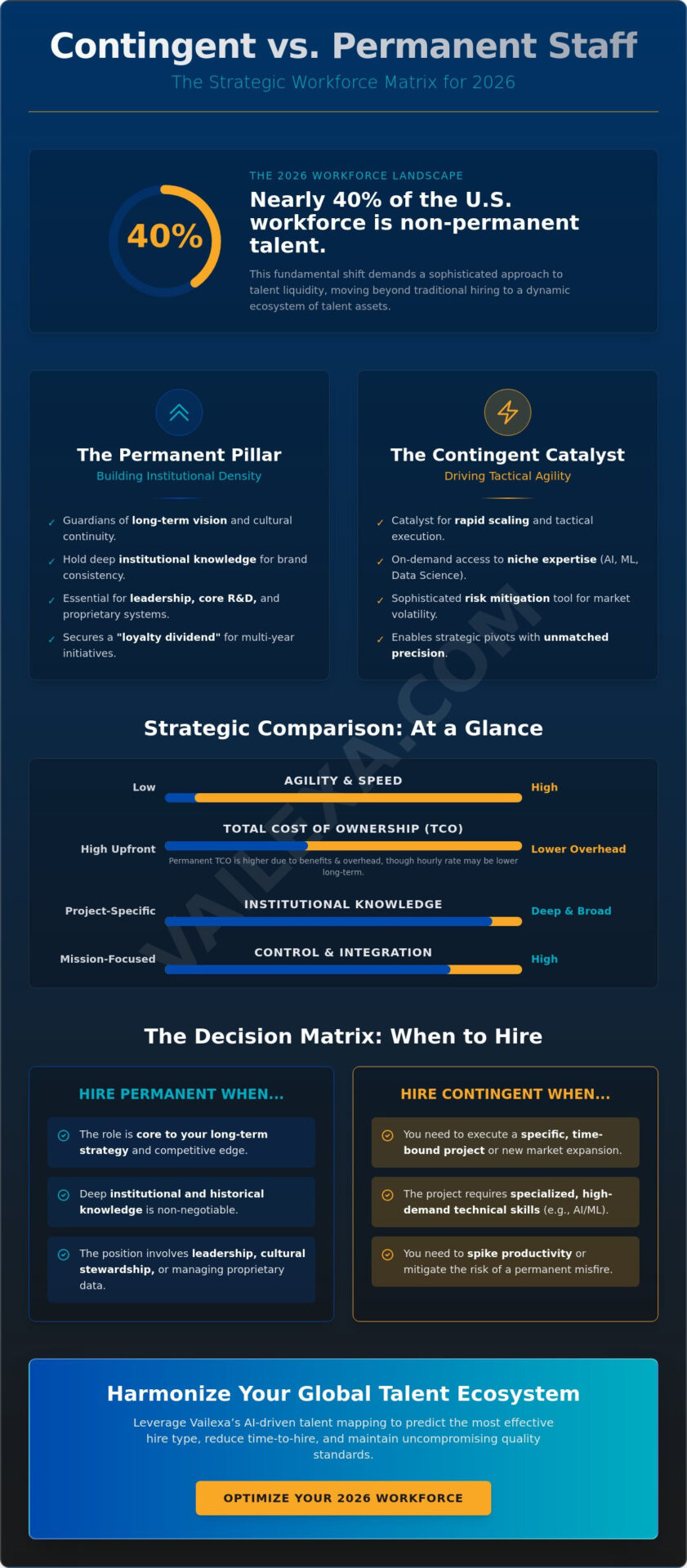
As of early 2026, nearly 40% of the U.S. workforce is comprised of non-permanent talent, signaling a fundamental shift in how global enterprises must approach human capital. You understand that the friction of unpredictable project timelines and the high cost of permanent misfires are no longer just HR issues; they are existential threats to your bottom line. The urgent need for specialized AI and data skills requires a level of precision that traditional hiring models often fail to deliver. Deciding between contingent vs permanent staff is no longer a binary choice but a sophisticated exercise in talent liquidity.
Discover the definitive strategic framework for balancing contingent agility with permanent talent density to optimize your 2026 workforce ROI. This article provides a clear ROI comparison and a decision-making matrix designed for high-performance departments. You’ll learn how to reduce your time-to-hire while maintaining the uncompromising quality standards your organization demands. We’ll move from high-level strategy to the granular details of regulatory compliance and department-specific alignment, ensuring your workforce is both a visionary architect of growth and a reliable guardian of organizational standards.
Key Takeaways
- Reframe your workforce as a dynamic ecosystem of talent assets to drive institutional growth and cultural continuity.
- Master the strategic balance of contingent vs permanent staff by aligning operational agility with the deep institutional knowledge required for long-term stability.
- Evaluate the Total Cost of Ownership beyond simple hourly rates to uncover the true ROI of flexible talent models in high-stakes projects.
- Utilize a precision decision-making matrix to determine the optimal hiring model for specialized technical builds and new market expansions.
- Leverage AI-driven talent mapping to predict the most effective hire type and reduce time-to-hire while maintaining uncompromising quality standards.
Defining the Modern Workforce: Contingent vs Permanent Roles in 2026
Permanent staff remain the cultural anchors of the enterprise, holding the institutional knowledge that defines a brand’s competitive edge. In contrast, contingent staff represent a diverse pool of independent contractors, freelancers, and agency-managed specialists focused on specific deliverables. To understand the modern Contingent Work Definition, one must look beyond temporary clerical help. Today, this category includes high-level consultants and technical experts who drive innovation without the constraints of a traditional long-term contract. Balancing these two groups requires a disciplined methodology that aligns human capital with overarching business objectives.
The Permanent Pillar: Building Institutional Density
Permanent employees serve as the guardians of long-term vision. They are essential for roles involving leadership, core R&D, and the management of proprietary data systems. This “institutional density” creates a foundation of stability that allows for consistent brand messaging and cultural continuity. When you invest in permanent recruitment, you’re securing a loyalty dividend. This dividend pays off during multi-year strategic initiatives where deep context and historical knowledge are non-negotiable requirements for success.
The Contingent Catalyst: Driving Tactical Agility
Contingent solutions act as a catalyst for rapid scaling and tactical execution. In the volatile markets of 2026, the ability to access niche expertise in AI, machine learning, and data science on demand is a significant competitive advantage. This model functions as a sophisticated risk mitigation tool; it allows departments to spike their productivity for market expansions or specific project builds—such as partnering with a 香港網頁設計公司 for localized digital transformation—without incurring permanent overhead. By utilizing a skills-on-demand approach, enterprises can pivot their strategy with a level of precision that traditional hiring models simply cannot match.
Strategic Comparison: Agility, Control, and Organizational Impact
Success in the 2026 economy requires a nuanced understanding of the trade-offs between operational control and administrative flexibility. While traditional models often viewed external workers as mere support staff, modern enterprises utilize data-driven insights to determine the optimal mix of contingent vs permanent staff. This choice dictates your organization’s ability to protect its core culture while simultaneously absorbing disruptive technologies. High-level integration of AI and data analytics has transformed the contingent market; it’s no longer just about filling gaps, but about injecting high-velocity expertise into critical workflows. By leveraging AI staffing solutions, firms can now identify and deploy specialized talent with a level of precision that was historically reserved for executive search.
Integrating external talent without diluting brand values is a sophisticated leadership challenge. Successful organizations utilize advanced talent mapping to identify where institutional density is required and where tactical agility can thrive. According to BLS Employment Data, the characteristics of the workforce are shifting toward more specialized, project-based engagements. This trend makes it imperative to have a structured approach to global talent solutions that respects both legal boundaries and cultural alignment. You must ensure that your external specialists feel aligned with the project’s mission while maintaining the necessary distance to preserve their independent status.
Operational Control vs Autonomy
The legal distinction between management styles is a critical pillar of workforce strategy when evaluating the impact of contingent vs permanent staff. Permanent employees typically operate under direct supervision, allowing for granular control over processes and long-term professional development. Conversely, contingent talent is managed through deliverable-based oversight; you direct the outcome, not the specific hourly method. This distinction is vital for managing co-employment risks in a global environment. By maintaining clear boundaries, you ensure that your resource allocation remains compliant while empowering specialists to execute their tasks with high-level autonomy. This balance allows your internal leadership to focus on long-term strategy while your external assets drive immediate project milestones.
Speed and Scalability in a Volatile Market
Speed-to-market is the ultimate differentiator in a landscape defined by rapid innovation. The average permanent hiring cycle often stretches into months due to extensive vetting and cultural fit assessments, whereas understanding how contingent staffing works allows for deployment in as little as two to three weeks. This rapid scaling is essential for capitalizing on market spikes or launching complex tech builds before competitors can react. When market corrections occur, the ability to scale down through seamless offboarding provides a level of financial protection that permanent models cannot match. If you’re looking to refine your approach, exploring strategic workforce planning can help harmonize these competing needs.
Total Cost of Ownership (TCO): Analyzing the Real ROI
Financial leadership often defaults to a binary comparison of hourly rates, yet the true fiscal impact of contingent vs permanent staff is found in the Total Cost of Ownership (TCO). While a contingent worker’s bill rate might appear higher at first glance, it represents a fully loaded cost. In contrast, a permanent salary is merely the baseline of a much larger financial commitment. You must account for the “Cost of Vacancy,” which is the daily loss in productivity and revenue that occurs while a critical role remains unfilled during a multi-month permanent search. According to U.S. Bureau of Labor Statistics data, the structural shifts in employment types require organizations to move beyond simple payroll accounting to maintain fiscal health in 2026.
A strategic TCO analysis challenges the myth that flexible talent is inherently more expensive. By quantifying the long-term professional development costs and the administrative burden of managing diverse worker types, enterprises can make data-driven decisions that protect their bottom line. The goal is to move from reactive hiring to a state of talent liquidity where every dollar spent is directly mapped to a specific outcome. Selecting the right contingent workforce solutions partner is a critical step in achieving this level of financial precision and global spend visibility.
The Hidden Burden of Permanent Payroll
Calculating the real cost of a permanent employee requires looking at the “multiplier effect” of a base salary. Beyond the standard paycheck, you’re financing a complex suite of insurance premiums, 401k matching, and paid time off. These benefits often add 30% to 40% to the initial salary figure. There’s also the long-term liability of severance, unemployment insurance, and the ongoing legal compliance costs associated with permanent headcount. Perhaps most damaging is the cost of “downtime” between major projects. When your permanent staff isn’t fully utilized, you’re essentially paying for presence rather than productivity, which erodes your workforce ROI over time.
Contingent ROI: Paying for Results, Not Presence
The primary financial advantage of a contingent model is the efficiency of zero-waste billing. You pay only for active project hours, which eliminates the overhead of recruitment and onboarding for short-term initiatives. This model is particularly effective in high-stakes environments where specialized AI staffing solutions can reduce the cost of trial-and-error. Instead of gambling on a permanent hire for a niche data science build, you access the exact skill set required for that specific deliverable. This precision ensures that your budget is allocated toward high-value execution rather than administrative maintenance. It’s a disciplined approach that transforms labor from a fixed expense into a scalable strategic asset.
The Decision Matrix: When to Hire Permanent vs Contingent
Organizations that treat the choice between contingent vs permanent staff as a simple binary proposition often find themselves either over-leveraged with fixed costs or under-skilled during critical project phases. Sophisticated leadership requires a hybrid ecosystem where talent liquidity serves as the primary metric for success. By utilizing strategic workforce planning, you can align your hiring model with the specific risk profile and lifecycle of each department. For example, entering a new geographic market demands the rapid deployment of local experts who understand regional regulations; this is a classic contingent scenario. Conversely, maintaining your core proprietary software requires the long-term dedication of institutional anchors who hold your competitive secrets.
The Permanent Hire Checklist
Permanent recruitment is a strategic investment in the future of your organization’s culture and innovation. Use these criteria to identify when a full-time commitment is necessary:
- Strategic Alignment: Is the role central to our three-year strategic roadmap and core mission?
- Institutional Knowledge: Does this position require deep, proprietary insights that cannot be easily documented or transferred?
- Market Stability: Is the skill set readily available and stable, allowing for a sustainable long-term career path?
If your requirements meet these standards, building institutional density through permanent hires is the most reliable path to stability.
The Contingent Engagement Checklist
Modern contingent solutions provide the tactical speed required to navigate market volatility. Evaluate your immediate project needs against these points:
- Defined Deliverables: Is this a project-based engagement with a clearly defined end date and specific technical milestones?
- Specialized Transformation: Do we need niche expertise, such as AI model training or data architecture, for a temporary growth phase?
- Fiscal Agility: Is the market demand for this role currently hyper-inflated, making a permanent salary commitment a financial risk?
Choosing the correct model ensures that your budget empowers growth rather than funding administrative inertia. If you’re ready to optimize your talent mix and drive measurable results, explore our Strategic Workforce Planning solutions to align your human capital with your 2026 objectives.
Vailexa’s Integrated Solution: Harmonizing Your Global Talent Ecosystem
Vailexa transforms the traditional friction between contingent vs permanent staff into a cohesive, high-performance talent strategy. Our methodology integrates Recruitment Process Outsourcing (RPO), Executive Search, and Contingent Staffing into a single, data-driven ecosystem. We don’t just fill open roles; we architect workforce solutions that prioritize talent liquidity and long-term stability. By leveraging our AI staffing solutions, your enterprise gains the precision to predict whether a specific business challenge requires a permanent cultural anchor or a high-velocity contingent specialist. This disciplined approach ensures your “Talent Mix” is always optimized for maximum ROI. We act as your authoritative strategic guide, managing the complex layers of global compliance and diversity initiatives across every worker type to protect your organizational standards.
Our commitment to excellence extends beyond simple placement. We provide the steady, polished voice that corporate decision-makers rely on to navigate volatile markets. By blending visionary advisory with practical execution, we ensure that your human capital strategy remains an engine for progress. Your organization deserves a partner that speaks with the weight of an equal and delivers with the precision of a seasoned expert.
Strategic RPO and Talent Mapping
Effective workforce planning starts with a granular, data-backed understanding of your internal capabilities. Vailexa utilizes advanced talent mapping to identify the specific operational gaps that are best addressed by contingent experts. This process is reinforced by our diversity and inclusion consulting, which ensures that your hybrid teams are balanced and representative of the global markets you serve. We provide scalable global talent solutions that evolve alongside your enterprise. This provides the structural support needed for sustainable expansion without the burden of administrative inertia.
Future-Proofing with AI and Data Analytics Staffing
The rapid evolution of generative technologies demands a specialized approach to human capital. Traditional models often struggle to source the rare skill sets required for complex AI and data analytics projects. Vailexa bridges this gap by combining the depth of executive search with the agility of contingent labor. We secure the leaders of the future through strategic mapping and disciplined execution, ensuring your organization is not just reacting to market shifts but actively shaping them. Our AI-powered workforce management tools automate talent acquisition while improving compliance across borders. Partner with Vailexa to optimize your 2026 workforce strategy and secure your competitive advantage in a global landscape.
Mastering Talent Liquidity for the 2026 Enterprise
The strategic choice between contingent vs permanent staff is no longer a simple operational decision; it’s the cornerstone of organizational resilience. You’ve seen how balancing institutional density with tactical agility allows your firm to absorb market shocks while protecting core innovation. By analyzing the Total Cost of Ownership and utilizing a disciplined decision matrix, your leadership can move beyond reactive hiring toward a model of true talent liquidity. This evolution ensures that your budget remains an engine for growth. Precision matters.
Vailexa stands as your authoritative guide in this transformation. With a global reach across 50+ markets and specialized talent pools in AI and Data Analytics, we provide the precision required for complex global expansions. Our integrated RPO and Executive Search solutions are designed to harmonize your entire human capital ecosystem. It’s time to transform your workforce into a scalable strategic asset. Scale Your Workforce with Strategic Precision; Contact Vailexa Today. Your path to optimized workforce ROI starts with a partner dedicated to your long-term excellence.
Frequently Asked Questions
What is the primary difference between contingent and permanent staff?
The primary difference between contingent vs permanent staff lies in the duration of the engagement and the nature of the employer-worker relationship. Permanent staff are long-term institutional anchors integrated into your core payroll; conversely, contingent workers are project-based specialists engaged for specific deliverables. This distinction dictates your level of operational control and the depth of the worker’s integration into your multi-year strategic roadmap.
Is it more expensive to hire a contingent worker than a permanent employee?
While contingent hourly rates often appear higher, the Total Cost of Ownership (TCO) is frequently lower for short-term or specialized projects. You avoid the multiplier effect of permanent salaries, which includes insurance, retirement matching, and paid time off. By paying only for active project hours, you eliminate the fiscal burden of downtime and the high administrative costs associated with permanent headcount maintenance.
Can contingent workers eventually become permanent staff?
Transitioning contingent workers into permanent roles is a sophisticated strategy for mitigating hiring risks. This model allows leadership to evaluate a worker’s technical precision and cultural alignment before committing to a long-term contract. It functions as a real-world vetting process that reduces the likelihood of a bad hire while ensuring that your institutional density is built upon proven talent assets.
How do I manage the legal risks of a contingent workforce?
Managing legal risks requires a disciplined approach to worker classification and co-employment boundaries. You must ensure that contingent management remains focused on deliverables rather than direct behavioral control. Utilizing a global workforce solutions provider ensures that your contracts align with local labor laws, protecting your organization from the financial penalties associated with misclassification in a complex regulatory environment. A comprehensive approach to contingent workforce risk management is essential for navigating these multi-jurisdictional compliance challenges with confidence.
Which industries benefit most from a contingent workforce model?
Industries defined by rapid innovation and project-based cycles, such as technology, pharmaceuticals, and global finance, realize the greatest benefits from this model. These sectors require the ability to spike their productivity for specific transformations, such as AI model deployments or new market entries. High-growth enterprises use talent liquidity to access niche skills without the stagnation often caused by rigid hiring structures.
How does Vailexa help in choosing between contingent and permanent hires?
Vailexa provides an integrated framework that harmonizes your talent ecosystem through Strategic Workforce Planning and Talent Mapping. We help you identify which gaps require the stability of permanent recruitment and which are best filled by our specialized AI and data analytics staffing pools. Our methodology ensures that your talent mix is optimized for both immediate tactical agility and long-term institutional growth.
What are the tax implications of hiring contingent workers globally?
Tax implications vary significantly by jurisdiction and the specific nature of the worker’s engagement. When you engage contingent talent through a global staffing partner, the administrative burden of payroll taxes and local social contributions is typically managed by the provider. This arrangement simplifies your international operations, allowing your internal finance teams to focus on high-level strategy rather than the granular details of foreign tax compliance.
How do I maintain company culture with a high percentage of contingent staff?
Maintaining culture with a hybrid workforce requires a purposeful commitment to shared project goals and inclusive communication. You should integrate contingent specialists into your mission-critical updates while utilizing Diversity & Inclusion (D&I) consulting to ensure a cohesive team environment. By focusing on project-based alignment, you protect your brand values without necessitating the deep, long-term commitment of a permanent employment contract.