
Recruitment velocity isn’t simply a product of increased effort. It’s the calculated result of strategic talent mapping and agile workforce orchestration. With the national average time-to-fill stretching toward 68 days in specialized sectors, the cost of vacancy for critical technical roles has become an unsustainable burden on corporate growth. You’ve likely felt the mounting pressure from stakeholders as key positions remain open, yet the solution isn’t just to move faster. By focusing on reducing time to fill metrics through a lens of precision rather than haste, you secure the high-level talent your organization requires without compromising on cultural or technical alignment.
It’s frustrating to watch manual screening processes stall your momentum when the April 2026 unemployment rate of 4.3% signals a relentlessly competitive market. We promise to help you master the methodologies required to accelerate your entire hiring cycle while maintaining the highest standards of quality. This guide previews the strategic shift toward data-backed recruitment ROI, exploring how sophisticated workforce solutions and AI-driven insights can refine your talent pipeline and ensure your search accuracy remains high even as your hiring timelines compress.
Key Takeaways
- Differentiate between time-to-hire and time-to-fill to isolate the specific operational delays that hinder your efforts in reducing time to fill metrics.
- Calculate the true “Cost of Vacancy” to secure stakeholder buy-in and accelerate the feedback loops that are critical for securing elite technical talent.
- Deploy talent mapping and contingent staffing levers to build an “always-on” pipeline, effectively eliminating the productivity gap during sudden vacancies.
- Integrate AI-powered sourcing and RPO strategies to transform recruitment from a reactive necessity into a predictable, data-driven engine for organizational growth.
The Strategic Significance of Reducing Time to Fill Metrics
Recruitment velocity serves as a barometer for an organization’s ability to execute its strategic vision. In the current climate of 2026, where the U.S. economy continues to add jobs despite a low 4.3% unemployment rate, the competition for specialized skill sets is absolute. Organizations that view reducing time to fill metrics as a secondary concern often overlook the compounding damage caused by recruitment latency. A slow hiring cycle doesn’t just delay a start date; it actively erodes your market position by allowing competitors to capture the very innovators who could have driven your next phase of growth. Moving from a reactive to a proactive posture is no longer an elective strategy; it’s a requirement for long-term stability.
Time to Fill vs. Time to Hire: A Critical Distinction
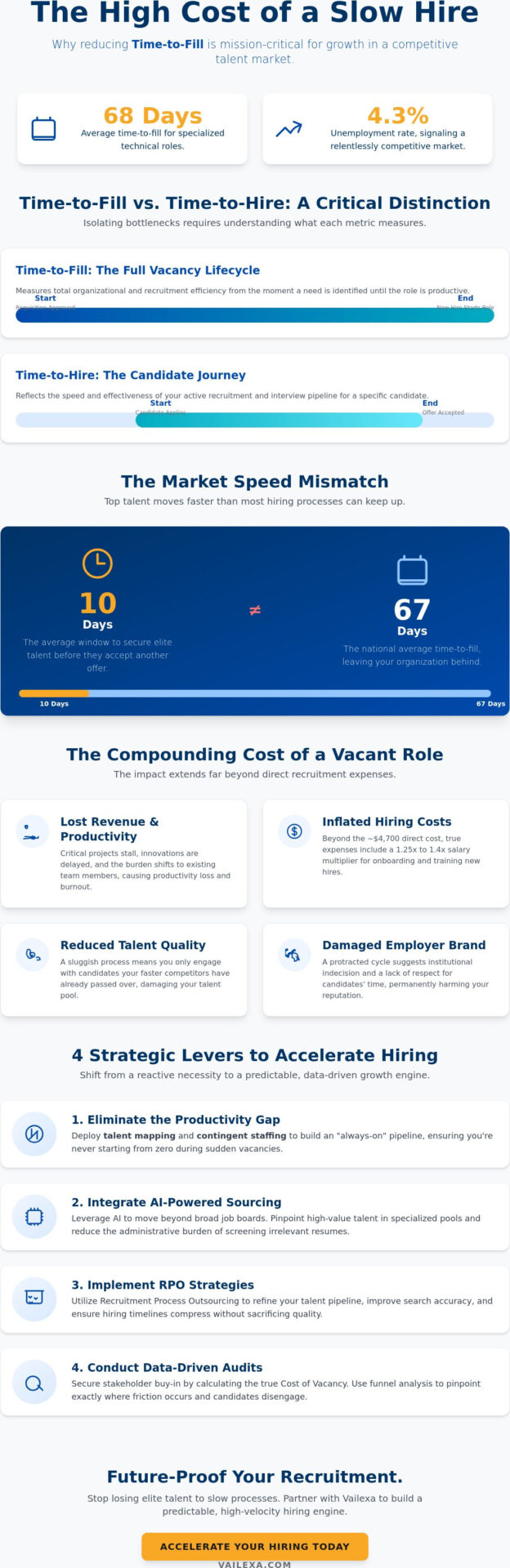
Understanding the nuances of Recruitment Metrics is essential for any leader conducting a meaningful operational audit. Time to fill measures the total duration a position remains vacant, spanning from the initial requisition approval until the new hire actually begins their role. This differs significantly from time to hire, which tracks the speed of the candidate journey from the moment of application to the final offer acceptance. While time to hire reflects the efficiency of your interview pipeline, time to fill serves as the ultimate measure of recruitment department efficiency and total organizational alignment. By isolating these two data points, you can identify whether bottlenecks exist in your external sourcing or your internal approval workflows.
The Business Impact of Recruitment Latency
The cost of a vacant seat extends far beyond the direct expenses of job board postings. In high-growth sectors like AI and data analytics staffing, prolonged vacancies stall critical project timelines and delay the deployment of revenue-generating innovations. When a technical role remains open for the national average of 62 to 67 days, the burden inevitably shifts to existing team members. This leads to measurable productivity loss and increased burnout, which can trigger a secondary wave of resignations.
The financial implications are equally stark. While direct recruitment expenses average approximately $4,700 for non-executive roles, the true cost of vacancy accounts for lost revenue and the 1.25 to 1.4 times salary multiplier required for onboarding and training. Speed is also a matter of quality; top-tier talent typically exits the market within 10 days of beginning their search. A sluggish process ensures your organization only engages with the candidates your competitors have already passed over. Ultimately, a high recruitment velocity signals a decisive, high-performing culture, whereas a protracted cycle suggests institutional indecision that can permanently damage your employer brand reputation.
Diagnosing the Bottlenecks: A Data-Driven Audit
Precision begins with visibility. While many organizations recognize that their hiring speed is suboptimal, few can pinpoint the exact stage where the momentum falters. A data-driven audit isn’t merely about tracking dates; it’s about dissecting the entire recruitment lifecycle to identify structural friction. By systematically reducing time to fill metrics, you transform your talent acquisition from a reactive scramble into a predictable engine of growth. This requires a granular look at your recruitment analytics to uncover where qualified candidates are dropping off and why your top-tier prospects are choosing competitors instead.
Sourcing efficiency often serves as the first point of failure. In the stabilizing labor market of early 2026, relying on broad, non-specialized job boards frequently leads to a “quantity over quality” trap. This creates an administrative burden for your team, as they must sift through hundreds of irrelevant resumes while high-value talent remains untouched in specialized pools. Furthermore, candidate ghosting has evolved into a significant diagnostic signal. If prospects are disengaging mid-process, it’s often a direct reflection of a fragmented candidate experience or a lack of perceived urgency. To truly reduce time to fill, you must ensure that every touchpoint reinforces your brand’s authority and respect for the candidate’s time.
Funnel Analysis: Identifying the Friction Points
Rigorous funnel analysis involves examining the ratio of applicants to qualified leads to assess your initial sourcing accuracy. If the conversion rate from “applied” to “first interview” is low, your market calibration is likely off. You should also audit the “latency period” between the final interview and the issuance of an offer. Delays here are often fatal. For organizations struggling with these internal hurdles, adopting Mastering Global Agility: The Strategic Guide to Contingent Staffing in 2026 provides a framework for using flexible models to bypass traditional hiring bottlenecks. This approach allows you to maintain productivity while the permanent search continues in the background.
Stakeholder Alignment and Communication Protocols
Internal misalignment is the most common “hidden” killer of recruitment speed. We call this “The Stakeholder Gap,” where slow feedback from hiring managers causes elite candidates to lose interest. Preventing “requirement creep” is essential; job descriptions must be standardized and locked before the search begins to avoid moving the goalposts mid-stream. Implementing formal Service Level Agreements (SLAs) for feedback ensures that everyone involved in the process understands their role in maintaining velocity. Pre-screening calibration meetings between recruiters and hiring managers are not optional; they’re the foundation of search accuracy. If you’re looking to refine these internal dynamics, partnering with a workforce solutions provider can help establish the disciplined protocols necessary for executive-level excellence.
Speed vs. Quality: The Optimization Framework
Precision is the hallmark of a high-performing recruitment function. The tension between speed and quality often creates a false dichotomy in talent acquisition, yet the most successful organizations recognize that velocity is actually a byproduct of superior process design. By shifting from a reactive “post-and-pray” model to a sophisticated optimization framework, you can achieve the dual goal of reducing time to fill metrics while elevating the caliber of your hires. This transformation requires a disciplined move toward proactive talent mapping and the strategic use of flexible workforce models to bridge productivity gaps.
Scalability is another critical component of this framework. Leveraging Recruitment Process Outsourcing (RPO) allows an organization to inject expert resources into the hiring cycle during periods of intense growth without permanently bloating internal overhead. This partnership model provides the specialized AI staffing solutions and data analytics staffing expertise required to navigate a tight labor market. When you balance these automated screening tools with a high-touch, human-centric candidate experience, you create a recruitment engine that is both efficient and attractive to elite prospects.
Proactive Talent Mapping and Pipeline Building
Strategic talent mapping replaces the uncertainty of traditional sourcing with a predictable, “always-on” pipeline. Instead of beginning a search from zero when a vacancy arises, your team maintains active engagement with high-potential prospects and “silver-medalist” candidates who previously reached final interview stages. This continuous identification of talent ensures that your organization remains visible to passive candidates who aren’t actively browsing job boards. Implementing a rigorous talent mapping strategy reduces sourcing time by up to 50% by ensuring the most difficult phase of the search is completed before the requisition is even opened. It’s a proactive investment that transforms recruitment into a long-term asset rather than a series of urgent transactions.
The Role of Contingent Staffing in Agile Recruitment
Contingent labor serves as a powerful lever for maintaining operational momentum during extended searches for permanent technical talent. In industries like engineering or energy, where the average time-to-fill can stretch to 62 or 67 days, the “time to productivity” metric becomes a significant risk. Utilizing contingent staffing allows you to place specialized experts in critical roles within days, ensuring that project timelines remain intact while the broader search for a permanent hire continues. This flexible model is particularly effective during periods of market volatility, such as the stabilizing labor market seen in early 2026. By integrating temporary-to-permanent pathways, you can evaluate a candidate’s fit in a real-world environment, which drastically reduces the long-term risk of a bad hire while providing immediate relief to your existing team.
The 5-Step Execution Guide to Accelerate Hiring
Execution is where strategy meets reality. While diagnosing bottlenecks provides the roadmap, the actual acceleration of your hiring cycle requires a disciplined, five-step approach to operational excellence. By focusing on reducing time to fill metrics through systematic refinement, you ensure that every stage of the process adds value rather than friction. This guide moves beyond general advice to provide a concrete framework for securing elite talent in a market where the unemployment rate remains a tight 4.3%.
The journey begins with Intelligent Persona Definition and Market Calibration. If your hiring team and stakeholders aren’t perfectly aligned on the ideal candidate profile, you’ll inevitably waste time on misaligned interviews. This initial calibration ensures that your search accuracy is high from day one, preventing the “requirement creep” that often derails technical searches. Once the persona is locked, you can move into the high-velocity phases of sourcing and selection.
Leveraging AI and Data in Sourcing
Modern recruitment requires more than just access to talent; it requires predictive insights. Implementing AI-powered tools allows your team to identify passive talent in niche markets like Data Analytics staffing before those individuals even consider a move. These systems use predictive candidate matching to rank prospects based on their likelihood to engage, effectively front-loading your pipeline with high-intent leads. To maintain speed without sacrificing quality, you can automate initial technical assessments to filter out unqualified applicants early in the funnel. It’s vital to balance this efficiency with ethical standards; our approach to diversity and inclusion consulting ensures that AI tools are configured to eliminate bias rather than reinforce it, maintaining a broad and equitable talent pool.
Optimizing the Interview and Offer Stage
Calendar lag is the primary enemy of recruitment velocity. To combat this, high-performing organizations are consolidating multi-stage interview rounds into “Super Days,” where a candidate meets all key stakeholders in a single, well-orchestrated session. This approach doesn’t just save time; it provides a superior candidate experience that signals your organization’s decisiveness. Training hiring managers on behavioral interviewing is equally critical; it empowers them to make faster, more confident decisions based on objective data rather than “gut feel.” Once a decision is made, using digital offer management systems eliminates manual paperwork delays, ensuring that the momentum you’ve built isn’t lost at the finish line. For complex technical requirements, leveraging specialized AI staffing solutions can provide the external expertise needed to navigate these final hurdles with precision.
The final step in this execution guide is the implementation of Continuous Feedback Loops. Recruitment isn’t a static process; it’s a living system that requires constant metric refinement. By analyzing the data from every hire, you can identify which sourcing channels are delivering the highest ROI and which interview stages are still causing unnecessary delays. This commitment to data-backed improvement ensures that your recruitment engine remains agile, predictable, and capable of supporting your organization’s most ambitious growth targets.
Future-Proofing Your Recruitment with Vailexa
Recruitment is a strategic function that dictates an organization’s trajectory. While the tactical steps of reducing time to fill metrics are vital for operational health, achieving long-term excellence requires a partner capable of transforming these metrics into a distinct competitive advantage. Vailexa operates as that authoritative guide; we provide the sophisticated orchestration necessary to navigate a labor market defined by high competition and a stabilizing 4.3% unemployment rate. By integrating our specialized expertise into your talent acquisition framework, you ensure that your hiring velocity never comes at the expense of search accuracy or cultural alignment.
Our approach centers on the belief that recruitment should be a catalyst for growth rather than a source of friction. Whether you’re navigating the complexities of AI staffing solutions or seeking elite leadership through our executive search capabilities, we provide the stability and precision required to secure top-tier talent. This partnership allows your internal leadership to focus on core business objectives while we manage the granular details of pipeline development and market calibration.
Scalable RPO and Workforce Solutions
Vailexa’s Recruitment Process Outsourcing (RPO) model functions as a seamless extension of your internal team. We eliminate the administrative burden of high-volume hiring by deploying our proprietary talent mapping and executive search databases to identify qualified prospects in hours rather than weeks. This isn’t a one-size-fits-all approach; we customize our staffing models to your specific organizational needs. From contingent staffing for immediate project relief to permanent recruitment for foundational roles, our workforce solutions provider model is built for scalability. By leveraging our deep industry knowledge, you gain access to a disciplined execution engine that consistently delivers on the promise of reducing time to fill metrics across every department.
Partnering for Strategic Growth
True organizational resilience comes from moving beyond transactional hiring and embracing strategic workforce planning. Vailexa identifies the niche talent pools that generalist agencies often overlook, particularly in highly technical fields such as data analytics staffing. Our global talent solutions provide the reach necessary to source elite professionals across international markets, ensuring your pipeline remains robust regardless of local labor shortages. We also integrate diversity & inclusion consulting into our high-velocity strategies, ensuring that your search for speed never compromises your commitment to an equitable workplace. It’s time to transform your recruitment from a reactive necessity into a visionary architect of success. Optimize your recruitment efficiency with Vailexa’s global talent solutions and secure the future of your enterprise today.
Mastering the Future of Talent Acquisition
Recruitment excellence is no longer defined by the volume of resumes but by the strategic precision of your pipeline. By reducing time to fill metrics, you’re doing more than just closing a requisition; you’re protecting your organization’s revenue and ensuring that your technical projects remain on schedule. You’ve learned that a data-driven audit and proactive talent mapping are essential tools for bypassing traditional bottlenecks and securing elite professionals in a competitive landscape.
Transforming your hiring cycle requires a partner with the global reach and specialized expertise necessary to navigate modern complexities. Vailexa provides proven RPO models that offer enterprise scalability, alongside deep knowledge in AI and Data Analytics staffing. We empower you to find world-class talent across multiple continents in hours, not weeks. Partner with Vailexa to accelerate your talent acquisition strategy and turn your recruitment velocity into a sustainable competitive advantage. It’s time to build a workforce that matches the speed of your ambition.
Frequently Asked Questions
What is the average time to fill for technical roles in 2026?
The average time to fill for technical roles varies by specialization, with engineering positions typically requiring 62 days and IT roles averaging 41 days. These timelines reflect the intense competition for specialized skills in a stabilizing labor market where the unemployment rate remains at 4.3%. Highly specialized sectors like energy and defense can see these metrics stretch beyond 67 days due to the scarcity of niche expertise.
How does reducing time to fill affect the quality of hire?
Strategic velocity actually enhances the quality of hire by ensuring your organization engages elite talent before they’re captured by competitors. Top-tier candidates often exit the market within 10 days of starting their search; therefore, a decisive process allows you to secure high-performers who prioritize professional efficiency. Reducing time to fill metrics through precision rather than haste ensures that standards remain high while momentum increases.
Can AI staffing solutions truly speed up the hiring process?
AI staffing solutions drastically accelerate the recruitment cycle by deploying predictive candidate matching and automated technical assessments. These tools identify high-intent prospects in specialized pools like data analytics staffing much faster than traditional manual screening. By front-loading the pipeline with qualified leads, your team can focus their energy on high-value interviews rather than administrative filtering.
What are the most common bottlenecks in the recruitment process?
The primary killer of recruitment speed is the “Stakeholder Gap,” which occurs when slow feedback from hiring managers causes calendar lag. Other common friction points include misaligned job personas that lead to requirement creep and manual, paper-based offer management systems. Eliminating these structural hurdles is the first step toward achieving predictable recruitment velocity and improving stakeholder satisfaction.
How does an RPO partnership impact time to fill metrics?
An RPO partnership transforms reducing time to fill metrics from a reactive struggle into a scalable, data-driven strategy. By acting as an extension of your internal team, a workforce solutions provider uses proprietary talent mapping and global databases to find talent in hours rather than weeks. This model provides the specialized resources needed to handle sudden hiring surges without permanently increasing your internal overhead.
Is it possible to maintain diversity and inclusion goals while hiring quickly?
Speed and equity are entirely compatible when you integrate diversity and inclusion consulting into a proactive sourcing framework. By building an “always-on” pipeline of diverse talent through strategic mapping, you don’t have to sacrifice representation for the sake of a quick hire. Automated tools can also be configured to eliminate unconscious bias, ensuring a fair and expansive talent pool even as timelines compress.
What is the difference between time to fill and time to hire?
Time to fill measures the entire duration a position remains open, from the initial requisition approval until the new hire’s start date. In contrast, time to hire tracks the specific candidate journey from the moment they apply until they accept the formal offer. Distinguishing between these two is vital for operational audits, as it helps you identify whether delays are occurring in external sourcing or internal approval workflows.