
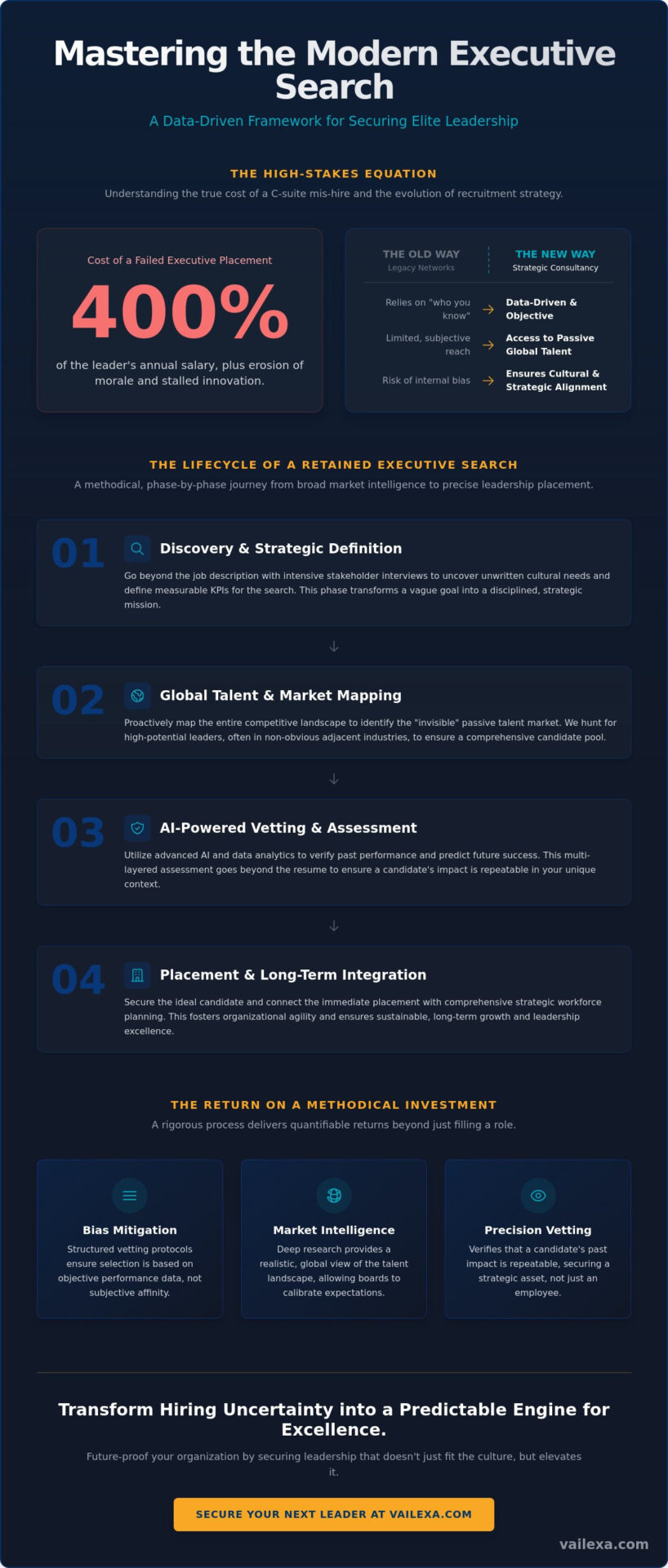
A failed executive placement can cost your organization up to 400% of that leader’s annual salary. This formidable risk explains why the traditional reliance on personal networks has been replaced by a more disciplined science of strategic alignment. You understand that in 2026, the complexity of global markets and the scarcity of elite talent make the executive search process a high-stakes endeavor where there’s no room for error or internal bandwidth constraints. It’s no longer enough to simply fill a seat; you must secure a leader who possesses the digital fluency and agility to navigate a volatile corporate landscape.
This guide empowers you to master the intricacies of modern leadership acquisition through a structured, data-backed methodology. You’ll gain the blueprint needed to access passive global talent while minimizing the risks associated with cultural misalignment. We’ll examine the critical stages of market mapping, the impact of AI on candidate vetting, and the essential compliance standards like California’s SB 642. By following this framework, your organization can transform executive hiring from a source of uncertainty into a predictable engine for long-term excellence.
Key Takeaways
- Recognize the transition from traditional networking to a data-driven consultancy model that secures high-stakes leadership in an increasingly competitive global market.
- Master each critical stage of the executive search process, from initial discovery and market mapping to the precise calibration of the C-suite profile.
- Utilize advanced AI and data analytics to verify past performance and predict long-term cultural alignment beyond the limitations of a standard resume.
- Implement rigorous protocols for maintaining absolute confidentiality while ensuring seamless alignment among board members and internal stakeholders during transitions.
- Connect immediate leadership placement with comprehensive strategic workforce planning to foster organizational agility and ensure sustainable long-term growth.
The Strategic Importance of a Rigorous Executive Search Process
Modern leadership acquisition is far more than a transactional hiring exercise; it represents a high-stakes consultancy engagement designed to protect organizational value. When a company initiates an executive search process, they aren’t just looking for a resume. They’re seeking a strategic catalyst. In 2026, the market demands a shift away from legacy “who you know” networks. Instead, firms now rely on data-driven assessments to decode a candidate’s leadership DNA. This evolution ensures that every placement aligns with long-term stability and specific growth trajectories. Success requires a partner who acts as an architect of growth, not just a vendor of talent.
Defining the Executive Search Mandate
Every successful search begins by identifying the core business problem that requires solving. A replacement hire seeks to maintain the status quo, while transformative leadership acquisition targets a visionary capable of pivoting the entire enterprise. Distinguishing between these two paths is critical for long-term health. To ensure accountability, we establish measurable KPIs for the search itself. These metrics might include candidate diversity ratios, time-to-shortlist, and long-term retention benchmarks. This level of precision transforms a vague search into a disciplined strategic mission that yields predictable results. It’s about finding the leader who doesn’t just fit the culture but elevates it.
The ROI of a Methodical Approach
The financial consequences of a misstep at the C-suite level are staggering. Industry data suggests a failed executive placement can cost between 200% and 400% of the individual’s annual salary. Beyond the balance sheet, a poor hire erodes team morale and stalls innovation. A methodical executive search process mitigates these risks through several key mechanisms:
- Bias Mitigation: Structured vetting protocols ensure that selection is based on objective performance data rather than subjective affinity.
- Market Intelligence: Deep research provides a realistic view of the talent landscape, allowing boards to calibrate their expectations.
- Precision Vetting: Multi-layered assessments verify that a candidate’s past impact is repeatable in a new context.
Phase-by-Phase: The Lifecycle of a Retained Executive Search
The lifecycle of a retained search is a methodical journey from broad market intelligence to the precise selection of a singular leader. It’s a high-stakes progression where each phase builds the foundation for the next. Unlike standard recruitment, this executive search process prioritizes alignment over speed, ensuring the final candidate isn’t just available but exceptional. You aren’t just filling a vacancy; you’re engineering a leadership solution. Most organizations recognize this as a partnership where fees are typically structured in thirds, reflecting the strategic milestones achieved from launch to placement.
Discovery: Beyond the Job Description
Success starts with a deep dive into the organizational psyche. We conduct intensive stakeholder interviews to uncover the “unwritten” cultural requirements that a standard job description often misses. This phase involves benchmarking the role against global industry standards to ensure the position is competitive. We then craft a compelling Value Proposition that speaks directly to the aspirations of high-level leaders. It’s about positioning your opportunity as the logical next step in their career trajectory, ensuring the role attracts visionaries rather than just job seekers.
Talent Mapping: The Science of Sourcing
Identifying the “invisible” passive market requires a rigorous talent mapping process to visualize the entire competitive landscape. We don’t wait for applications; we proactively hunt for high-potential leaders, often in non-obvious adjacent industries where transferable skills are abundant. In a borderless leadership market, having a global reach is no longer optional. It’s a necessity for finding the best possible fit, especially when looking for leaders who can navigate the regulatory complexities of 2026.
The evaluation phase marks the pivot from broad sourcing to intensive vetting. This is where we distill the “long list” into a refined shortlist of candidates who possess the specific “Leadership DNA” required for your unique challenges. We use structured assessments to mitigate unconscious bias, focusing on evidence of leadership agility and digital fluency. During final selection and negotiation, the focus shifts to closing the deal with high-impact talent. This requires a sophisticated touch to balance compensation expectations with organizational equity and long-term incentives.
Finally, the process concludes with a dedicated onboarding and integration phase. We understand that the search isn’t truly complete until the new executive has successfully navigated their first 100 days, establishing trust and driving early wins. If you’re ready to secure your next C-suite leader, our specialized executive search solutions provide the predictability and precision your board expects.
Advanced Vetting: Integrating AI and Data Analytics into Leadership Assessment
Precision is the hallmark of a sophisticated executive search process in 2026. Relying solely on a candidate’s curated resume or a charismatic interview performance is a strategic gamble your organization doesn’t need to take. Today, AI-enhanced executive search utilizes machine learning to predict leadership success by cross-referencing past performance data with current market volatility. We move beyond the CV, using data analytics to verify the specific impact a leader had on their previous organization’s growth. This shift from qualitative “gut feel” to quantitative evidence ensures that your next hire possesses the resilience and agility required for the C-suite.
While algorithms provide a powerful baseline, they don’t replace human judgment. Instead, they augment it. Over 60% of recruiting teams now use some form of AI to identify passive talent and map behavioral patterns. This technology allows us to see through the “halo effect” of a prestigious pedigree, focusing instead on the candidate’s actual ability to navigate uncertainty. We balance these algorithmic insights with psychometric testing to gauge how a leader handles high-pressure environments, ensuring they’re built for the long term.
Predictive Analytics for Leadership Success
Predictive analytics allows us to forecast how a leader will perform in your specific corporate context. By analyzing behavioral patterns, we identify “soft skill” gaps that traditional interviews often miss. This data-driven approach is particularly effective for identifying leaders who can drive digital transformation. However, we maintain a strict focus on ethics. With GDPR regulations carrying fines of up to 4% of global revenue, ensuring data privacy and compliance is a non-negotiable component of our vetting methodology. Our commitment to strategic workforce planning ensures that every data point serves a larger organizational goal.
The Human Element: Behavioral Interviewing
Even with advanced data, the human element remains the final arbiter of fit. We utilize competency-based interviewing to probe for specific evidence of leadership impact. This involves assessing emotional intelligence (EQ) and cultural adaptability through deep-dive scenarios. We look for leaders who don’t just solve problems but inspire teams to innovate during times of transition. Leadership DNA is the intersection of skill, will, and cultural alignment. By combining this high-touch behavioral assessment with our analytical framework, we deliver a shortlist of candidates who aren’t just qualified on paper but are prepared to lead your organization into its next chapter.
Navigating Confidentiality and Stakeholder Alignment in C-Suite Recruitment
Confidentiality isn’t merely a preference in high-level hiring; it’s a strategic necessity that protects your organization’s market valuation and the candidate’s professional standing. While some critics view the lack of immediate transparency as a “black box,” seasoned decision-makers understand that a disciplined executive search process functions as a secure bridge between current operations and future leadership. This methodology allows for rigorous vetting and market mapping without triggering unnecessary speculation among competitors or internal teams. By maintaining a quiet profile, you protect the organization’s reputation while securing the attention of elite, passive talent who wouldn’t respond to a public posting.
The search firm acts as a neutral buffer during the most sensitive stages of negotiation. This role is particularly critical when replacing an incumbent leader or entering a new market where your intentions must remain shielded. A professional partner manages the delicate balance of keeping stakeholders informed while ensuring that sensitive data remains restricted to a need-to-know basis. This mediation prevents direct friction between the board and prospective hires, allowing for a more objective evaluation of leadership DNA without the interference of personal biases or emotional reactions.
Managing Confidential Mandates
Executing a confidential executive search requires a multi-layered security protocol. We utilize secure data rooms and ironclad NDAs to protect sensitive organizational information throughout the engagement. Initial outreach to candidates is handled with extreme discretion, focusing on the opportunity’s challenges and rewards without revealing your company’s identity until a high level of mutual interest is established. We also strictly adhere to “off-limits” agreements. These protocols ensure that we maintain healthy industry relationships by not poaching from our current partners, a standard that reinforces the ethical integrity of the entire search.
Stakeholder Management and Consensus Building
Aligning a Board of Directors is often the most complex aspect of the search. Different members frequently hold divergent priorities; one may prioritize financial austerity while another seeks aggressive innovation. Facilitating final-round interviews requires strategic mediation to ensure that the evaluation remains focused on the established KPIs rather than subjective preferences. Research indicates that a CEO search can demand over 50 hours of collective leadership time, making efficient consensus-building essential for organizational stability. By integrating diversity and inclusion consulting, boards can broaden their perspective and identify leaders who bring unique, transformative value to the enterprise. If you’re ready to align your stakeholders behind a unified vision, explore our specialized executive search solutions today.
Future-Proofing Leadership: The Vailexa Approach to Executive Excellence
Vailexa doesn’t view leadership acquisition as an isolated transaction. We treat the executive search process as a vital pillar within a strategic guide to contingent staffing and permanent workforce architecture. This perspective addresses a common industry gap where executive hiring is disconnected from broader talent strategy. By aligning C-suite acquisition with your long-term succession planning, we provide a foundation for enduring stability. Our approach ensures that your leadership team isn’t just prepared for today’s market but is structured to thrive through the volatility of the next decade.
Our commitment to diversity isn’t a checkbox; it’s a core component of our search methodology. We build inclusive leadership teams from day one by accessing global talent pools that traditional firms often overlook. With a global infrastructure that supports seamless cross-border transitions, we manage the complexities of international relocation and local compliance, allowing you to focus on strategic growth. We act as your visionary architect, ensuring that every new leader possesses the digital fluency and cultural intelligence required to lead a diverse, global workforce in 2026.
Beyond the Placement: Long-term Leadership Sustainability
The journey doesn’t end when the contract is signed. We provide post-placement coaching and integration support to ensure the new executive hits the ground running. We conduct periodic check-ins at the six-month mark to verify that the alignment remains strong and that the leader is meeting their established KPIs. This commitment to sustainability helps build a robust leadership bench, ensuring your organization is prepared for future needs before they become urgent vacancies. Our focus is on long-term impact, ensuring that the human element of business growth is nurtured well past the initial 100 days.
The Vailexa Difference: Agility and Precision
We reject the “one-size-fits-all” model favored by massive, legacy firms. Instead, Vailexa offers a bespoke approach that combines high-touch human expertise with our proprietary AI staffing solutions. This allows us to map the market with unprecedented accuracy, identifying candidates who possess the exact blend of leadership agility and data-driven decision-making skills. Our process is designed for organizations that demand both speed and surgical precision in their talent acquisition. We provide the steady, polished voice of a strategic partner while delivering the innovative results of a bold industry leader.
Ready to transform your leadership tier? Experience the Vailexa Executive Search Process and secure the visionaries your organization deserves.
Architecting Organizational Resilience Through Strategic Leadership
The transition toward a data-driven executive search process is no longer a luxury for the forward-thinking enterprise; it’s a fundamental requirement for survival in 2026. You now possess the blueprint to navigate the complexities of C-suite acquisition, from the initial discovery phase to the final stages of executive onboarding. Success in this high-stakes environment requires a partner who combines global market intelligence with the surgical precision of modern technology. By prioritizing cultural alignment and predictive analytics, you ensure your next leader is capable of driving transformative growth while maintaining organizational stability.
Vailexa stands ready to serve as your authoritative strategic guide. We leverage specialized expertise in AI and Data Analytics staffing to identify visionaries who other firms simply cannot find. Our AI-powered vetting protocols have consistently delivered a 98% placement success rate, providing the reliability you need to hire with absolute confidence. It’s time to move beyond traditional recruitment and embrace a methodology that guarantees excellence.
Secure Your Future Leadership with Vailexa’s Strategic Search Process
The path to C-suite excellence is paved with disciplined methodology and visionary insight. Let’s build your leadership legacy together.
Frequently Asked Questions
How long does a typical executive search process take?
A standard executive search process typically requires 90 to 120 days from the initial discovery phase to the final offer acceptance. This timeline accounts for the rigorous market mapping and multi-layered vetting necessary to secure elite talent in a competitive global landscape. Organizations should expect to invest 20 to 30 hours of internal leadership time for finalist interviews to ensure absolute cultural and strategic alignment.
What is the difference between retained and contingent executive search?
Retained search functions as an exclusive, consultative partnership where a firm dedicates specific resources to a comprehensive market mapping effort for high-level roles. In contrast, contingent recruitment is a non-exclusive, success-based model often utilized for mid-management positions. For C-suite appointments, the retained model is preferred because it guarantees a deeper level of psychometric assessment and cultural vetting that transactional models don’t provide. Understanding the full implications of retained vs contingent search is essential for making the right strategic choice for your organization’s leadership needs.
How do executive search firms find passive candidates who aren’t looking for a job?
Firms access the “invisible” market by utilizing advanced AI staffing solutions and proprietary databases to identify high-performers who aren’t actively seeking new opportunities. This proactive approach involves analyzing behavioral data and industry influence to find leaders with the agility to navigate uncertain conditions. By looking beyond active applicants, firms tap into a global talent pool that represents the most qualified visionaries rather than just the most available candidates.
What are the common mistakes companies make during the executive search process?
One frequent error is relying on outdated job descriptions that don’t reflect the digital fluency and leadership agility required in 2026. Companies also struggle when they fail to align the Board of Directors on the ideal candidate profile before the executive search process begins. Slow decision-making during the final evaluation phase risks losing top-tier talent to competitors, potentially leading to the high cost of a failed hire.
How much does it cost to engage an executive search firm?
Industry standards for retained searches involve a fee based on a percentage of the candidate’s first-year total compensation, reflecting the high-level consultancy and risk mitigation provided. These fees are typically paid in three strategic installments: at the search launch, upon shortlist presentation, and at the time of hire. This structure ensures the firm remains focused on quality and long-term alignment throughout the entire lifecycle of the engagement.
How do you ensure diversity and inclusion in an executive search?
Ensuring diversity requires integrating specialized Diversity & Inclusion (D&I) consulting into the talent mapping phase to ensure a broad and equitable candidate pool from the start. We utilize structured, competency-based interviewing and data-driven assessments to mitigate unconscious bias during the evaluation process. This methodical approach ensures that selection is based on objective performance data and leadership DNA rather than subjective affinity or legacy networks.
What role does the Board of Directors play in the search process?
The Board of Directors serves as the ultimate arbiter of strategic alignment and long-term vision for the organization. They are responsible for defining the core business problems the new leader must solve and participating in final-round interviews to build consensus. For critical roles like a CEO, board members often spend over 50 hours collectively to verify that the candidate’s values and agility align with the corporate mission.
Can a company conduct its own executive search internally?
While internal teams can identify talent, they often lack the bandwidth and neutrality required for confidential executive search vetting and sensitive negotiations. External firms provide a necessary buffer and possess the specialized infrastructure needed for global reach and deep psychometric assessment. Most organizations find that the risk of a failed hire, which can cost up to 400% of an executive’s salary, makes a professional partnership a more secure investment.