
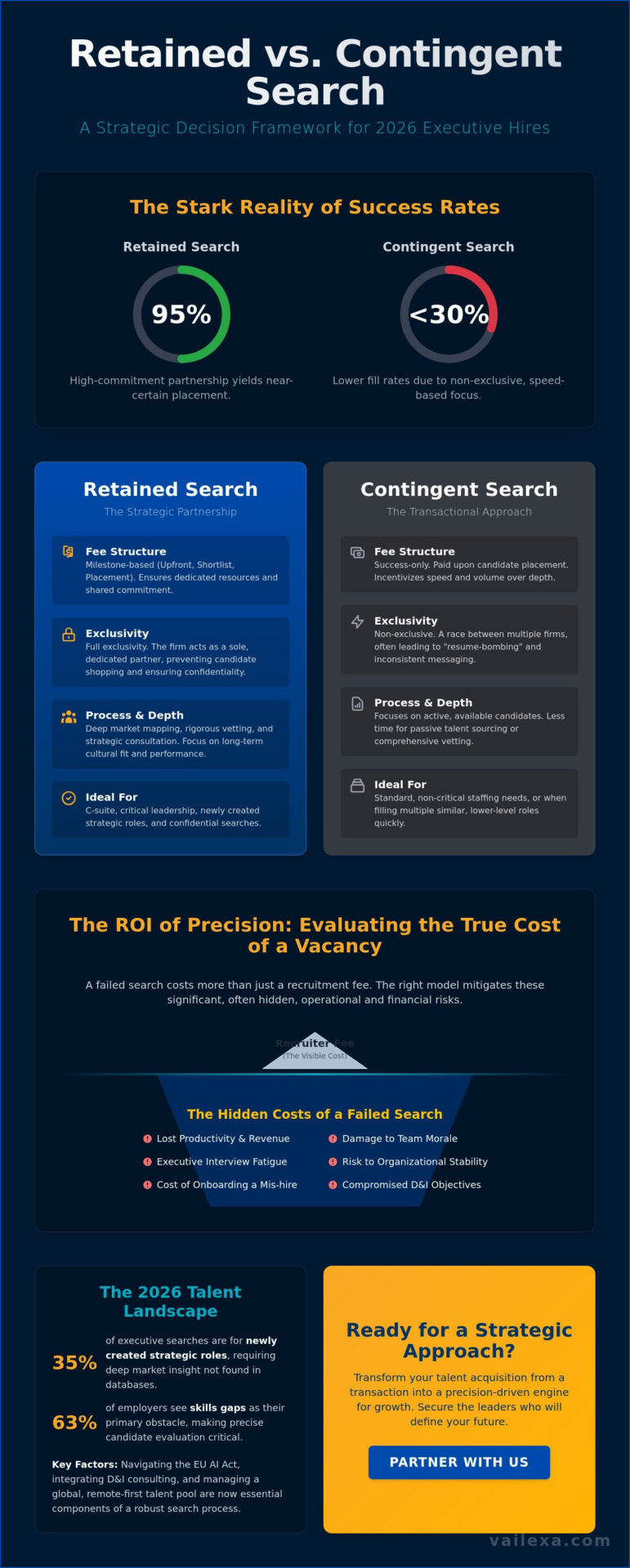
Did you know that while retained searches boast a 95% success rate, contingent models often struggle to fill more than 30% of their assignments? It’s a staggering disparity that highlights why choosing between retained vs contingent search is a foundational business decision rather than a mere administrative choice. You’ve likely felt the frustration of reviewing low-quality resumes while the cost of a vacancy in a critical AI or leadership role continues to climb. When competitors engage in candidate shopping due to a lack of exclusivity, your organizational stability is at risk.
We understand that securing top-tier talent requires more than just a broad net; it demands a disciplined, strategic partnership. This guide provides the framework you need to navigate the complexities of executive recruitment in 2026, from understanding the impact of the EU AI Act on your hiring process to mastering the operational differences between search models. You’ll gain a clear understanding of which approach mitigates risk and how to justify high-value recruitment spend to your CFO. We’ll explore how to transform your talent acquisition strategy into a precision-driven engine for growth.
Key Takeaways
- Master the structural shift toward specialized leadership roles and learn how to align your recruitment model with 2026 business objectives to prevent costly mis-hires.
- Evaluate the core differences between retained vs contingent search models, focusing on how exclusivity levels and commitment frameworks impact the depth of your candidate shortlist.
- Discover how to quantify the hidden costs of a failed search and implement strategies that reduce interview fatigue for your executive leadership team.
- Access a 2026-ready decision framework that helps you justify recruitment spend to the CFO while mitigating the operational risks of high-stakes vacancies.
- Learn how integrating Diversity & Inclusion (D&I) consulting into your search process transforms a simple transaction into a high-level strategic partnership.
The Strategic Talent Dilemma: Aligning Search Models with 2026 Business Goals
Leadership in 2026 requires a surgical approach. The era of broad recruitment has faded, replaced by a demand for specialized executives who can navigate rapid AI integration and shifting global regulations. Organizations that treat executive acquisition as a routine administrative task often face expensive mis-hires. These errors don’t just cost money; they erode competitive advantages and stall momentum. With 35% of executive searches now focused on newly created strategic roles, the stakes for your next hire have never been higher.
Understanding the fundamental choice between retained vs contingent search is the first step toward securing long-term stability. These Executive search models defined by their depth of engagement offer vastly different outcomes. A contingent model operates on a reactive, success-only basis, which works well for standard staffing needs. Conversely, a retained model functions as a proactive strategic partnership. It provides the thorough market intelligence and exclusivity required for sensitive, high-stakes leadership placements.
Market volatility in 2026 makes simple resume-matching obsolete. Data from industry reports suggests that 63% of employers view skills gaps as the primary obstacle to business transformation. Consequently, choosing between retained vs contingent search is not just a procurement task; it’s a strategic investment in the future of your organization. Your search process must move beyond historical experience to identify agility and cultural alignment.
Why Search Strategy Is an Executive-Level Decision
A vacancy in the C-suite is a public signal of organizational vulnerability. It can trigger fluctuations in stock price and create a leadership vacuum that dampens employee morale. Boards should view the selection of a search model as a rigorous risk management exercise. When the search methodology aligns with the role’s complexity, long-term retention rates improve. A disciplined approach ensures the chosen leader possesses the precise technical acumen and cultural fit to drive the business forward under pressure.
The Evolving Landscape of Global Talent Acquisition
Modern search workflows now leverage advanced AI staffing solutions to identify passive talent with high accuracy. This technology allows for deeper data analytics, ensuring candidates are vetted for their ability to thrive in a fragmented global economy. Cross-border hires have become standard as remote work models stabilize, yet they introduce complex regulatory nuances. Additionally, Diversity and Inclusion (D&I) benchmarks are no longer secondary considerations; they’re essential indicators of a robust, high-performing leadership team.
Decoding the Mechanics: Retained vs Contingent Search Defined
Choosing between retained vs contingent search involves more than comparing invoices. It’s a choice between a transaction and a transformation. While both models aim to fill a vacancy, their underlying mechanics dictate the level of commitment, the depth of candidate vetting, and the ultimate security of your leadership pipeline. In the fast paced market of 2026, understanding these distinctions is vital for protecting your organizational interests.
| Feature | Retained Search | Contingent Search |
|---|---|---|
| Fee Structure | Milestone-based (Upfront, Shortlist, Placement) | Success-only (Paid upon hire) |
| Exclusivity | Full exclusivity; the firm is your sole partner | Non-exclusive; often a race between multiple firms |
| Time Commitment | High; dedicated resources and deep market mapping | Variable; focus shifts based on ease of placement |
The financial architecture of these models creates different incentives. Contingent search relies on a “success-only” payment, which naturally prioritizes speed and volume. This often leads to “resume-bombing,” where agencies rush to submit candidates to claim ownership before their competitors do. Conversely, retained search utilizes milestone payments. This structure funds a rigorous research phase where firms use advanced data analytics to map the entire market, ensuring you see the best talent, not just the most available talent. These 2026 executive hiring trends emphasize that for high-stakes roles, the “Success-Only” model often carries a higher risk of vacancy or a mediocre hire.
A critical, yet often overlooked, component is the “Off-Limits” agreement. When you engage a firm on a retained basis, they typically agree not to poach talent from your organization for a specified period. This protective layer is absent in most contingent agreements. Without this exclusivity, you’re essentially paying a vendor who could legally recruit your top performers for a competitor the following month. If you’re looking to build a resilient leadership team, exploring a dedicated executive search partnership offers the security your board expects.
The Retained Search Process: A Deep Dive into Partnership
The executive search process is a comprehensive methodology designed for C-suite excellence. It begins with an intensive intake to understand your culture, followed by proactive outreach to “passive candidates”—the high performers who aren’t actively looking but would move for the right strategic opportunity. This process ensures a perfect cultural fit through multi-stage assessments that go far beyond a standard interview.
Contingent Search: Speed and Volume for Non-Critical Roles
While less exhaustive, contingent staffing remains a powerful tool for mid-level roles or urgent, standardized skill sets. It’s effective when the talent pool is deep and the role’s impact on stock price or organizational stability is limited. However, you must manage the risk of candidate competition, as top talent may be presented to multiple employers simultaneously, driving up salary expectations and reducing your control over the hiring timeline.
The ROI of Precision: Evaluating Financial and Operational Risk
Precision in leadership selection isn’t a luxury; it’s a fiscal necessity. While the upfront investment of a retained search may seem daunting to some CFOs, the alternative often carries a much steeper price tag. When comparing retained vs contingent search, you must look beyond the agency fee to the total cost of vacancy and the long-term impact of quality-of-hire. A failed search doesn’t just leave a hole in the org chart. It slows down strategic initiatives and can even damage a company’s market valuation.
There is a persistent misconception that contingent search is “free” if a placement isn’t made. This logic ignores the operational drain on your internal resources. Every hour your executive team spends interviewing a candidate who lacks the necessary cultural or technical alignment is an hour stolen from high-value strategic work. Retained search mitigates this “interview fatigue” by presenting only a highly curated shortlist of individuals who have already passed rigorous vetting. By utilizing data analytics to justify the initial spend, organizations can ensure they aren’t just hiring for speed, but for sustained performance.
Calculating the True Cost of a Bad Executive Hire
Industry analysis indicates that the financial impact of a bad C-suite hire often reaches 2 to 3 times the candidate’s annual salary when factoring in disruption and replacement costs. The disparity in vetting depth is stark. A contingent agency typically performs a 10-hour scan of active databases. A retained firm, however, invests roughly 100 hours into exhaustive research and deep-market intelligence. Incorporating talent mapping into this process ensures that you aren’t just filling a current role, but identifying future talent gaps before they become crises.
Exclusivity as a Competitive Advantage
Exclusivity acts as a shield for your corporate reputation. When multiple agencies approach the same high-level candidate, it signals a lack of control and can make the role appear less prestigious. Top-tier executives value discretion and professional authority; they prefer engaging with a single, exclusive consultant who has a deep understanding of the organization’s vision. This focused approach creates a superior candidate experience, positioning your firm as an employer of choice in a crowded market. Choosing the right path between retained vs contingent search ultimately determines how the elite talent pool perceives your brand.
Decision Framework: When to Retain and When to Contingently Recruit
Selecting the appropriate engagement model is a nuanced exercise in strategic alignment. It requires an honest assessment of the role’s impact, the scarcity of the required skill set, and the level of discretion required. The choice between retained vs contingent search should never be arbitrary; it must be a deliberate response to specific organizational pressures. To guide your selection, consider this 5-point checklist for executive decision-makers:
- Strategic Impact: Is this role essential for driving 2026 business transformation or protecting market share?
- Candidate Scarcity: Does the position require a “Niche AI” specialist or a leader with rare cross-border experience?
- Confidentiality: Is the search replacing an incumbent or entering a sensitive new market?
- Market Intelligence: Do you require comprehensive talent mapping to understand competitor structures?
- Culture Alignment: Is a deep behavioral assessment necessary to ensure long-term executive retention?
The Case for Retained: Complexity, Confidentiality, and Seniority
Senior roles often carry baggage that requires a neutral third party to manage. This is especially true for a confidential executive search, where internal leaks could destabilize the organization. In “Niche AI” or deep-tech sectors, the talent pool is so small that a transactional contingent scan will likely fail. You need a partner who can act as a brand ambassador, reaching out to high-performing passive candidates with a compelling, exclusive narrative. Retained search offers the “neutrality” needed to handle sensitive transitions without damaging internal morale or external reputation.
The Case for Contingent: Agility and Standardized Skills
Contingent models thrive when the talent pool is broad and the skills are standardized. If your goal is “broad market coverage” rather than “deep vetting,” this model delivers speed. However, managing multiple contingent partners requires discipline to avoid damaging your employer brand through inconsistent messaging. High-growth startups often find that transitioning from contingent staffing to a more structured RPO model helps them scale rapidly while maintaining quality standards. If you are ready to optimize your leadership pipeline, contact our team today to discuss our Executive Search and Global Talent Solutions.
Beyond the Model: Why Strategic Partnership Trumps Transactional Search
The debate surrounding retained vs contingent search often centers on fee structures, yet the most successful organizations recognize that the true differentiator is the depth of the partnership. A transactional approach might fill a role, but a strategic alliance builds a legacy. Vailexa operates as an Authoritative Strategic Guide, moving beyond the role of a traditional vendor to become a dedicated architect of your leadership team. We don’t just provide resumes. We deliver market intelligence, organizational alignment, and a commitment to excellence that safeguards your corporate standards.
Our methodology leverages specialized AI staffing expertise to identify talent that remains invisible to standard search tools. By combining global reach with data-driven insights, we ensure your leadership pipeline is both resilient and forward-thinking. This level of precision is essential in 2026, where leadership agility is the primary currency of business transformation. We understand that your next hire is a reflection of your brand’s future, and we treat every search with the gravity it deserves.
The Vailexa Advantage: Data-Driven Global Talent Solutions
We utilize predictive analytics to pinpoint “ready-to-move” leaders, ensuring you engage with talent before your competitors even realize they’re available. This proactive stance is bolstered by our integrated diversity and inclusion consulting, which we weave into every search engagement. We believe that a diverse C-suite is a high-performing C-suite. Our commitment to high search accuracy ensures that every candidate presented is a technical and cultural match for your unique organizational DNA.
Next Steps: Optimizing Your 2026 Recruitment ROI
Ready to transform your leadership acquisition strategy? Schedule a consultation with Vailexa’s executive search team to begin your journey toward strategic excellence.
Elevating Your Executive Acquisition Strategy for 2026
Navigating the choice between retained vs contingent search is ultimately a decision about the level of risk your board is willing to tolerate. As leadership roles become more specialized and global markets more fragmented, the depth of your vetting process directly determines the future stability of your organization. We’ve seen how milestone-driven models provide the rigorous market mapping necessary for C-suite excellence; meanwhile, contingent frameworks offer the agility required for standardized roles. Success in the modern economy demands a partner who can move beyond resume matching to provide deep market intelligence.
Vailexa serves as your authoritative strategic guide, bridging the gap between talent scarcity and organizational growth. With a global reach across 50+ markets and specialized pools for AI and Data Analytics talent, we provide the precision required for high-stakes placements. Our commitment to excellence is reflected in a 95% retention rate for executive placements, ensuring that your investment yields long-term dividends. Optimize your leadership acquisition with Vailexa’s strategic search solutions. The right leader is waiting to transform your business; let’s identify them with the precision they deserve.
Frequently Asked Questions
What is the typical fee for a retained executive search in 2026?
Industry standard fees for a retained search in 2026 typically range from 25% to 35% of the candidate’s first-year total compensation. This figure usually includes the base salary and any projected bonuses. Unlike other models, these fees are structured as milestone payments distributed across the search lifecycle, which ensures the firm remains dedicated to the project until a successful placement is achieved.
Can I switch from a contingent to a retained search if the initial results are poor?
You can certainly transition an assignment from a contingent to a retained model if your initial efforts fail to produce high-quality shortlists. Many organizations make this shift when they realize a role requires deeper market mapping or a more exclusive approach to attract passive talent. This pivot allows you to reset the engagement with a more disciplined methodology and dedicated resources to resolve the issues found in a reactive scan.
What is an “off-limits” agreement in retained recruitment?
An “off-limits” agreement is a contractual commitment where the search firm agrees not to recruit talent from your organization for a specified period. This protection is a hallmark of the retained vs contingent search distinction, as it provides vital security for your existing leadership team. It ensures that the partner you’ve hired to build your organization isn’t simultaneously working to dismantle it by poaching your top performers.
How long does a typical retained search take compared to a contingent search?
A typical retained search usually takes between 90 and 120 days to complete, whereas a contingent search may deliver resumes within days but carries a much lower fill rate. The longer timeline for a retained engagement reflects the exhaustive research, deep vetting, and cultural alignment phases. This investment of time ensures a 95% success rate, significantly outperforming the 20% to 30% fill rate often associated with transactional models.
Is retained search only for C-level executives?
Retained search isn’t exclusively for C-level executives; it’s increasingly used for any high-stakes, specialized, or confidential role. In 2026, many firms utilize this model for “Niche AI” leadership or fractional executive positions that require precise technical vetting. If the cost of a vacancy or a mis-hire is high, the retained approach provides the necessary risk mitigation regardless of the specific title or seniority level.
What happens if a candidate placed via a retained search leaves within six months?
Most reputable search firms provide a replacement guarantee if a candidate placed via a retained search leaves within a specific timeframe, such as six or twelve months. If the executive departs for reasons other than organizational restructuring, the firm will typically conduct a new search at no additional professional fee. You should always verify the specific terms of this guarantee in your service agreement to ensure your investment is protected.
How do AI staffing solutions improve the accuracy of a retained search?
AI staffing solutions improve search accuracy by analyzing vast datasets to identify predictive patterns of leadership success and candidate “readiness to move.” These tools allow consultants to map talent pools with surgical precision, going beyond basic keywords to evaluate behavioral traits and cultural alignment. By pairing AI’s speed with human judgment, firms can deliver shortlists that are more likely to result in long-term organizational stability.
Why is exclusivity important when hiring for sensitive leadership roles?
Exclusivity is paramount for sensitive roles because it protects your brand’s reputation and ensures a consistent narrative in the talent market. When you choose between retained vs contingent search, exclusivity prevents multiple agencies from “shopping” the role to the same candidates, which can signal desperation. It also allows for a confidential approach, which is vital when you’re replacing an incumbent or entering a new global territory.