
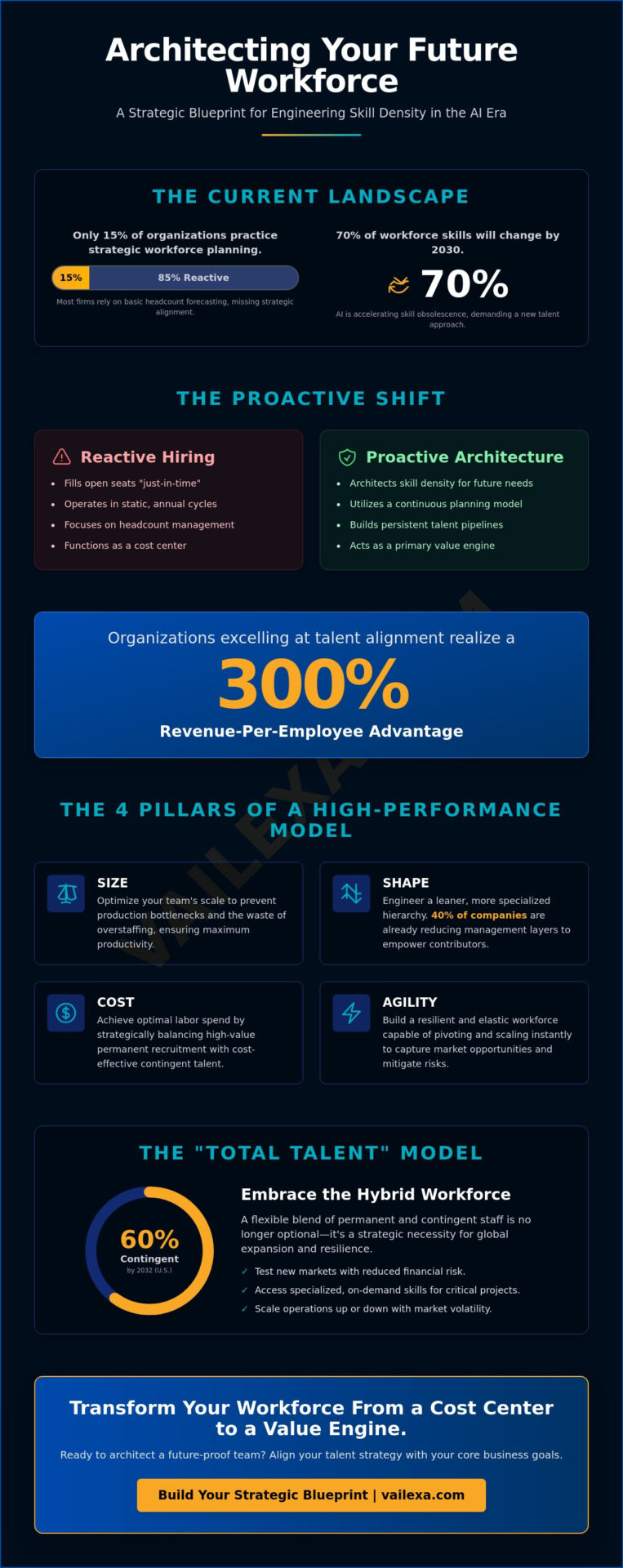
Only 15% of organizations currently practice strategic workforce planning beyond basic headcount forecasting, even though 70% of the skills your team utilizes today are forecasted to change by 2030. You likely feel the tension of this misalignment as AI accelerates skill obsolescence and complicates long-term resource allocation. It’s no longer enough to manage headcount; you must architect skill density. This guide empowers you to align global talent with your core business strategy to ensure your organization thrives in a volatile, AI-driven economy.
We will outline a precise framework for talent mapping and the integration of sophisticated global talent solutions that drive measurable ROI. You’ll discover how to move from static, annual cycles to a continuous planning model that leverages both permanent recruitment and agile contingent staffing. This approach creates a flexible, high-performance workforce capable of seamless global expansion and sustained competitive advantage.
Key Takeaways
- Master the synchronization of human capital with long-term vision by shifting from reactive hiring to proactive organizational architecture.
- Optimize your team’s size and shape to prevent operational bottlenecks. You’ll ensure a precise balance of leadership and technical expertise.
- Integrate predictive analytics to forecast evolving skill needs so you don’t fall behind as automation impacts core productivity.
- Deploy strategic workforce planning to identify high-density global talent hubs that offer the ideal alignment of skill availability and cost efficiency.
- Implement a rigorous three-year roadmap. It’s the most reliable way to transform a capability audit into a scalable engine for business growth.
Defining Strategic Workforce Planning in the 2026 Global Economy
In the high-stakes environment of 2026, the traditional approach to hiring has become a liability. True strategic workforce planning transcends the simple act of filling open seats; it’s the deliberate synchronization of human capital with a long-term corporate vision. While operational HR focuses on the immediate pressure of today’s vacancies, strategic planning functions as the architectural blueprint for 2026 and beyond. This shift moves your organization away from rigid, role-based structures toward a fluid, skill-based design that can pivot as fast as the market dictates.
The urgency is backed by clear economic outcomes. Organizations that excel at talent alignment realize a 300% revenue-per-employee advantage over their competitors. In a market defined by 2.2% GDP growth and a “low-hire, low-fire” equilibrium, the margin for error in headcount allocation has vanished. Leaders are now required to integrate Strategic human resource planning into the very core of their business model to maintain a competitive edge. It isn’t just about survival; it’s about dominating your sector through superior capability density.
The Evolution of Talent Acquisition: From Reactive to Proactive
Standard recruitment cycles often fail in 2026 because they’re inherently reactive. By the time a vacancy is identified and filled, the required skill set has often evolved. Proactive organizations have abandoned this “just-in-time” model in favor of persistent talent pipelines. This transition requires a partner who acts as an Authoritative Strategic Guide, moving beyond resume sourcing to deep talent intelligence. By building these pipelines before a need becomes critical, you ensure that your expansion plans aren’t throttled by talent scarcity or the rapid pace of technological change.
Strategic Alignment: Bridging the Gap Between Finance and HR
Modern executives treat human capital with the same analytical rigor as financial capital. Strategic workforce planning informs long-term investment strategies by providing a clear view of where talent ROI is highest. When HR and Finance are aligned, talent-related business cases are validated by hard data rather than intuition. This collaboration ensures that every dollar spent on permanent recruitment or contingent staffing is a calculated move toward your three-year growth targets. It transforms the workforce from a cost center into the primary engine of organizational value creation.
The Four Pillars of a High-Performance Workforce Planning Model
The structural integrity of your organization relies on four critical pillars that define high-performance strategic workforce planning. Precision is the new standard. To maintain growth in a cautious 2026 economy, leaders must move beyond generalized hiring goals to focus on the specific dimensions of Size, Shape, Cost, and Agility. Size ensures you don’t face production bottlenecks or the waste of overstaffing; it requires a granular understanding of productivity metrics. Shape addresses the hierarchy of your team. With over 40% of companies reducing management layers as of February 2026, the emphasis has shifted toward leaner, more specialized structures that empower individual contributors.
Cost remains a primary driver of fiscal responsibility, yet it shouldn’t come at the expense of quality. Achieving the optimal labor spend involves balancing high-value permanent recruitment with cost-effective global talent solutions. Finally, Agility represents the ability to pivot. It’s the difference between an organization that’s brittle and one that’s resilient. By building a workforce that can scale instantly, you protect your bottom line against market volatility while positioning your brand to capture emerging opportunities. Identifying these pillars is the first step toward architecting a truly modern enterprise.
The “Total Talent” Approach: Perm vs. Contingent Strategy
A hybrid workforce is no longer a luxury; it’s a strategic necessity. By 2032, contingent workers are predicted to make up 60% of the U.S. workforce. Smart executives use this flexible labor pool to test new markets and specialized projects before committing to full-scale permanent hiring. This “Total Talent” model provides the elasticity needed to expand globally without the traditional risks of high-fixed-cost headcount. You can learn more about this by Mastering Global Agility with Contingent Staffing to ensure your expansion is both rapid and secure. It’s about having the right person for the right duration, every time.
Skill Density: The New Metric for Organizational Health
Headcount is a vanity metric; skill density is the reality of organizational health. 70% of the skills required for most jobs today are forecasted to be different by 2030. This reality makes it vital to identify “single points of failure” where critical expertise is concentrated in too few individuals. Increasing talent density, especially in high-impact leadership roles, ensures that your business strategy isn’t derailed by individual departures or technological shifts. If you’re ready to refine your team’s composition, our global talent solutions offer the data-driven insights needed to map and acquire the specialized expertise your future requires.
Integrating AI and Data Analytics into Your Talent Strategy
The global AI workforce planning market is projected to grow from $3.3 billion in 2026 to $8.5 billion by 2034. This explosive growth signals a fundamental shift in how organizations must architect human capability. Relying on manual talent tracking or gut-feeling projections is no longer a viable strategy for the executive suite. To remain competitive, you must transition toward data-driven workforce intelligence that provides a real-time view of your organization’s skill density and productivity potential. This integration allows you to move beyond simple headcount and start managing your workforce as a dynamic, high-yield asset.
Staffing for the AI-First Enterprise
Building an AI-first enterprise requires a sophisticated understanding of role vulnerability versus role augmentation. While routine data processing and administrative functions are increasingly handled by automated decision systems, the demand for specialized data analytics staffing is reaching record highs. You must prioritize hiring for machine learning experts who can also demonstrate high-level soft skills like creative problem-solving and strategic leadership. In an automated world, these human-centric capabilities become your most valuable competitive differentiators. We focus on finding individuals who can lead the integration of technology into your unique corporate culture.
Predictive Modeling: Scenario Planning for 2026-2030
Predictive modeling is the engine that drives your three-to-five-year talent outlook. With 70% of the skills required for most jobs forecasted to change by 2030, a static plan is a recipe for obsolescence. You need to develop robust “What-If” scenarios that account for sudden market expansions, technological breakthroughs, or shifts in global talent availability. This level of foresight allows you to anticipate impending retirements and secure leadership succession years before a vacancy occurs. By treating talent forecasting with the same rigor as financial modeling, you ensure your organization remains resilient against the volatility of the coming decade. Organizations that invest in predictive workforce planning gain the ability to build accurate 12-month talent forecasts and significantly reduce time-to-fill for critical roles.
Global Agility: Talent Mapping and Market Expansion
Expanding into new territories requires more than just capital; it demands a sophisticated understanding of the local human landscape. In 2026, the talent mapping process has evolved into a vital competitive intelligence tool. It allows you to visualize the concentration of specialized skills across various geographies before you commit to a physical footprint. This proactive layer of strategic workforce planning ensures that your expansion is supported by a sustainable pipeline of expertise rather than a series of reactive hires. Leaders who treat global agility as a data problem find themselves better positioned to capture market share in emerging tech hubs.
Evaluating global talent hubs requires a balanced analysis of cost, skill availability, and cultural alignment. You must also account for increasingly complex regulatory environments that vary by region. For instance, California’s SB 294 requires written notice of workplace rights by February 1, 2026; meanwhile, revised FEHA regulations concerning Automated Decision Systems (ADS) took effect in October 2025. Successfully architecting a global plan means navigating these compliance hurdles while maintaining a consistent organizational standard. It’s about finding the sweet spot where operational efficiency meets high-caliber talent density without exposing the firm to unnecessary legal risk.
Diversity as a Strategic Advantage
Integrating diversity and inclusion consulting into your workforce framework is a business imperative. Diverse perspectives are the primary drivers of innovation in global product development. They allow your team to anticipate the needs of a multifaceted customer base. Beyond innovation, inclusive hiring practices have a documented impact on retention. When employees feel their unique backgrounds are a valued part of the corporate architecture, they’re more likely to commit long-term. This stability is essential when scaling operations across different time zones and cultures.
Talent Mapping for New Market Entry
Deciding where to open your next global office should never be a matter of intuition. You need to analyze competitor talent pools and local skill availability to ensure the region can support your three-year growth strategy. This data allows you to identify where competitors are vulnerable or where a “talent drain” might provide an opening for your brand. This is where Executive Search becomes indispensable. Securing local leadership who understand the nuances of the regional market is critical for a smooth transition. By combining high-level talent mapping with targeted recruitment, you build an expansion model that is both aggressive and disciplined.
If you’re ready to identify your next growth market, explore our Global Talent Solutions to begin architecting your international footprint with precision.
Implementation: From Strategic Blueprint to Operational Excellence
Execution is the bridge between a visionary strategy and tangible market dominance. To transform a blueprint into operational excellence, you must follow a rigorous four-step implementation process. First, conduct a comprehensive audit of current capabilities and gaps. You can’t navigate toward your 2030 goals without a precise understanding of your starting point. This audit must move beyond simple headcount to measure the skill density discussed in previous chapters. Second, you must align the workforce plan with your three-year business growth strategy. This ensures every talent initiative directly serves your long-term commercial objectives.
The third step focuses on execution through a balanced mix of internal development and strategic external partnerships. While 82% of organizations increased their investment in internal mobility in early 2026, external expertise remains vital for rapid scaling and specialized skill acquisition. Finally, establish a feedback loop for continuous refinement. This cycle allows your organization to remain agile, adjusting your talent density as AI and market conditions evolve. As a premier workforce solutions provider, Vailexa stands ready to help you execute these complex, global talent strategies with precision and reliability.
Choosing a Strategic Workforce Solutions Partner
Modern enterprises are moving away from standard recruitment agencies in favor of Recruitment Process Outsourcing (RPO) and strategic consultants. They’re seeking partners who act as an equal, authoritative guide. When evaluating a partner, prioritize their ability to handle a cohesive suite of services, including Executive Search, contingent staffing, and D&I consulting. A global reach is essential, but it must be paired with deep local market expertise to navigate regional compliance and cultural nuances effectively. Understanding the full spectrum of RPO pricing models is equally critical to ensuring your recruitment investment scales efficiently with your growth objectives. Our global talent solutions provide the infrastructure needed to maintain high standards across distributed teams.
Success Metrics: Measuring the ROI of Workforce Planning
Measuring the ROI of strategic workforce planning is critical for maintaining executive buy-in. Focus on “Time-to-Value” for new hires in critical roles to track how quickly talent contributes to strategic objectives. You should also monitor the reduction in talent-related operational bottlenecks and the long-term impact on employee retention. With U.S. workplace engagement at a low 32% as of late 2025, improving this metric through better alignment is a high-priority goal. When your plan is executed correctly, organizational stability increases, and your human capital becomes your most reliable driver of sustained growth.
Architecting Your Future Workforce with Precision
The transition from basic headcount management to sophisticated strategic workforce planning is the defining challenge for the modern executive. By moving toward a model centered on skill density and global agility, you ensure your organization doesn’t just survive AI disruption but actively leads it. Building a “Total Talent” ecosystem that balances permanent recruitment with agile contingent staffing allows for the rapid scaling and market expansion required in today’s economy. These strategic shifts transform human capital from a fixed cost into a dynamic engine of competitive advantage.
Achieving this level of organizational excellence requires a partner with deep industry intelligence and a proven track record. Vailexa provides the global reach and specialized expertise in AI staffing and data analytics required to bridge critical capability gaps. From comprehensive RPO solutions to high-stakes executive search, we deliver the precision your strategy demands. Partner with Vailexa for Your Strategic Workforce Planning and begin architecting a workforce that is as resilient as it is visionary. Your future growth depends on the decisions you make today.
Frequently Asked Questions
What is the difference between workforce planning and strategic workforce planning?
Workforce planning focuses on short-term operational needs like filling current vacancies or managing immediate attrition. In contrast, strategic workforce planning aligns human capital with your long-term corporate vision. It involves architecting a team that possesses the specific skill density required to execute a three-year growth strategy. This proactive approach ensures you aren’t just reacting to market changes but are building a sustainable pipeline of talent.
How far in advance should an organization plan its workforce strategy?
Most high-performance organizations operate on a three-to-five-year planning horizon. In the 2026 economy, a rolling three-year strategy is ideal because it balances long-term vision with the flexibility to pivot as AI shifts skill requirements. This timeline allows you to anticipate leadership successions and secure specialized talent mapping data well before a critical vacancy impacts your productivity or market expansion.
Can small and medium-sized enterprises (SMEs) benefit from strategic workforce planning?
Small and medium-sized enterprises gain a significant competitive advantage from strategic workforce planning by optimizing limited resources. While larger firms might absorb the cost of a hiring mistake, an SME needs every role to drive immediate value. Planning helps smaller teams identify “single points of failure” and utilize contingent staffing to access high-level expertise without the fixed costs of a permanent executive hire.
How does AI change the traditional workforce planning model in 2026?
AI shifts the model from static, annual cycles to a continuous, data-driven process. Instead of guessing headcount, leaders now use predictive analytics to forecast skill obsolescence and productivity gains. This evolution requires a “Total Talent” mindset where automated decision systems and human creativity are architected to complement one another. It transforms planning from a spreadsheet exercise into a real-time talent intelligence system.
What are the most common pitfalls in implementing a workforce plan?
The most frequent failure is treating workforce planning as an isolated HR task rather than a core business strategy. Without alignment between Finance and HR, plans often lack the budget or data needed for execution. Other pitfalls include ignoring the rise of the contingent workforce or failing to conduct a rigorous audit of current capabilities. Success requires a unified approach where talent goals mirror commercial objectives.
How do you integrate diversity and inclusion goals into a workforce plan?
You integrate these goals by embedding diversity and inclusion consulting into your initial talent mapping and recruitment process. It isn’t a separate initiative; it’s a strategic layer that ensures your global teams represent the markets they serve. This architectural approach improves innovation and retention by creating a culture where diverse perspectives are hard-coded into your organizational structure and leadership pipelines.
What role does contingent staffing play in a strategic workforce model?
Contingent labor provides the essential “Agility” pillar in a modern workforce model. It allows you to scale specialized projects rapidly or test new global markets without committing to permanent headcount. By integrating flexible talent into your broader strategy, you maintain high productivity levels while protecting your bottom line against economic volatility. It’s a vital tool for accessing niche skills in a high-speed market.
How can data analytics improve the accuracy of talent forecasting?
Data analytics removes the guesswork by providing a clear view of internal skill gaps and external talent availability. By tracking “Time-to-Value” and productivity metrics, you can validate talent-related business cases with the same rigor as financial investments. This level of insight allows for precise forecasting, helping you avoid the bottlenecks that occur when critical roles remain vacant during a major growth phase.