
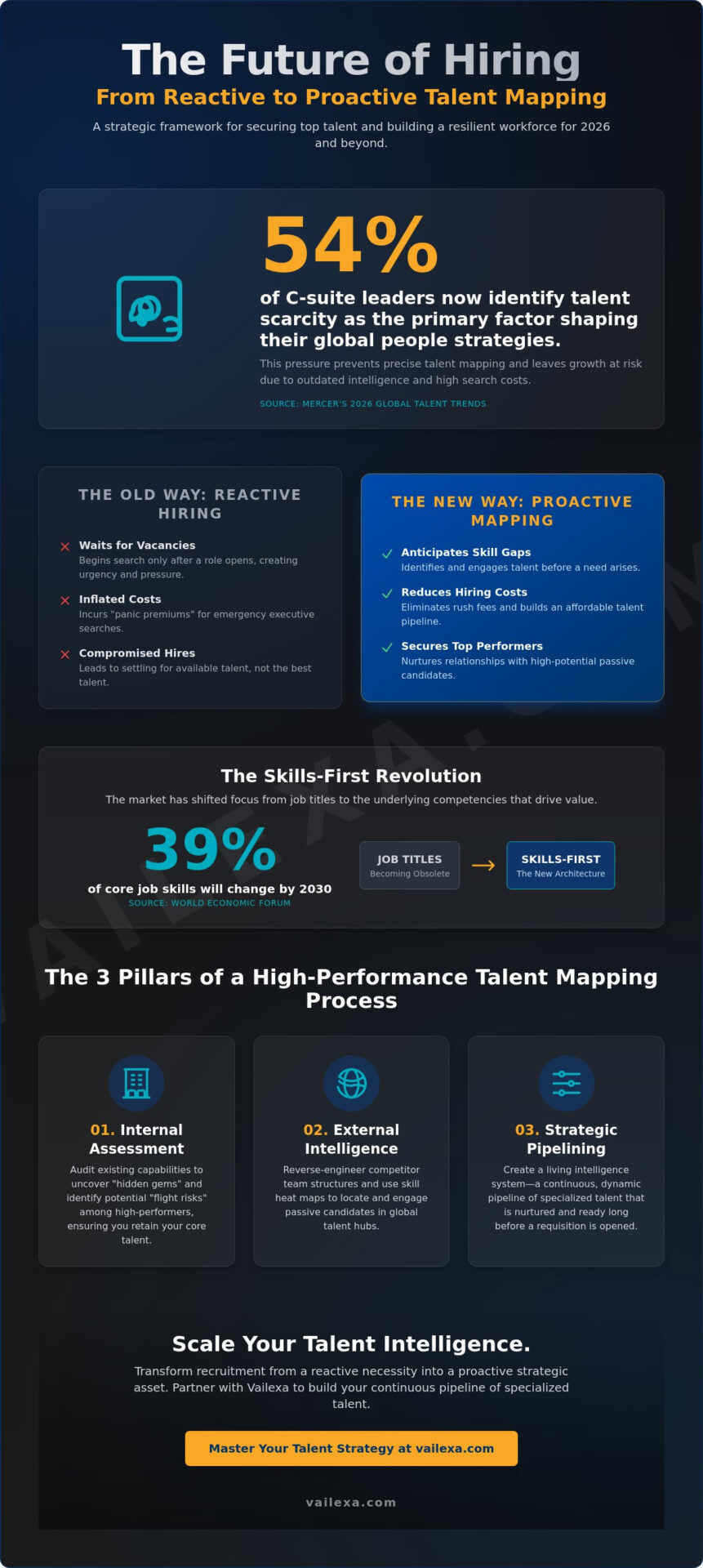
54% of C-suite leaders now identify talent scarcity as the primary factor shaping their global people strategies, according to Mercer’s 2026 Global Talent Trends report. You likely feel this pressure in every boardroom discussion regarding specialized AI and data talent. It’s a frustrating reality where high executive search costs and stale data prevent you from executing a precise talent mapping process or gaining visibility into competitor team structures. When your internal intelligence lags behind your business ambitions, your growth remains at risk.
You can reclaim your competitive edge by mastering a sophisticated approach that transforms recruitment from a reactive necessity into a proactive strategic asset. This guide provides you with a repeatable framework to reduce time-to-hire for your most critical roles. We’ll explore how to align your human capital with your overarching business strategy, ensuring your organization remains agile and prepared for the workforce challenges of 2026 and beyond.
Key Takeaways
- Transition from reactive hiring to a visionary model that anticipates skill gaps before they’ve disrupted your operations.
- Implement a rigorous talent mapping process that balances internal talent audits with dynamic, external competitive intelligence.
- Uncover the organizational structures of your key competitors to identify high-potential talent and understand market-leading team compositions.
- Connect your long-term business strategy to granular skill profiling, ensuring every hire supports your three-year growth trajectory.
- Discover how global RPO partnerships provide the necessary scale and precision to maintain a continuous pipeline of specialized talent.
Beyond Reactive Hiring: Why the Talent Mapping Process is Non-Negotiable in 2026
Reactive recruitment is a defensive posture. It waits for a vacancy to appear before searching for a solution, often resulting in compromised hires and inflated costs. In contrast, a sophisticated talent mapping process functions as an offensive strategy. It identifies, tracks, and engages high-potential talent long before a requisition is ever opened. This isn’t just about filling seats; it’s about securing the intellectual capital required to outpace competitors in an increasingly volatile market.
By 2026, the traditional focus on job titles has eroded. Organizations now prioritize a skills-first architecture. The World Economic Forum projects that 39% of core job skills will change by 2030, making title-based tracking obsolete. Mapping now identifies the underlying competencies that drive actual value:
- Specialized AI architecture and deployment.
- Cross-functional data synthesis and storytelling.
- Strategic leadership in decentralized environments.
This precision directly reduces the cost per hire by eliminating the “panic premium” often paid during emergency executive searches. It also slashes time to productivity. When you’ve already mapped and engaged a candidate, they hit the ground running with a clear understanding of your organizational culture and strategic objectives.
The Evolution of Talent Intelligence
AI and big data have accelerated market analysis from months to minutes. Modern intelligence tools allow leaders to move beyond internal succession planning toward comprehensive external market mapping. This evolution isn’t merely about speed; it’s about depth. A global-first mindset is now mandatory. You aren’t just competing for talent in your local hub. You’re identifying excellence across continents to ensure your team possesses the highest possible caliber of expertise.
Talent Mapping vs. Traditional Workforce Planning
While often used interchangeably, these concepts serve different ends. Workforce planning sets the high-level vision, but the talent mapping process provides the tactical execution. It’s the bridge between strategic human resource planning and real-world acquisition. The focus here is on “Talent Density,” the concentration of high-performers within a team. Mapping takes abstract numbers and turns them into a list of real, reachable professionals.
The Anatomy of a High-Performance Talent Mapping Process
A high-performance talent mapping process is not a static report gathering dust on a digital shelf. It is a living, breathing intelligence system. To maintain organizational agility, this process must rest on three foundational pillars: Internal Assessment, External Market Intelligence, and Strategic Pipelining. When these pillars are integrated, they create a “Dynamic Data” environment where talent insights update in real-time as market conditions shift. This ensures your leadership isn’t making decisions based on last year’s talent landscape.
Sophisticated mapping also incorporates Diversity and Inclusion (D&I) at the foundational level rather than as an afterthought. By identifying diverse talent clusters early, you can build a more representative pipeline that reflects global markets. This is often visualized through “Skill Heat Maps,” which identify regional talent clusters. For instance, if your data shows a surge in specialized AI talent in specific European tech hubs, your talent mapping process should immediately pivot to prioritize engagement in those geographies.
The Internal Audit: Assessing Existing Capabilities
Data analytics now allows you to uncover “hidden gems” within your own organization. The traditional 9-box grid has evolved to meet the needs of a remote-first world. It now measures digital collaboration and cross-functional influence alongside traditional performance metrics. Internal mapping also serves as an early warning system. By analyzing engagement and mobility patterns, you can identify “Flight Risks” among your high-potentials. If you find your internal pipeline is thinning, it may be time to consult with an expert workforce solutions provider to bridge the gap.
External Market Intelligence: Understanding the Competitor Landscape
Understanding your competition requires more than just knowing their names. It involves reverse-engineering their team structures to identify how they distribute high-value talent. This level of intelligence is critical for executive search, where the goal is to map the “Passive Candidate” market. These are professionals who aren’t actively looking but possess the exact competencies your organization requires. For a deeper dive into these methodologies, you can reference this guide for strategic hiring which details the alignment between business goals and workforce analysis.
In the tech sector, 62% of employers anticipate using AI for most hiring stages by 2026. Leveraging AI staffing solutions allows you to identify emerging skill sets before they become mainstream. This proactive approach ensures you’re not just following the market, but actively shaping your organization’s future by securing the talent that competitors haven’t even identified yet.
External Market Intelligence: Mapping Your Competitors’ DNA
Understanding a competitor’s strategic direction requires more than monitoring their quarterly reports. It demands a deep dive into their human capital architecture. By identifying “Target Companies” based on high industry performance and cultural synergy, you can begin to decode the engine behind their success. This phase of the talent mapping process isn’t just about finding names; it’s about understanding how your rivals structure their most successful teams and where they’re concentrating their intellectual resources.
Executive search plays a pivotal role here by providing qualitative market intelligence that data alone can’t capture. Through discreet, high-level engagements, search consultants uncover the nuances of a competitor’s leadership style, internal pain points, and upcoming project shifts. When combined with 89% of HR functions restructuring to improve cross-functional decision-making as of 2026, this intelligence allows you to predict a rival’s next move. If a competitor suddenly accelerates their data analytics staffing in a specific region, they’re likely preparing for a major digital transformation or product launch.
Ethical considerations remain paramount throughout this intelligence gathering. Professional mapping focuses on publicly available data, professional networking, and voluntary candidate conversations. It’s a disciplined exercise in market transparency that respects privacy while empowering your organization to make informed, high-stakes hiring decisions without compromising corporate integrity.
Identifying Talent Hubs and Clusters
Success in 2026 depends on knowing where specialized talent lives. Global hotspots for AI and Big Data projects shift rapidly. When traditional hubs like Silicon Valley become oversaturated, your mapping strategy must pivot toward emerging clusters. Leveraging offshore and nearshore RPO models allows you to tap into these high-density talent pools with speed and precision. This geographic flexibility ensures you aren’t overpaying for talent in hyper-competitive markets when equivalent expertise is available in burgeoning tech corridors.
Benchmarking Your Talent Against the Market
Mapping provides the objective data needed to compare your internal salary structures and benefits against the broader market. It’s the most effective way to identify a “Skills Gap” between your current workforce and industry leaders. When you can present the board with a clear visualization of the talent landscape, it’s easier to justify the investment in a specialized talent mapping process or premium executive search. You’re no longer asking for a budget based on a hunch; you’re presenting a data-driven business case for securing the skills that will define your organization’s future.
Step-by-Step: Implementing a Data-Driven Talent Mapping Strategy
Executing a sophisticated talent mapping process requires more than just access to a candidate database. It demands a disciplined, five-step methodology that aligns your immediate hiring needs with your three-year corporate vision. This isn’t a one-off project; it’s a repeatable framework for talent intelligence that ensures your organization remains agile in a volatile market.
Step 1: Define Strategic Objectives. Every map must begin with a destination, requiring you to define exactly where the business intends to be in the next 36 months. Step 2: Role and Skill Profiling. Move beyond the static job description to identify the specific, future-proof competencies required for success. Step 3: Market Research and Long-Listing. This “Search and Discover” phase involves a global scan of the talent market to identify potential matches who possess the desired DNA. Step 4: Competency Assessment. Verify the skills of mapped talent using a blend of AI-driven vetting and professional human expertise. Step 5: Pipeline Engagement. The final step involves turning a list of names into a living network through consistent, value-driven engagement that builds trust before a role even opens.
Defining the High-Impact Roles
Efficiency dictates that you prioritize the roles that drive 80% of your organizational value. While mapping for contingent staffing focuses on technical proficiency and immediate availability, mapping for executive search requires a deeper analysis of leadership philosophy and cultural alignment. Critical roles are those where a talent deficit directly compromises the organization’s ability to execute its core strategic mission or sustain its competitive advantage.
Leveraging AI Staffing Solutions for Precision
Machine learning algorithms now identify “lookalike” candidates by analyzing the traits and trajectories of your most successful hires. By using AI staffing solutions, you can automate the initial data scrape, which allows your human recruiters to focus their energy on high-touch engagement and relationship building. These tools also help maintain D&I compliance by utilizing objective data points to minimize unconscious bias during the early mapping stages.
Continuous Monitoring and Iteration
A talent map is a perishable asset with a half-life of approximately six months. Market shifts, such as competitor layoffs or sudden mergers, serve as triggers to refresh your data and pivot your strategy. Establishing a tight feedback loop between your mapping data and RPO performance ensures your acquisition strategy remains responsive to real-world hiring outcomes. To begin building your future pipeline, start your talent mapping process with our strategic advisors today.
Scaling Your Talent Intelligence with Vailexa’s Global RPO
A sophisticated map is only as valuable as the execution behind it. While many organizations struggle to maintain the internal momentum required for continuous intelligence, Vailexa serves as the strategic architect that brings your vision to life. By integrating the talent mapping process into a comprehensive Recruitment Process Outsourcing (RPO) framework, we provide the scale and precision necessary to navigate a global market. With the global RPO market expected to reach approximately $9.53 billion in 2026, it’s clear that leading enterprises are moving away from fragmented hiring toward centralized, intelligence-driven solutions.
Our expertise in specialized AI and data analytics staffing ensures that your organization isn’t just finding candidates, but securing the specific technical DNA required for modern transformation. We bridge the gap between high-level market research and successful permanent placement. This transition is seamless because our teams don’t start from scratch when a role opens; they activate a pre-vetted, engaged pipeline that has been meticulously cultivated through our mapping efforts. This proactive stance transforms recruitment from a cost center into a competitive engine.
The Vailexa Advantage: Global Reach, Local Insight
Our global workforce solutions provide real-time data across continents, allowing you to identify talent clusters in emerging markets before they become hyper-competitive. We understand that global strategy requires local nuance. There is a powerful, calculated synergy between our executive search capabilities and Strategic Workforce Planning. This alignment ensures that every leadership hire isn’t just a cultural fit for today, but a strategic driver for your organization’s 2029 objectives. We provide the steady, polished voice of a partner who understands the weight of your corporate decisions.
From Mapping to Placement: Closing the Talent Gap
Execution is where the talent mapping process delivers its true ROI. We use our deep market maps to fuel both contingent staffing and permanent recruitment, ensuring a consistent standard of quality across your entire human capital ecosystem. The results of this proactive approach are measurable and impactful. In recent engagements, our clients have seen a 40% reduction in executive search time by leveraging our existing talent maps. This efficiency allows your leadership to focus on innovation rather than vacancies. When you’re ready to move beyond reactive hiring, Schedule a Talent Strategy Consultation to secure your organization’s future.
Transforming Insights into Organizational Excellence
Success in the 2026 market belongs to organizations that view human capital as a dynamic ecosystem rather than a series of vacancies. Precision is the new currency. By institutionalizing a rigorous talent mapping process, you move beyond the limitations of traditional search to build a resilient, future-proof workforce. This strategy empowers your leadership to anticipate market shifts, decode competitor structures, and secure specialized expertise before the need becomes a crisis.
True agility requires a partner capable of translating complex market data into actionable growth. Vailexa delivers this through global workforce solutions across 50+ countries and specialized AI and Data Analytics staffing experts who understand the nuances of emerging technology. Our proven RPO models provide the enterprise scalability you need to maintain a competitive advantage on a global stage. The path from reactive hiring to strategic intelligence is clear, and it’s time to align your human capital with your most ambitious business goals.
Optimize Your Global Talent Strategy with Vailexa
Your organization’s next chapter of growth starts with the precision of a well-mapped future. We look forward to building that excellence alongside you.
Frequently Asked Questions
What is the difference between talent mapping and talent pipelining?
Talent mapping is the analytical phase of identifying and segmenting the talent landscape, whereas pipelining is the active engagement of those identified individuals. Mapping provides the strategic data you need to understand where talent lives. Pipelining is the tactical process of building and maintaining relationships with those candidates over time.
How long does a typical talent mapping process take to show results?
You’ll gain market intelligence and competitor visibility immediately, but the reduction in time-to-hire typically manifests within three to six months. This timeline allows your team to transition from initial discovery to meaningful candidate engagement. As your pipeline matures, the reactive pressure on your recruitment function begins to dissipate.
Is talent mapping only for executive-level roles?
It’s not exclusive to the C-suite. While often used for executive search, the talent mapping process is equally effective for specialized technical roles or high-impact positions that drive significant organizational value. Any role where a talent shortage exists or where specialized AI and data skills are required is a prime candidate for mapping.
How can AI staffing solutions improve the accuracy of my talent map?
AI staffing solutions enhance accuracy by identifying “lookalike” candidates through machine learning patterns that human recruiters might miss. These tools automate the initial data aggregation and cross-reference multiple professional signals. This ensures your map is built on a comprehensive and objective dataset rather than limited manual searches.
What are the biggest challenges in implementing talent mapping for a global team?
Compliance with evolving data privacy laws like the CCPA and COPPA represents the most significant hurdle for global teams in 2026. Managing cross-border data transfers while respecting local cultural nuances in candidate engagement requires a disciplined, regulatory-aware approach. Organizations must balance global reach with strict adherence to regional privacy standards.
How does talent mapping support diversity and inclusion (D&I) goals?
Mapping supports diversity by identifying talent clusters in underrepresented geographies and focusing strictly on objective competencies. It removes the bias often found in traditional referral networks by casting a wider, data-driven net. This proactive discovery ensures your pipeline is representative long before a vacancy even exists.
Can talent mapping help with succession planning for the C-suite?
It provides an essential external benchmark for your internal succession planning. By mapping the external market, you can objectively assess whether your internal high-potentials are ready to compete with the industry’s top tier. This intelligence allows boards to make informed decisions about whether to promote from within or initiate an external search.
Do I need specialized software to start the talent mapping process?
You don’t strictly need standalone software to begin, though enterprise-level scaling usually requires a sophisticated tech stack. Most organizations find that partnering with a global workforce solutions provider offers the most efficient access to high-tier mapping intelligence. This approach avoids the high overhead of maintaining internal tools and specialized data teams.