
By 2026, the global market for Recruitment Process Outsourcing is projected to reach a staggering $13.55 billion, signaling a fundamental shift in how elite organizations secure their future. For many leaders, the central question remains: what is RPO, and why is it suddenly the linchpin of corporate growth? While traditional hiring models often buckle under the weight of specialized tech demands and inconsistent branding, RPO offers a sophisticated alternative. It isn’t just about filling seats; it’s about embedding a high-performance talent engine directly into your organizational DNA.
You’ve likely experienced the frustration of soaring time-to-fill metrics and the scarcity of data analytics experts who can actually move the needle. We understand that a rigid recruitment process is no longer viable in a volatile market. This strategic guide promises to show you how RPO transforms talent acquisition into a scalable, data-driven advantage that can reduce recruiting costs by up to 40 percent. We’ll explore the mechanics of global talent pools, the integration of AI staffing solutions, and the precise methodology required to build a workforce that anticipates demand rather than just reacting to it.
Key Takeaways
- Understand what is RPO as a strategic business process outsourcing model that aligns your talent acquisition with long-term corporate objectives.
- Discover how integrating AI-driven platforms and data analytics transforms your hiring from a reactive task into a predictive, scalable engine.
- Distinguish between the transactional nature of traditional staffing and the transformational impact of a dedicated recruitment partnership.
- Learn to leverage sophisticated talent mapping and employer branding to secure niche experts in AI and data analytics across global markets.
- Identify the operational benchmarks required to reduce cost-per-hire while maintaining a high standard of quality and organizational alignment.
What is RPO? Defining Recruitment Process Outsourcing for 2026
In the high-stakes environment of global enterprise, clarity is paramount. While technical teams might use the acronym to discuss “Recovery Point Objectives” in data backup, the executive suite understands that a different kind of resilience is required for 2026. So, what is RPO in a talent context? Recruitment Process Outsourcing (RPO) is a specialized form of business process outsourcing (BPO) where an employer transfers all or part of its recruitment processes to an external service provider. It’s no longer just a tactical fix for a hiring surge. It has evolved into a sophisticated, long-term partnership that aligns human capital with overarching business objectives.
The narrative around outsourcing has shifted. Ten years ago, organizations looked to RPO primarily as a mechanism for cost reduction and administrative relief. Today, the focus is on competitive advantage. To truly understand what is RPO, one must look at it as a transformative strategy rather than a simple vendor agreement. Companies are moving away from fragmented, tactical hiring toward a model that prioritizes quality of hire and long-term retention. This evolution reflects a world where talent isn’t just a resource; it’s the primary engine of innovation and market share.
The Core Components of an RPO Partnership
An effective RPO partnership extends far beyond simply finding candidates. It’s a comprehensive ecosystem that manages the entire lifecycle from initial sourcing and employer branding to final onboarding. The provider takes full ownership of the technology stack, the recruitment methodology, and the data reporting. Crucially, a top-tier partner doesn’t operate in a vacuum. They integrate deeply with your internal HR culture, ensuring that every new hire reflects the values and vision of your organization. This seamless alignment ensures that the external team feels like a natural extension of your brand.
Why the Workforce Definition of RPO Matters Now
Recruitment Process Outsourcing is the strategic talent engine that enables 2026 enterprises to navigate global scarcity with precision and speed. Traditional hiring models often fail because they lack the scale to pivot during rapid market expansion or sudden shifts in technology. With global talent pools becoming more fragmented, the need for agility is absolute. An RPO model provides the elastic capacity required to scale up during a product launch or enter a new geographical market without the overhead of a massive internal HR department. It’s about building a sustainable pipeline of specialized experts who are ready to lead your business into the next decade.
The Operational Mechanics: How the RPO Model Works
Operational excellence doesn’t happen by accident. When an enterprise asks what is RPO in practice, they’re looking for a blueprint that balances high-level strategy with granular execution. The process begins with a meticulous audit of your existing recruitment life cycle. This transition phase establishes critical benchmarks for cost-per-hire and time-to-fill, ensuring every subsequent move is measured against historical performance. By identifying bottlenecks early, a strategic partner can design a customized roadmap that replaces friction with flow and ensures your talent acquisition is built on a foundation of data.
Technology serves as the central nervous system of this model. The answer to what is RPO lies in its ability to synchronize AI-driven Applicant Tracking Systems (ATS) and CRM platforms with human insight. These tools don’t just store resumes; they facilitate sophisticated talent mapping and predictive analytics. Whether your dedicated recruitment experts operate on-site or remotely, they use these insights to engage passive candidates who align with your cultural DNA. This continuous optimization ensures that your workforce remains a competitive asset rather than an operational burden, allowing you to anticipate market shifts before they occur.
Customizing Your RPO Engagement
Scalability is the hallmark of a modern workforce solutions provider. You don’t always need a total overhaul. A Full RPO model manages the entire end-to-end process, while a Project RPO addresses specific hiring surges, such as a new product launch or a regional expansion. For organizations targeting specific growth areas, Selective RPO allows you to outsource only particular departments or locations. This flexibility is essential to improve recruitment efficiency through targeted workflow automation. If you’re ready to refine your approach, exploring Global Talent Solutions can provide the necessary framework for international growth.
Key Performance Indicators (KPIs) in RPO
Success is defined by data, not just activity. While speed is vital, measuring the Quality of Hire is the true indicator of long-term stability. Strategic partnerships aim to reduce time-to-fill by up to 40 percent, yet this velocity never comes at the expense of diversity standards or cultural alignment. We focus on cost-per-hire reduction through process streamlining, often achieving savings of 30 to 40 percent compared to traditional methods. By tracking these metrics with precision, organizations can move from a reactive hiring stance to a proactive, results-oriented strategy that empowers every level of the business.
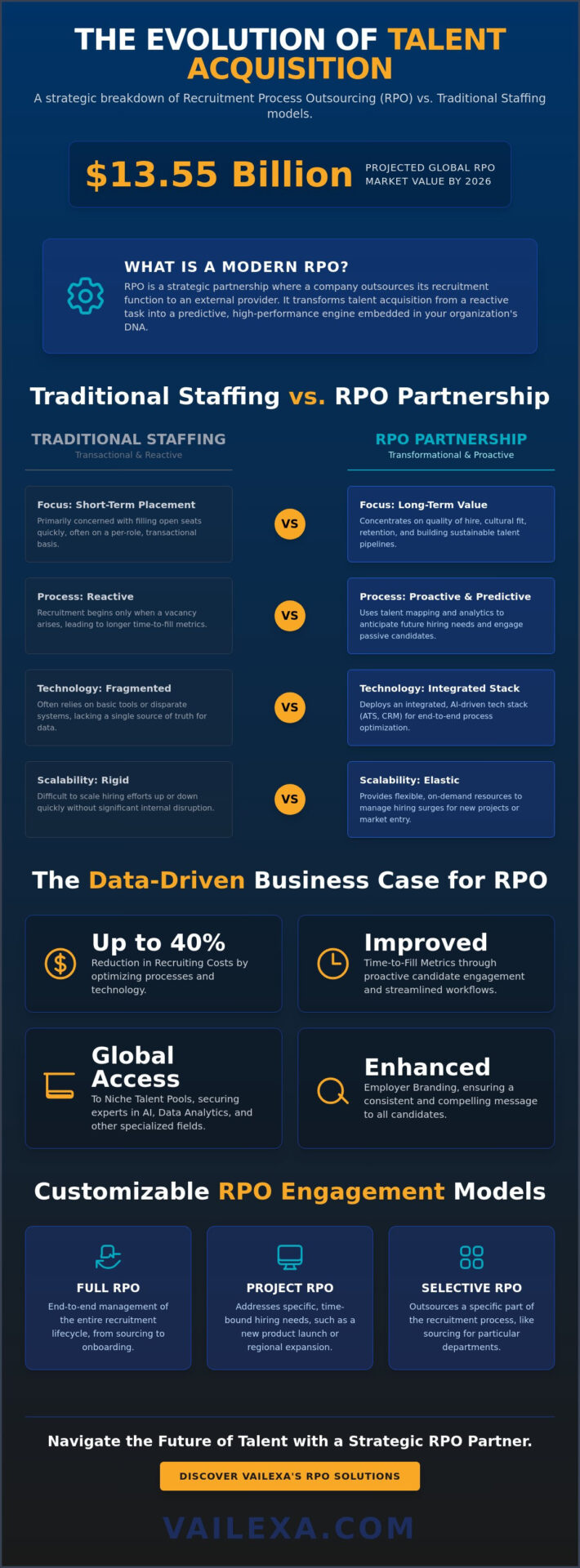
RPO vs. Traditional Staffing: A Strategic Comparison
Distinguishing between a staffing agency and a comprehensive talent partnership is often the difference between a temporary fix and a sustainable growth strategy. To understand what is RPO at its most fundamental level, one must recognize the shift from transactional hiring to transformational talent acquisition. Traditional staffing agencies typically operate on a contingent basis, focusing on filling individual vacancies through a volume-based approach. In contrast, an RPO provider takes full ownership of the recruitment lifecycle, ensuring that every hire is a calculated step toward organizational excellence.
While staffing agencies focus on the immediate delivery of a candidate, an RPO partnership focuses on the integrity of the process. This distinction is critical for maintaining a consistent employer brand and a high-quality candidate experience. When you choose an RPO model, the recruiters act as an extension of your internal team, often using your company’s email and branding to engage talent. This alignment ensures that the market perceives a unified, professional front, which is essential for attracting elite passive candidates who might otherwise overlook a third-party agency reach-out.
When to Choose RPO Over a Staffing Agency
The decision to pivot toward RPO often stems from a need for scalability and global consistency. If your organization is managing high-volume hiring surges or entering new international markets, the fragmented nature of traditional agencies can lead to inconsistent quality and rising overhead. A strategic partner allows you to integrate contingent staffing into a broader, more cohesive framework. This holistic view enables better workforce planning and ensures that your talent acquisition engine is prepared for rapid expansion without the friction of managing multiple vendor contracts.
The Financial Impact: Placement Fees vs. Management Fees
The economic logic of what is RPO becomes clear when analyzing the shift from reactive placement fees to predictable management fees. Traditional agencies often charge a percentage of a candidate’s salary, which can lead to volatile and often exorbitant costs during peak hiring periods. Research indicates that companies transitioning to an RPO model can reduce their recruiting costs by 30 to 40 percent compared to traditional staffing agencies. This financial efficiency is achieved through:
- Process streamlining that eliminates redundant administrative tasks.
- Improved retention rates that lower the long-term cost of turnover.
- Predictable monthly budgeting that replaces surprise invoices with a steady, manageable overhead.
By investing in the process rather than just the placement, organizations secure a higher return on investment and build a more resilient human capital infrastructure.
The Business Case for RPO: Why Modern Enterprises Switch
The decision to transition toward a managed recruitment model is rarely about cost alone; it’s about securing a future-proof talent pipeline. When a global enterprise evaluates what is RPO in the context of strategic ROI, they find a solution that mitigates the risk of internal team burnout and operational failure. By leveraging sophisticated data analytics and talent mapping, organizations gain a transparent view of the market landscape. This visibility allows them to identify and engage high-potential individuals before competitors even realize they’re available, turning recruitment into a proactive offensive strategy. For organizations ready to move beyond incremental improvements, adopting enterprise RPO solutions represents an architectural decision to build global talent density through precision and scale.
This strategic shift also empowers your employer brand. In a market where top-tier passive candidates are bombarded with generic offers, an RPO partner ensures your value proposition is communicated with precision and consistency. Beyond branding, these partnerships provide a critical layer of protection against compliance risks in diverse global hiring markets. They navigate complex labor laws with seasoned expertise, ensuring your expansion is both rapid and legally sound. This expertise also extends to social responsibility; partners provide diversity and inclusion consulting to ensure sourcing remains unbiased and representative of a global society.
Scalability: The RPO Secret Weapon
Agility defines the modern corporation. One of the most compelling reasons to adopt this model is the ability to flex recruitment capacity in real-time. Whether you’re facing a sudden hiring freeze or need to rapidly spin up teams for a new product launch, an RPO framework adjusts to your pace. It reduces the operational burden on internal HR departments, allowing them to focus on employee engagement and retention while the external team handles the high-volume heavy lifting. This elasticity ensures that your growth is never throttled by administrative limitations or fluctuating business demand.
Specialized Expertise in High-Growth Sectors
Internal recruitment teams often struggle to keep pace with the hyper-specialized requirements of the tech sector. Specialized RPO providers maintain deep, pre-vetted networks in AI, machine learning, and data analytics that generalist teams simply can’t replicate. Strategic partners such as Test Triangle bridge the tech skills gap through targeted sourcing and technical assessment in specialized IT domains. This level of precision is exactly why forward-thinking leaders partner with a Workforce Solutions Provider to secure the innovators who will define the next decade of business. By outsourcing these niche requirements, you ensure that your technical leadership is built on a foundation of excellence rather than just availability.
Navigating the Future: Vailexa’s Global RPO Solutions
Vailexa stands as more than a service provider; we are the Authoritative Strategic Guide for enterprises navigating the complexities of the 2026 labor market. Our Global Talent Solutions combine expansive reach with granular local expertise, ensuring that your expansion into new territories is seamless and culturally aligned. We don’t just fill positions. We build high-performance ecosystems that prioritize excellence, long-term stability, and the human element of business growth. When leaders ask what is RPO in the context of a true partnership, they find the answer in our commitment to acting as a practical, disciplined executor of their corporate vision.
We address the critical gaps in the current recruitment landscape by integrating AI Staffing Solutions and Data Analytics Staffing directly into our RPO framework. This level of technical precision is essential for organizations that cannot afford to lag in the race for digital dominance. Our custom frameworks are designed to source the visionaries who will architect your digital transformation, ensuring that your technical leadership is built on a foundation of verified expertise rather than mere availability. By synchronizing high-level strategy with granular data insights, we turn your talent acquisition into a formidable competitive advantage.
Building Your 2026 Workforce Strategy
A resilient organization requires depth at every level. By integrating a sophisticated executive search process with our RPO solutions, we ensure that your leadership pipeline is as robust as your frontline teams. We utilize advanced talent mapping to predict future skill requirements, allowing you to hire for the challenges of tomorrow rather than the needs of yesterday. Vailexa acts as the visionary architect of your growth, providing the Strategic Workforce Planning necessary to maintain momentum in a volatile global economy.
Next Steps: Partnering for Strategic Excellence
The journey toward a transformed recruitment model begins with a meticulous talent audit. Our initial discovery phase identifies hidden inefficiencies and establishes the benchmarks required for a successful transition. From there, we customize a scalable RPO model that aligns perfectly with your enterprise’s unique demands and diversity goals. It’s time to move beyond tactical hiring and embrace a model that empowers your entire organization. Transform Your Talent Strategy with Vailexa RPO and secure the experts who will drive your future success.
Empower Your Enterprise with Future-Ready Talent
The transition from fragmented, reactive hiring to a unified recruitment partnership is no longer a luxury for global organizations; it’s a strategic necessity. By now, the answer to what is RPO has evolved from a simple definition into a comprehensive blueprint for organizational resilience and scalability. We’ve explored how a managed model reduces operational friction, enhances employer branding, and leverages data to secure the specialized innovators your business requires to lead the market. This shift ensures your human capital remains an asset that grows in value over time.
Success in 2026 demands a partner that combines global reach with deep technical precision. As a premier workforce solutions provider, Vailexa offers the specialized expertise in AI and Data Analytics staffing needed to bridge the modern tech skills gap. We’re committed to acting as your strategic partner for D&I and workforce planning, ensuring your growth is both inclusive and sustainable. It’s time to stop reacting to the market and start defining it. Explore Vailexa’s Global RPO Solutions to begin your transformation. Your vision for excellence is within reach, and we’re ready to help you build the team that achieves it.
Frequently Asked Questions
What is the difference between RPO and traditional recruitment?
Recruitment Process Outsourcing is a strategic, long-term partnership where a provider takes full ownership of the recruitment lifecycle and its outcomes. Traditional recruitment is typically a tactical, contingent service focused on filling individual vacancies without integrating into the company’s internal technology or culture. While traditional agencies react to immediate needs, an RPO model builds a sustainable talent engine that scales with your business objectives.
How much does RPO typically cost for a global enterprise?
Pricing for global solutions depends on the hiring volume, the geographical complexity, and the level of technical specialization required. Most enterprises utilize a monthly management fee or a hybrid cost-per-hire model, which offers more predictable budgeting than volatile agency placement fees. This structure ensures that your talent acquisition costs remain aligned with your actual hiring demand and organizational growth.
Can RPO help with diversity and inclusion (D&I) hiring goals?
Yes, specialized providers integrate D&I consulting into the sourcing process to ensure unbiased candidate selection and measurable representation. By utilizing data-driven talent mapping and diverse sourcing channels, an RPO framework removes systemic barriers and broadens the talent pool. This approach allows organizations to meet their diversity objectives while maintaining a high standard of quality and organizational alignment.
What is the difference between RPO and RTO in a business context?
In the context of human capital, the answer to what is RPO refers to Recruitment Process Outsourcing, a strategy for managing talent acquisition. RTO stands for Recovery Time Objective, which is a critical metric in disaster recovery and IT business continuity. While both are essential for organizational resilience, they address entirely different aspects of corporate strategy and risk management.
Does RPO replace our internal HR department?
An RPO solution is designed to complement your internal HR team rather than replace it. It functions as a seamless extension of your department, handling the heavy lifting of sourcing, screening, and technology management. This partnership empowers your internal HR professionals to focus on high-impact areas like employee engagement, retention strategy, and internal cultural development.
How long does it take to implement an RPO solution?
Most implementations require a period of six to twelve weeks to ensure a smooth transition and full operational alignment. This timeframe includes a meticulous audit of your current processes, the integration of AI-driven ATS platforms, and the training of recruitment experts on your brand values. A structured rollout is essential for establishing the benchmarks needed to measure long-term success and ROI.
Is RPO suitable for small businesses or just large corporations?
While large enterprises often use full-scale models, smaller organizations benefit significantly from project-based or fractional RPO solutions. These flexible frameworks allow smaller businesses to access elite talent pools and sophisticated technology without the overhead of a massive internal team. Any organization experiencing rapid growth or a need for niche tech experts can utilize these strategic talent solutions.
What are the main benefits of using an RPO provider for AI staffing?
Specialized providers maintain deep, pre-vetted networks of machine learning and data analytics experts that are typically beyond the reach of generalist recruiters. This expertise ensures high search accuracy and faster time-to-fill for hyper-technical roles. By leveraging a provider’s technical sourcing infrastructure, organizations can bridge the tech skills gap and secure the specialized innovators who drive digital transformation.