
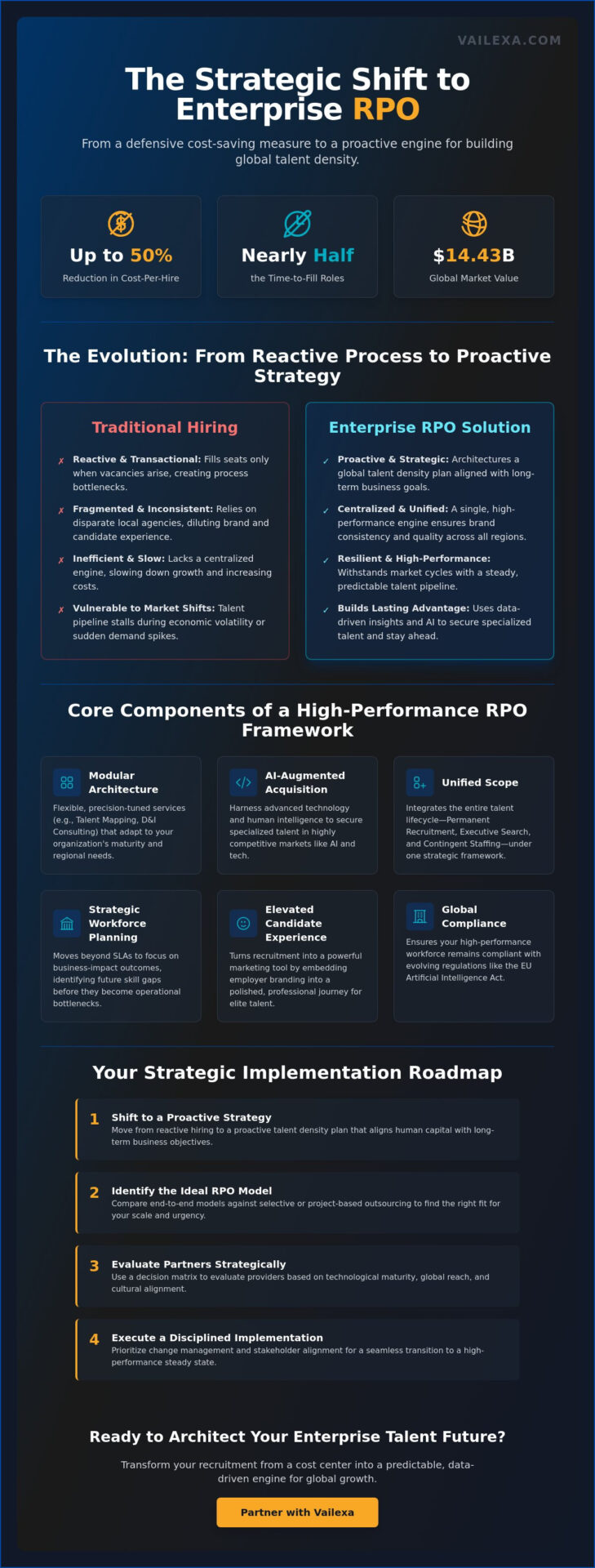
While many executives still view outsourcing as a defensive cost-saving measure, organizations partnering with a strategic provider can reduce their cost-per-hire by up to 50% while cutting time-to-fill by nearly half. In a global market currently valued at $14.43 billion, the shift toward enterprise RPO solutions represents much more than a simple operational upgrade. It is an architectural decision to build global talent density through precision and scale. You likely feel the mounting frustration of fragmented processes across regions and the exhausting hunt for specialized AI talent in a landscape where traditional methods no longer suffice.
We recognize that your ultimate goal is not just to fill seats but to engineer a high-performance workforce that remains compliant with evolving regulations like the EU Artificial Intelligence Act. This guide provides the strategic framework you need to evaluate, select, and implement a solution that transforms recruitment into a predictable, data-driven engine for growth. We will examine how to align global mobility with AI-augmented acquisition to secure a lasting competitive advantage and ensure your organization stays ahead of the curve.
Key Takeaways
- Move from reactive hiring to a proactive talent density strategy that aligns human capital with long-term business objectives.
- Identify the ideal configuration within enterprise RPO solutions by comparing end-to-end models against selective process outsourcing.
- Use a strategic decision matrix to evaluate potential partners based on technological maturity and regional reach.
- Execute a disciplined implementation roadmap that prioritizes change management for a seamless transition to a high-performance steady state.
- Harness AI-augmented recruitment methodologies to secure specialized talent in an increasingly competitive market.
The Evolution of Enterprise RPO Solutions: From Process to Strategy
The landscape of global recruitment has undergone a fundamental transformation. Historically, businesses treated hiring as a reactive, transactional necessity; a series of isolated events triggered by a vacancy. Modern leaders now recognize that this fragmented approach creates systemic inefficiencies that slow down growth and dilute brand consistency. Today, enterprise RPO solutions represent a paradigm shift from simple process outsourcing to the architectural design of global talent density. This isn’t a short-term fix. It is a multi-year commitment to excellence that replaces the chaos of local agency clusters with a single, high-performance recruitment engine.
By centralizing the acquisition process, organizations gain the resilience needed to withstand volatile market cycles. While traditional agencies often struggle during economic shifts, a strategic partner maintains a steady pipeline. This ensures that the talent engine doesn’t stall when demand spikes or markets shift unexpectedly. Moving away from localized, fragmented providers allows for a unified strategy that empowers the brand across every region it operates in.
Defining the Enterprise Scope
True enterprise-wide solutions differ significantly from project-based initiatives. While a project might focus on a specific hiring surge, a full-scale enterprise model integrates the entire recruitment lifecycle across all business units. This comprehensive scope typically includes Permanent Recruitment, Executive Search, and Contingent Staffing under one unified banner. For multinational brands, establishing a global recruitment architecture is essential. It ensures that whether you’re hiring in New York, London, or Singapore, the quality of talent and the candidate experience remain consistently superior.
The Shift to Strategic Partnership
The value of a partner is no longer measured solely by Service Level Agreements (SLAs) or basic metrics like time-to-fill. Instead, the focus has shifted toward transformative business-impact outcomes. To truly understand what is RPO in the current market, one must look at it as a strategic consulting function.
Modern Recruitment Process Outsourcing (RPO) providers now embed themselves into the client’s long-term vision. They provide sophisticated Strategic Workforce Planning and Talent Mapping to identify future skills gaps before they become operational bottlenecks. This proactive stance allows enterprises to build deep talent pools rather than simply reacting to departures. It is a transition from being a service consumer to working with a visionary architect who designs the very foundation of your organizational growth. By leveraging enterprise RPO solutions, you align your human capital strategy with your most ambitious commercial goals.
Core Components of a High-Performance RPO Framework
Building a resilient recruitment engine isn’t just about adding headcount. It demands a modular architecture where services are precision-tuned to your organizational maturity. While basic business process outsourcing (BPO) often focuses on repetitive, administrative tasks, high-performance enterprise RPO solutions provide a sophisticated integration of human intelligence and advanced technology. This framework allows leaders to toggle specific services, such as talent mapping or D&I consulting, depending on the immediate needs of different global regions. It’s about creating a flexible system that grows alongside your enterprise.
A truly strategic framework prioritizes the candidate experience as a core business driver. Every interaction reflects your employer brand, turning the recruitment process into a powerful marketing tool. By embedding branding experts within the RPO team, enterprises ensure that their value proposition remains consistent across every continent. This alignment is vital for securing elite talent who expect a polished, professional journey from the first click to the final onboarding step. When your recruitment process mirrors your corporate excellence, you don’t just find candidates; you attract advocates.
End-to-End vs. Project-Based Models
Selecting the right model is a balance of scale and urgency. End-to-end RPO provides a holistic, long-term solution that manages every facet of the talent lifecycle. This model offers the most significant financial advantages. Consolidating global recruitment under one provider reduces the overhead of managing multiple vendor contracts and eliminates the hidden costs of fragmented processes. Conversely, project-based RPO is ideal for specific hiring surges or entering new market territories. When moving toward a hybrid model, successful enterprises focus on clear change management to help internal HR teams see the workforce solutions provider as an empowering partner rather than a replacement.
AI Staffing and Technology Integration
Technology doesn’t just automate tasks; it serves as the foundation of modern talent acquisition. By leveraging AI staffing solutions, organizations can surface high-potential candidates who might otherwise remain invisible in traditional databases. These tools go beyond simple keyword matching. They use behavioral signals to identify passive talent with specialized tech expertise. These systems also improve recruitment efficiency by applying predictive analytics to historical hiring data. This foresight allows you to anticipate talent shortages before they impact your bottom line. Maintaining rigorous data security is essential, ensuring that global candidate information remains protected while providing the transparency needed for executive-level decision-making.
Evaluating Enterprise RPO Providers: A Strategic Decision Matrix
Selecting a partner for global talent acquisition is a high-stakes architectural decision. It requires moving beyond surface-level metrics to evaluate how a provider integrates with your long-term vision. High-performance enterprise RPO solutions are built on three pillars: geographic reach, industry-specific expertise, and technological maturity. A provider might claim global capabilities, but you must verify their ability to execute in high-growth sectors where specialized executive search and niche tech roles are the primary drivers of value. If a partner cannot navigate the nuances of your specific industry, they’ll struggle to identify the talent density required for your success. A rigorous approach to evaluating RPO providers ensures you move beyond surface-level claims to identify a partner capable of architecting true talent density in today’s complex market.
Cultural alignment is often the invisible differentiator between a failed engagement and a transformative partnership. Your RPO provider acts as an extension of your brand. They must mirror your standards of excellence and communicate your value proposition with the same authority as your internal leadership. Transparency in pricing is equally vital. You should demand a clear breakdown between monthly management fees and placement costs. This clarity ensures that incentives are aligned toward long-term talent health rather than just short-term volume.
Global Scalability and Compliance
True global scalability isn’t just about having a logo in multiple countries. It’s about the sophisticated management of compliant offshore RPO programs that adhere to local labor laws and rigorous data privacy regulations. Whether it’s navigating GDPR in Europe or CCPA in the United States, your partner must possess the legal infrastructure to protect your organization. A physical presence in key global talent hubs provides the local market intelligence necessary to outpace competitors. This boots-on-the-ground approach ensures that your recruitment strategy remains sensitive to regional cultural shifts and regulatory updates.
Data Integrity and ROI Metrics
Success in modern recruitment is defined by data-driven insights. You must move past vanity metrics and focus on the KPIs that impact the bottom line: quality of hire, long-term retention rates, and the depth of your talent pipeline. Advanced providers use strategic talent mapping to benchmark your internal workforce against the broader market, identifying exactly where your competitive advantages lie. Before signing a contract, audit the provider’s technology stack for AI readiness. Ensure their tools don’t just automate processes but actually provide the predictive analytics needed to anticipate future workforce needs. This level of scrutiny transforms recruitment from an administrative expense into a measurable engine of ROI.
Implementation Strategies for Global Workforce Transformation
Transitioning to enterprise RPO solutions requires a disciplined roadmap that bridges the gap between current operational hurdles and a future state of talent density. This journey begins with a rigorous discovery phase, where your current recruitment architecture is audited for inefficiencies and hidden costs. Following this, the design phase crafts a customized framework that aligns with your specific growth targets. The actual implementation involves a phased rollout, often starting with a pilot region to refine processes before scaling to a global steady-state. This methodical approach ensures that the transition is seamless and that the recruitment engine remains operational throughout the migration.
Establishing a robust governance model is essential for maintaining long-term performance. This model provides a structured environment for ongoing performance management, using real-time data to audit sourcing and engagement tactics. Continuous improvement isn’t just a buzzword; it’s a data-driven discipline. By leveraging advanced analytics, your partner can identify which channels yield the highest quality of hire and adjust strategies accordingly. This level of oversight ensures that the partnership evolves alongside your business, constantly refining its methods to secure a competitive advantage in a shifting market.
Change Management and Stakeholder Alignment
Success demands buy-in. Internal resistance often stems from a lack of clarity regarding how the RPO partner will interact with existing teams. You must secure active support from both hiring managers and executive leadership by demonstrating how the partnership alleviates their specific pains, such as slow time-to-fill or high cost-per-hire. Training internal HR teams to collaborate with the provider effectively transforms the relationship from a perceived threat into an empowering alliance. Maintaining employer brand consistency is paramount during this phase; every communication should reinforce your corporate values and vision to ensure the transition feels like a natural evolution of the brand.
Integrating D&I into the RPO Lifecycle
Modern recruitment must be both efficient and equitable. Strategic diversity and inclusion consulting informs every stage of the sourcing strategy, ensuring that talent pools are broad and representative. This involves implementing unbiased screening processes and diverse interview panels to mitigate unconscious bias. Compliance also plays a critical role. For example, as of January 2026, the new Philadelphia Criminal History Ordinance limits lookback windows for misdemeanor convictions to four years. Your RPO partner must integrate these regional legal requirements into their screening protocols to protect your organization. Measuring the long-term impact of these initiatives reveals a direct link between workforce diversity and organizational innovation, proving that inclusion is a strategic imperative rather than a mere checkbox.
Architecture matters. Explore how we can design your global workforce transformation and secure your organization’s future.
Vailexa: Architecting Your Enterprise Talent Future
At the intersection of visionary strategy and disciplined execution lies Vailexa. We don’t view recruitment as a back-office function; we see it as the most critical architectural component of your corporate growth. Our enterprise RPO solutions are designed for organizations that refuse to settle for the status quo. By partnering with us, you gain more than a service provider. You secure a guardian of your organizational standards and a catalyst for global excellence. We specialize in transforming fragmented processes into a cohesive, high-performance engine that drives talent density across every continent you inhabit.
Our methodology has been refined through years of partnership with Fortune 500 leaders who require more than just “seat-filling.” We provide a holistic suite of services, from Strategic Workforce Planning to Executive Search, ensuring that your leadership pipeline is as robust as your frontline teams. This comprehensive approach allows us to stabilize your hiring even during volatile market cycles. We don’t just react to your needs. We anticipate them, building a predictable and scalable recruitment engine that serves as a foundation for your long-term stability.
The Vailexa Difference: AI-Augmented Recruitment
We find the talent that others miss. By leveraging sophisticated AI Staffing Solutions and Data Analytics Staffing, we surface high-potential candidates through predictive modeling and behavioral signals. This technology allows us to identify specialized expertise in AI and ML sectors before those candidates even enter the active market. Our process doesn’t replace human intuition; it empowers it. We combine these advanced data insights with a meticulous eye for cultural alignment, ensuring that every hire contributes to your organizational innovation and long-term retention goals.
Global Reach with Localized Expertise
Navigating the complexities of international labor markets requires a partner who understands both the broad vision and the granular detail. Vailexa manages the delicate balance of Permanent Recruitment and contingent staffing across borders, providing you with a single, authoritative point of contact for all global talent needs. This centralization eliminates the friction of managing multiple regional vendors and ensures that your employer brand remains consistent worldwide. Whether you’re scaling a tech hub in Europe or expanding operations in North America, our Global Talent Solutions provide the compliance, speed, and quality you demand.
The future of your organization depends on the talent you secure today. Don’t leave your talent architecture to chance. Contact us for a strategic consultation to design your enterprise RPO roadmap and begin architecting a workforce that defines the next decade of your industry.
Secure Your Global Competitive Advantage through Strategic Talent Architecture
The transition from reactive hiring to a sophisticated talent architecture is no longer a choice; it’s a strategic necessity. By adopting high-performance frameworks and a disciplined selection matrix, you’ve learned how to replace fragmented processes with a unified global engine. High-impact enterprise RPO solutions provide the structural integrity required to secure specialized talent while maintaining rigorous compliance across diverse regions. It’s about moving beyond simple headcount to achieve true talent density that fuels innovation.
Vailexa empowers this transformation through a unique blend of human intelligence and advanced technology. Our footprint across 50+ global markets and specialized expertise in AI and Data Analytics staffing ensure you remain ahead of the curve. We don’t just fill roles; we integrate strategic D&I consulting into every placement to build resilient, diverse teams. The architecture you design today will define your competitive advantage for the next decade.
Consult with our RPO architects to design your global talent strategy.
Your path to global recruitment excellence starts with a single, decisive step toward a smarter, more scalable workforce.
Frequently Asked Questions
What is the difference between standard RPO and enterprise RPO solutions?
Standard RPO typically focuses on specific projects or departmental surges; however, enterprise RPO solutions represent a holistic, multi-year strategic partnership. These solutions integrate with the entire recruitment lifecycle across all business units, encompassing permanent recruitment and contingent labor globally. It’s the difference between reactive seat-filling and architecting a unified talent engine that drives long-term organizational growth and stability across your entire company footprint.
How does an enterprise RPO partner help with global compliance?
A strategic partner manages the complexities of international labor laws and data privacy regulations, such as GDPR and the EU Artificial Intelligence Act. By August 2026, organizations using AI in hiring must comply with strict standards for transparency and fairness. A high-level provider ensures your recruitment architecture remains compliant in every jurisdiction, protecting your brand from legal risks while maintaining high standards for diversity and inclusion.
Can an RPO provider help with executive search and C-suite recruitment?
Yes, comprehensive enterprise models often integrate Executive Search to secure C-suite and senior leadership talent. This unified approach ensures that your high-level leadership strategy aligns perfectly with your broader workforce planning. By using the same partner for executive and specialized roles, you maintain consistent employer branding and cultural alignment across every tier of the organization, from specialized tech leads to the boardroom.
What are the typical cost savings associated with enterprise RPO?
Organizations that partner with a strategic provider can see a reduction in their cost-per-hire of 30% to 50%. These savings result from consolidating fragmented vendor contracts and eliminating the systemic inefficiencies of localized recruitment. Beyond direct costs, the reduction in time-to-fill by 40% to 55% ensures that critical roles are filled faster, minimizing the lost productivity associated with vacant specialized positions in high-growth sectors.
How long does it take to implement a global enterprise RPO solution?
A successful implementation follows a structured roadmap from discovery to steady-state, which can take several months depending on global scale. The process begins with a rigorous audit of your current recruitment architecture, followed by a phased rollout often starting with a pilot region. This methodical approach ensures the transition is seamless, allowing for process refinement before scaling the solution across your entire global footprint to ensure consistent quality.
How does AI staffing integrate into a traditional RPO model?
AI staffing solutions transform traditional models by utilizing predictive analytics and advanced matching algorithms to identify high-potential talent. These tools go beyond simple database searches; they surface passive candidates with specialized skills who might otherwise remain invisible. This technological integration empowers recruiters with data-driven insights, allowing them to anticipate hiring needs and build deep talent pipelines before a vacancy even occurs, creating a more proactive recruitment environment.
What metrics should I use to evaluate the success of an RPO engagement?
You should evaluate success using high-impact KPIs such as quality of hire, long-term retention rates, and the depth of your talent pipeline. While time-to-fill and cost-per-hire are foundational, the true value of enterprise RPO solutions lies in their ability to drive strategic outcomes. Metrics related to diversity and inclusion and the efficiency of AI-augmented sourcing also provide critical insights into the health and resilience of your recruitment engine.
Is it possible to maintain my employer brand while using an RPO provider?
Maintaining your employer brand is a core objective of a strategic RPO partnership. The provider acts as an authoritative extension of your brand, mirroring your values and standards of excellence in every candidate interaction. By embedding branding experts within the recruitment team, the partnership ensures that your value proposition remains consistent across all global markets, turning the candidate journey into a powerful marketing tool that attracts elite talent.