
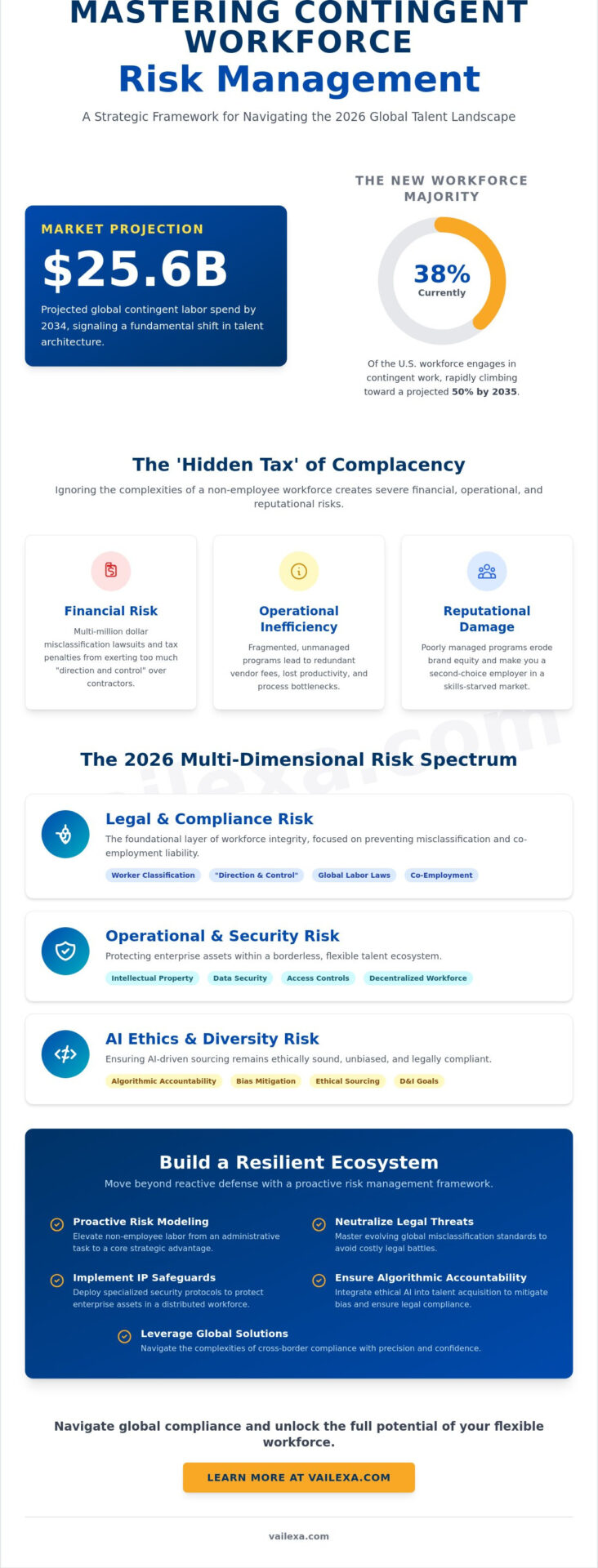
Global contingent labor spend is projected to reach $25.6 billion by 2034, signaling a fundamental shift in how modern enterprises architect their talent pools. This rapid expansion has transformed the non-employee workforce from a peripheral resource into a primary operational engine, but it has also invited unprecedented scrutiny from global regulators. You likely recognize that managing a decentralized workforce across multiple jurisdictions has become a complex legal minefield, where a single misstep in classification can lead to multi-million dollar liabilities. The fear of misclassification lawsuits and a lack of visibility into third-party supplier practices are valid concerns for any forward-thinking executive.
This guide provides a sophisticated, data-driven framework for mastering contingent workforce risk management in the 2026 landscape. We’ll help you navigate the complexities of global labor laws while delivering a bulletproof compliance checklist designed to reduce co-employment liability. From neutralizing operational security threats to integrating ethical AI into your sourcing process, we preview a strategic roadmap that aligns your flexible talent with corporate excellence. Let’s move beyond reactive defense and build a resilient, high-performance ecosystem that thrives under global scrutiny.
Key Takeaways
- Orchestrate a proactive risk management model that elevates non-employee labor from a reactive administrative task to a core strategic advantage.
- Neutralize legal and operational threats by mastering the systematic process of contingent workforce risk management, specifically regarding evolving global misclassification standards.
- Implement specialized security protocols and intellectual property safeguards designed to protect enterprise assets within a borderless, flexible talent ecosystem.
- Integrate “Algorithmic Accountability” into your talent acquisition strategy to mitigate bias and ensure AI-driven sourcing remains ethically and legally sound.
- Leverage global talent solutions and strategic workforce planning to navigate the complexities of cross-border compliance with precision and confidence.
The Modern Landscape of Contingent Workforce Risk Management
The workforce of 2026 has undergone a fundamental transformation. What was once supplemental talent has matured into a primary driver of enterprise scalability. Recent data indicates that approximately 38% of the U.S. workforce now engages in contingent work. This figure is rapidly climbing toward the 50% mark predicted for 2035. This scale means that “contingent” is no longer an outlier; it’s core. Consequently, the traditional, reactive approach to compliance is insufficient. Organizations must transition toward a model of proactive contingent workforce risk management to maintain their competitive edge.
Modern enterprises recognize that mastering global agility requires a robust risk framework that moves beyond simple box-ticking. Effective contingent workforce risk management isn’t a defensive posture. It’s a strategic enabler that allows leaders to deploy talent across borders with speed and precision. In a climate of radical transparency, the stakes of mismanagement extend far beyond the balance sheet. A single misstep in worker classification or data security can erode years of brand equity and alienate the very talent you seek to attract.
Defining the 2026 Risk Spectrum
The spectrum of risk is multi-dimensional. It starts with legal and regulatory compliance, which serves as the foundation of workforce integrity. With the U.S. Department of Labor’s February 2026 rule focusing on economic dependence, the criteria for worker classification have become more nuanced. Beyond the law, operational and security risks loom large. Protecting intellectual property and sensitive data is paramount when your workforce is decentralized and flexible. Finally, strategic and reputational risks require that external talent aligns perfectly with your corporate D&I goals and brand values.
The Cost of Complacency
Ignoring the complexities of a non-employee workforce creates a “Hidden Tax” of fragmented, unmanaged programs. This inefficiency often manifests as redundant vendor fees and lost productivity. More critically, the legal consequences are severe. Governments globally are tightening labor laws. The risk of multi-million dollar misclassification judgments is a reality for firms that fail to audit their practices. Poorly managed programs also damage the employer brand. High-caliber contractors prioritize organizations that offer clear structures and fair treatment. Failing to provide this makes you a second-choice employer in a skills-starved market.
Legal and Compliance Risk: The Foundation of Workforce Integrity
Effective contingent workforce risk management is the systematic process of identifying and neutralizing legal and operational threats associated with non-permanent labor. It’s more than a checkbox exercise; it’s a rigorous methodology designed to safeguard your organization’s financial and structural health. At its core, this discipline focuses on the “Direction and Control” boundary. When an enterprise exerts too much influence over how, when, or where a contractor performs their tasks, the line between an independent partner and a traditional employee blurs. This ambiguity is the primary catalyst for co-employment lawsuits and tax penalties that can reach into the millions.
The regulatory environment of 2026 has become significantly more precise. While the general shift toward economic dependence is clear, the practical application of the “ABC Test” and evolving misclassification standards requires granular attention. According to a U.S. GAO report on contingent workers, job instability and workplace safety remain central concerns for regulators, driving the push for stricter classification. Organizations must understand how contingent staffing works at scale to ensure that every engagement remains compliant with these evolving benchmarks.
Navigating Global Regulatory Jurisdictions
Managing a borderless workforce requires localized expertise. In the U.S., the distinction between 1099 and W-2 workers is under intense scrutiny, particularly with the Labor Commissioner’s enhanced enforcement mechanisms effective as of January 1, 2026. Across the Atlantic, the UK’s IR35 rules continue to set a precedent for off-payroll working, while the EU Platform Work Directive influences broader labor strategies by introducing a presumption of employment for digital platform workers. If your expansion plans include these regions, partnering with a provider of Global Talent Solutions can help you navigate these nuances without compromising your speed to market.
The Compliance Audit Checklist
To maintain a bulletproof program, your contingent workforce risk management strategy should include a recurring audit cadence. Use this checklist to verify your current standing:
- SOW Precision: Ensure all contract templates utilize a clear Statement of Work (SOW) that defines deliverables rather than hours worked.
- Automated Screening: Implement protocols for right-to-work and background checks that trigger automatically during onboarding.
- Classification Audits: Establish a quarterly global cadence to review worker status against the latest local labor laws.
- AI Disclosure: In jurisdictions like Connecticut and Illinois, ensure you provide required notices regarding the use of AI in employment decisions as per 2026 legislation.
The Enterprise Checklist for Operational and Security Risks
Security protocols for external talent shouldn’t be an afterthought. When evaluating the operational needs of contingent vs permanent staff, leaders often discover that while the contract structure varies, the depth of system access is nearly identical. This parity necessitates a sophisticated approach to contingent workforce risk management that prioritizes data integrity and intellectual property (IP) protection. In a world of borderless talent, your digital assets are only as secure as the weakest link in your supply chain. You must treat contractor security with the same rigor as your internal staff, even if the technical delivery differs.
Shadow spend isn’t just a budgetary leak. It’s a security breach. When hiring managers bypass established procurement channels to acquire talent, they create a massive blind spot in your risk strategy. These unvetted workers operate without the oversight of your security or legal teams, creating a gateway for data breaches or compliance failures. Eliminating this risk requires a unified workforce ecosystem where every engagement is tracked, vetted, and secured according to enterprise standards. Vigilance here prevents the “Hidden Tax” of fragmented programs mentioned earlier from evolving into a full-scale security crisis.
Technical Safeguards and IP Protection
Maintaining control over your digital perimeter involves three critical pillars. First, standardize IP assignment clauses across all non-employee contracts to ensure ownership remains with the enterprise from day one. Second, implement automated offboarding protocols. A digital “Kill Switch” should trigger the moment a contract ends, instantly revoking system access to prevent lingering vulnerabilities. Finally, enforce strict device management and secure remote access protocols. Every contractor environment must meet your internal security benchmarks before they touch sensitive data or proprietary code.
Supplier and Vendor Risk Management
A fragmented supply chain is a risky supply chain. Consolidating your vendor list allows for deeper oversight and higher-quality partnerships. We recommend a “Vendor-of-Record” model to gain visibility into Tier 2 and Tier 3 suppliers, ensuring that every layer of your workforce adheres to your specific standards. Regular financial stability audits of your staffing partners are also essential. These audits protect you from sudden service disruptions that could stall critical projects or leave you with unexpected liability. By streamlining your partnerships, you reduce the surface area for operational risk while increasing the precision of your talent delivery.
Navigating the New Frontier: AI Ethics and Diversity Risk
As of early 2026, 84% of hiring processes leverage artificial intelligence. This rapid adoption has introduced a sophisticated layer to contingent workforce risk management: algorithmic accountability. It’s no longer enough to vet the human recruiter; you must now vet the code. When algorithms drive your talent sourcing, any inherent bias in the training data becomes a systemic legal liability. Organizations that fail to audit these automated tools risk violating new transparency mandates, such as Illinois HB 3773, which prohibits discriminatory AI use in employment decisions effective January 1, 2026. Precision in AI governance is now a prerequisite for ethical scaling.
Modern enterprises must ensure their external workforce reflects their broader Environmental, Social, and Governance (ESG) commitments. This requires a seamless integration of diversity and inclusion consulting into the entire contingent lifecycle. A robust risk framework acknowledges that a “Two-Tiered Culture,” where contractors are treated as second-class citizens, creates significant reputational damage. Aligning your non-employee population with your corporate values isn’t just about ethics. It’s about protecting your employer brand in a global market that demands radical transparency and social responsibility.
AI Staffing and Data Privacy Risks
Vetting your technology partners is critical to neutralizing “Black Box” risks. You must confirm that your providers comply with the EU AI Act and regional U.S. frameworks like Connecticut SB 5. These laws require clear disclosures when automated systems influence employment outcomes. Data privacy is equally paramount; ensure that contractor data processed by AI remains secure and doesn’t leak into public LLMs. To stay ahead of these complexities, consider partnering with a provider that offers specialized AI Staffing Solutions to ensure your technology stack is both innovative and compliant.
The D&I Risk Management Framework
Building a diverse contingent pool requires intentionality and data-driven insights. Start by tracking diversity metrics within your external population without infringing on individual privacy rights. Use inclusive sourcing strategies to reduce the risk of “Homogeneous Talent Pools” that can result from narrow AI screening parameters. Finally, strive for parity in treatment. Ensuring that your contingent workers feel integrated and valued reduces the risk of legal friction and enhances the quality of your talent pipeline. By treating D&I as a risk management pillar, you build a more resilient and representative organization.
Scaling Safely with Strategic Global Workforce Solutions
Scaling a global enterprise in 2026 requires more than just access to a vast talent pool. It demands a foundation built on regulatory precision. As you expand into new markets, the complexity of managing non-permanent labor increases exponentially. Leading organizations recognize that contingent workforce solutions must be architected with compliance as the primary pillar. This approach allows you to move from a mindset of risk avoidance to one of risk optimization. When your legal and operational safeguards are bulletproof, you can deploy talent with a speed that competitors, burdened by compliance fears, simply cannot match.
A Global Employer of Record (EOR) serves as a vital strategic tool in this landscape. By assuming the legal responsibilities of employment, an EOR neutralizes cross-border risks associated with local labor laws, tax withholding, and benefits administration. This partnership ensures that your organization remains agile without the administrative weight of establishing multiple legal entities. Vailexa’s methodology takes this further by merging AI-driven precision with human-centric governance. We don’t just fill roles; we build a resilient framework that protects your enterprise while empowering your workforce to achieve excellence.
Choosing a Risk-Averse Sourcing Partner
Selecting a partner is a high-stakes decision that influences your entire organizational integrity. Evaluate potential partners based on their global regulatory footprint and their ability to provide localized expertise in real-time. Vailexa’s specialized AI and data analytics staffing reduces technical risk by ensuring that the talent you engage is vetted through rigorous, bias-free protocols. Our “Total Talent” philosophy advocates for a unified approach to contingent workforce risk management. By treating every hire as a strategic asset, we ensure that your compliance standards remain consistent across all departments and jurisdictions, regardless of the worker’s contract type.
Final Strategic Recommendations
Success in the modern talent landscape requires centralized oversight and constant evolution. We recommend the following steps to solidify your program and maintain your competitive advantage:
- Centralize Governance: Place your contingent labor oversight under a single strategic lead to eliminate shadow spend and visibility gaps.
- Adopt a Living Manual: Create a compliance framework that evolves alongside global legislation, such as the EU Pay Transparency Directive or the latest U.S. Department of Labor rules.
- Audit Regularly: Don’t wait for a legal challenge to discover a flaw in your classification or data protocols.
The transition from reactive protection to proactive excellence is a journey that requires an expert partner. Consult with Vailexa to audit your contingent workforce risk today. Together, we’ll build a workforce strategy that is as secure as it is ambitious.
Architecting a Resilient Talent Ecosystem
The 2026 workforce landscape demands a departure from static compliance models toward a dynamic orchestration of talent. By mastering contingent workforce risk management, your organization transitions from a defensive posture to a state of strategic agility. You’ve established that neutralizing misclassification threats and securing intellectual property are the non-negotiable foundations of a high-performance ecosystem. Integrating AI ethics and diversity goals ensures your external workforce reflects the highest standards of corporate integrity. This isn’t just about protection; it’s about building a scalable engine for growth.
Vailexa stands as your authoritative partner in this transformation. With a global footprint spanning 50+ markets and a proprietary AI staffing risk-mitigation model, we provide the precision required to navigate today’s complexities. Our strategic D&I integration ensures your contingent labor program is both representative and compliant. Secure Your Global Talent Strategy with Vailexa and unlock the full potential of your borderless workforce. Your journey toward operational excellence starts with a single, decisive step toward a more secure future.
Frequently Asked Questions
What is the biggest risk in a contingent workforce program?
The primary risk is worker misclassification, which leads to severe legal and financial repercussions. Under the U.S. Department of Labor’s February 2026 rule, regulators look beyond contract language to evaluate the actual economic dependence of a worker. Misjudging this relationship exposes your firm to multi-million dollar lawsuits, unpaid overtime claims, and back taxes. Maintaining a rigorous audit cadence is the only way to safeguard your organization against these evolving regulatory standards.
How does co-employment liability affect global enterprises?
Co-employment liability occurs when a court determines that a client company and a staffing provider share the legal responsibilities of an employer. This determination can force global enterprises to provide retroactive benefits, healthcare, and pension contributions to non-employee staff. To mitigate this, you must maintain a clear “Direction and Control” boundary, ensuring your managers don’t treat contractors as internal employees in their day to day operations.
What is the difference between an IC and an employee in 2026?
In 2026, the distinction hinges on the worker’s economic dependence on the employer. An employee is usually integrated into the core business and subject to direct supervision. An independent contractor operates as a separate business entity, providing specialized services through their own equipment and methods. They bear the risk of profit or loss, whereas employees receive a steady wage and typically rely on the employer for their primary income.
Can a VMS solve all contingent workforce compliance issues?
A VMS is a powerful tool for visibility, but it isn’t a standalone compliance solution. While these systems automate onboarding and spend tracking, they lack the legal nuance required for a comprehensive contingent workforce risk management strategy. You still need expert human governance to interpret shifting global labor laws and ensure that your automated workflows align with the latest jurisdictional requirements in the U.S., UK, and EU.
How do I manage IP theft risk with remote contingent workers?
Protecting your intellectual property requires a combination of contractual safeguards and technical barriers. You should enforce standardized IP assignment clauses in every non-employee contract and utilize secure remote access protocols. Implementing an automated “Kill Switch” for system access is also critical. This ensures that a contractor’s ability to view or download sensitive data is revoked the moment their engagement ends, preventing any lingering security vulnerabilities.
What are the penalties for misclassifying workers in the UK and US?
Penalties are substantial and vary by region. In the U.S., misclassification can result in massive fines, back taxes, and unpaid wage judgments, with enhanced enforcement active as of January 1, 2026. In the UK, failing to comply with IR35 rules makes the end-client liable for unpaid Income Tax and National Insurance contributions. These financial hits are often compounded by reputational damage that can alienate future talent and investors.
How does AI impact contingent workforce risk management?
AI adds a new dimension of risk through algorithmic bias and data privacy concerns. If your automated sourcing tools inadvertently discriminate against protected groups, your organization is legally liable under frameworks like the EU AI Act or Illinois HB 3773. Incorporating “Algorithmic Accountability” into your contingent workforce risk management plan is essential. You must regularly audit your AI staffing solutions to ensure they remain transparent, ethical, and fully compliant with regional transparency laws.
What role does an MSP play in mitigating staffing risks?
An MSP serves as the strategic architect of your contingent program, centralizing vendor oversight to eliminate fragmented hiring practices. They enforce standardized compliance protocols across your entire supply chain, reducing the risk of “Shadow Spend” and unvetted rogue hiring. By consolidating your vendor management under an MSP, you gain a unified view of your workforce risk, allowing for more precise talent mapping and long term stability.