
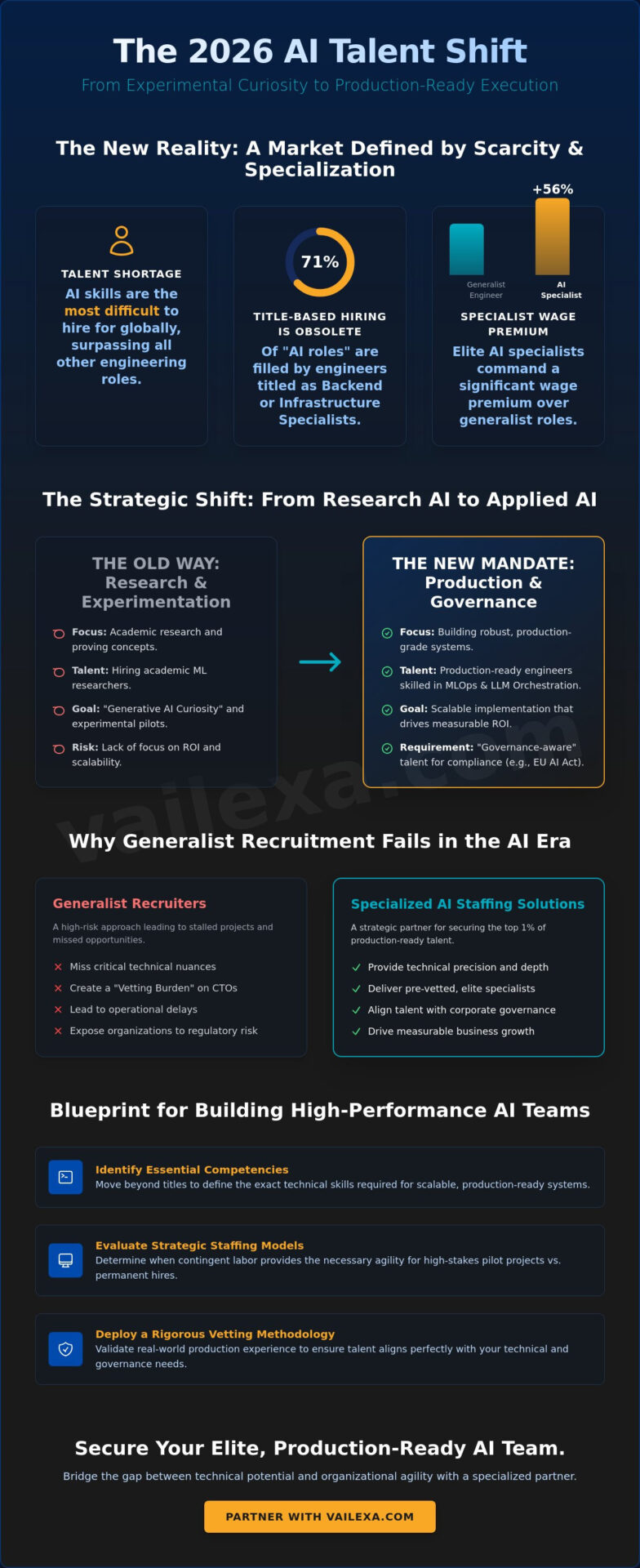
In 2026, the traditional search for “AI engineers” has become a strategic liability. With 71% of AI roles actually being filled by engineers currently titled as backend or infrastructure specialists, title-based hiring is officially obsolete. You’re likely feeling the pressure of a global talent shortage where AI skills are now the most difficult to hire for worldwide, surpassing all other engineering roles for the first time. To bridge this gap, enterprises must adopt sophisticated AI staffing solutions that prioritize technical precision over simple job titles. Generalist recruiters often miss the technical nuances required for production-ready systems, leaving your organization exposed to both operational delays and new regulatory risks like the EU AI Act.
Securing elite talent requires a partner that understands why a specialist can command a 56% wage premium in the current market. We recognize that aligning high-cost talent with complex state-level regulations in Colorado or California is a significant challenge for any executive team. This article provides a comprehensive blueprint for building high-performance, production-ready teams. We’ll examine how to select the right staffing models, access pre-vetted specialists, and ensure your new hires drive measurable business growth through strategic workforce planning and precise talent mapping.
Key Takeaways
- Identify the essential competencies required for production-ready teams, moving beyond experimental “Generative AI curiosity” toward scalable implementation.
- Evaluate the strategic advantages of different AI staffing solutions to determine when contingent labor provides the agility premium necessary for high-stakes pilot projects.
- Deploy a rigorous vetting methodology that validates real-world production experience and ensures technical talent aligns perfectly with your existing corporate governance.
- Leverage advanced talent mapping to identify elite specialists who can navigate the complexities of modern regulatory frameworks while driving measurable business growth.
- Build a sustainable workforce roadmap by integrating global talent solutions that bridge the gap between technical potential and organizational agility.
The 2026 AI Talent Landscape: Navigating Scarcity and Evolution
The year 2026 marks a definitive end to the era of AI experimentation. Global enterprises have moved past “Generative AI curiosity,” shifting their focus toward robust, production-grade implementation that delivers measurable shareholder value. In this environment, AI staffing solutions serve as the essential strategic bridge between raw technical potential and realized business outcomes. It’s no longer enough to hire for general technical ability. The market now demands Applied AI Engineering, a discipline where technical mastery meets operational discipline to drive corporate ROI. Recent data indicates that 84% of hiring processes now utilize AI in the hiring process, yet the human element of strategic alignment remains the true differentiator for high-growth firms.
Strategic leaders recognize that generic approaches yield generic results. By contrast, specialized AI staffing solutions provide the precision required to secure the top 1% of talent capable of building production-ready systems that integrate seamlessly with existing corporate governance.
The Shift from Research AI to Applied AI
The demand for academic machine learning researchers has cooled in favor of production-ready engineers who can build and maintain live systems. While research was necessary to prove concepts, 2026 is about execution. Organizations now prioritize candidates with proven expertise in LLM orchestration, MLOps, and the development of autonomous AI agents. This shift requires talent that is fundamentally “governance-aware.” As regulatory frameworks like the EU AI Act come into full force, your team must understand how to build systems that are compliant, transparent, and ethically sound from the first line of code. Talent that lacks this regulatory foresight is no longer an asset; it’s a liability.
Why Generalist Recruitment Fails in the AI Era
Generalist recruitment agencies often struggle to distinguish between a standard software engineer and a specialized AI architect. This lack of technical depth creates a significant “Vetting Burden” for internal CTOs and engineering leads. When agencies provide low-quality shortlists, your senior leadership wastes hours filtering out candidates who lack the specific nuances of model architecture or data pipeline optimization. This reality underscores the necessity for specialized AI staffing experts who possess a deep understanding of the full tech stack and the strategic vision to align talent with long-term goals. Relying on generalists in a highly specialized market is a recipe for stalled projects and missed opportunities. Partnering with a dedicated AI recruitment agency that applies deep technical screening can dramatically reduce time-to-hire for niche roles while ensuring every candidate shortlisted is genuinely production-ready.
Defining Modern AI Staffing Solutions: Key Roles and Competencies
Success in 2026 isn’t about collecting resumes; it’s about architecting a cohesive unit where each role amplifies the next. Modern AI staffing solutions must account for the intricate interdependencies between data ingestion, model fine-tuning, and operational deployment. While a single engineer might build a prototype, only a balanced team can sustain a production-grade ecosystem. This requires a shift from hiring generalists to identifying specialists who understand their place within a larger strategic workplace AI framework. We’ve seen that the most resilient enterprises don’t just hire for skills. They hire for team composition, ensuring that technical mastery is always balanced by strategic oversight.
The Core Technical Pillar: ML, LLM, and MLOps
LLM Engineers are the new vanguard of the technical stack. In 2026, these professionals don’t just write prompts; they orchestrate custom enterprise models using Retrieval-Augmented Generation (RAG) and sophisticated fine-tuning techniques to ensure data privacy. However, MLOps remains the unsung hero of the group. Without MLOps specialists to manage CI/CD pipelines for models, even the most advanced architecture will fail in a live environment. These roles rely heavily on robust data foundations, making it critical to master staffing for big data projects. A team’s output is only as reliable as the data fueling its engines, and MLOps ensures that this fuel remains consistent, scalable, and secure as the model evolves.
Strategic Leadership: AI Architects and Product Managers
Technical brilliance requires a commercial compass. AI Architects and Product Managers bridge the gap between business KPIs and model performance. A successful 2026 AI Product Manager understands both the limitations of neural networks and the demands of the boardroom. They translate “accuracy scores” into “revenue growth” and manage the lifecycle of an AI product from conception to retirement. Our executive search process specifically identifies these rare leaders who possess both the technical fluency to lead engineers and the strategic vision to satisfy stakeholders. They ensure that AI initiatives don’t just work in a lab but thrive in the market. By focusing on visionary leadership, enterprises can avoid the common pitfall of building technology for technology’s sake. Instead, they create solutions that drive long-term stability and competitive advantage.
Building this level of organizational maturity requires a partner that understands the nuances of the 2026 talent market. When you utilize specialized AI staffing solutions, you gain access to a pre-vetted network of specialists who are ready to integrate into your corporate culture and deliver immediate results. This holistic approach to staffing ensures that your AI team is not just a collection of individuals, but a high-performance engine for growth.
Strategic Delivery Models: Contingent vs. Permanent AI Recruitment
Selecting the right delivery model is as critical as the talent itself. Enterprises often rush into permanent hires for experimental projects, only to find themselves burdened with high overhead and misaligned skills as the technology evolves. Effective AI staffing solutions must balance immediate technical requirements with long-term fiscal responsibility. Navigating the AI talent shortage requires a nuanced understanding of when to invest in a permanent foundation and when to leverage the flexibility of specialized contractors. The goal is to build a hybrid workforce that remains agile in the face of rapid technological shifts.
The Case for Contingent AI Staffing
Contingent staffing offers what we call the “Agility Premium.” This model allows organizations to deploy specialized “squads” for high-intensity sprints without the long-term commitment of a full-time salary. It’s particularly effective for pilot projects or the initial implementation of new LLM architectures. Beyond speed, contingent models serve as a vital risk mitigation tool. Contract-to-hire arrangements allow you to evaluate a specialist’s production-ready performance within your specific corporate culture before making a final offer. This ensures that every permanent addition to your team has already proven their value in a live environment.
Enterprise RPO: Scaling AI at Velocity
For global enterprises undergoing massive transformations, Recruitment Process Outsourcing (RPO) provides a centralized engine for talent acquisition. An RPO partner doesn’t just fill open roles; they own the entire technical vetting pipeline. This centralization is essential when you need to scale multiple AI teams across different departments simultaneously. By leveraging a dedicated partner, you gain access to a pre-vetted talent pool and sophisticated assessment tools that generalist internal teams often lack. This approach significantly reduces the cost-per-hire and ensures that the technical quality remains consistent across the entire organization. Understanding the nuances of RPO pricing models is essential to ensuring your recruitment investment aligns with your scaling goals and delivers measurable ROI. It transforms recruitment from a reactive task into a proactive strategic advantage.
While contingent and RPO models drive speed, permanent recruitment remains the gold standard for core intellectual property development. If you’re building a proprietary model that defines your competitive edge, you need the long-term stability and deep cultural alignment that only a full-time hire provides. The most successful 2026 workforce strategies combine these models, using permanent architects to lead the vision while contingent squads execute the specialized technical tasks. This balanced approach ensures your organization possesses both the stability to innovate and the agility to pivot when the market demands it.
The Vailexa Methodology: Vetting for Production-Ready AI Talent
Efficiency in AI deployment begins with a rigorous, multi-layered vetting architecture. While many agencies focus on speed, our AI staffing solutions prioritize the long-term stability of your technical ecosystem. We’ve moved beyond the “Vetting Burden” that often plagues internal CTOs by implementing a four-step process designed for the complexities of 2026. This methodology ensures that every candidate isn’t just a skilled coder, but a production-ready engineer capable of navigating global regulatory standards and complex model architectures. Our approach transforms recruitment from a search for individuals into a strategic alignment of talent with business growth.
- Step 1: Strategic Alignment & Talent Mapping – We begin by identifying the specific business need and mapping it against the global talent landscape.
- Step 2: Multi-Layered Technical Vetting – Candidates undergo rigorous assessments that test real-world production experience, LLM orchestration, and MLOps discipline.
- Step 3: Cultural & Governance Integration – We ensure every hire understands enterprise standards and is prepared to comply with frameworks like the EU AI Act.
- Step 4: Diversity & Inclusion Audit – We build balanced teams that mitigate algorithmic bias through diverse perspectives.
Talent Mapping: Identifying the Gaps Before You Hire
Successful hiring requires a clear visualization of your existing skills landscape. Vailexa utilizes advanced talent mapping to identify “hidden” AI potential within your current workforce. Research shows that 71% of AI roles are often filled by engineers currently holding titles like “backend engineer” or “infrastructure engineer.” By uncovering these internal competencies, we help you avoid redundant hiring and optimize your team structure. This proactive mapping ensures that your AI staffing solutions are built on a foundation of data-driven insights rather than reactive guesswork. It’s about finding the right fit for the role, whether they’re already in your building or across the globe. For organizations that also need to hire a data analytics team capable of translating those insights into executive action, this same architectural approach to team composition is equally essential.
Inclusive AI: Why D&I is a Technical Requirement
In 2026, diversity is no longer just a social goal; it’s a technical necessity for building unbiased, ethical AI models. Diverse teams bring a variety of perspectives that are essential for identifying and mitigating potential biases in training data and model outputs. Our diversity and inclusion consulting improves AI product outcomes by ensuring that your team reflects the global market it serves. This commitment to inclusivity results in more robust, reliable, and socially responsible AI systems. We don’t just find talent; we build inclusive, high-performing teams that drive sustainable innovation.
Ready to architect a team that meets the highest standards of technical excellence and ethical governance? Partner with our experts to deploy AI staffing solutions that align with your long-term vision.
Building a Future-Proof AI Roadmap with Global Workforce Solutions
Moving from the initial realization of an AI talent gap to the deployment of a high-performance team requires more than just reactive hiring. It demands a sophisticated architecture that bridges technical excellence with long-term business strategy. Throughout this guide, we’ve explored the shifting landscape of 2026, defined the essential roles for production-grade systems, and analyzed the delivery models that offer the best balance of agility and stability. Choosing the right AI staffing solutions is the final, most critical step in ensuring your organization doesn’t just survive the AI revolution but leads it. Success depends on your ability to treat talent as a strategic asset rather than a line-item expense.
The journey to AI maturity is complex, yet the path is clear for those who prioritize precision and alignment. By implementing a rigorous vetting methodology and embracing diverse perspectives, you build more than just a team; you build an engine for sustainable innovation. This holistic approach ensures that every hire contributes to a resilient technical ecosystem that can adapt to the rapid shifts of the global market.
Global Reach, Local Expertise: The Vailexa Advantage
Accessing a worldwide talent pool is no longer a luxury; it’s a requirement for maintaining competitive development cycles. Our global talent solutions empower your enterprise to source niche specialists from emerging tech hubs where innovation often outpaces traditional markets. We manage the intricate complexities of global compliance and international payroll for your AI contractors, allowing your internal leadership to focus on product milestones rather than administrative friction. This seamless integration of global reach and local market intelligence ensures that your workforce remains as dynamic as the technology it builds. By leveraging a global footprint, your organization gains the capacity for continuous development, ensuring that your AI initiatives never lose momentum.
Next Steps: Initiating Your AI Talent Audit
Evaluating your current readiness is the first step toward a resilient future. Before initiating your next search, consider this strategic checklist to determine your organizational maturity:
- Have you mapped your internal technical gaps against your 2026 production goals?
- Is your current vetting process technical enough to identify production-ready engineers?
- Does your staffing model provide the agility needed for rapid AI experimentation?
- Are your diversity and inclusion standards integrated into your technical hiring?
If these questions reveal vulnerabilities, it’s time to transition from a service-provider relationship to a strategic partnership. We invite you to engage in a strategic consultation where we can tailor our workforce solutions to your specific organizational needs. Architecting a team that delivers sustained ROI requires a partner with the vision of an architect and the precision of an executor. Partner with Vailexa for your AI staffing solutions and secure your place at the forefront of global enterprise innovation. Together, we’ll build the high-performance team your future requires.
Secure Your Competitive Advantage in the AI Era
The transition from experimental AI to production-grade implementation demands a fundamental shift in how global enterprises perceive talent. Success in 2026 is defined by the ability to architect a hybrid workforce that balances technical precision with long-term strategic stability. Moving beyond traditional recruitment to embrace specialized AI staffing solutions allows your organization to navigate the global talent shortage while maintaining strict compliance with evolving regulatory standards. A team’s quality is no longer just a technical metric; it’s the primary driver of your competitive edge.
Vailexa stands as your authoritative guide in this journey. We provide a global reach across 50+ countries, ensuring you have access to elite specialists regardless of geography. Our specialized AI vetting methodology, combined with integrated D&I and strategic workforce planning, ensures that every hire is a catalyst for transformative growth. The future of your technical ecosystem depends on the decisions you make today. Don’t leave your talent strategy to chance.
Architect Your AI Workforce with Vailexa and build the high-performance team your vision deserves. The era of Applied AI is here; let’s lead it together.
Frequently Asked Questions
What exactly are AI staffing solutions in 2026?
Modern AI staffing solutions are strategic frameworks designed to bridge the gap between raw technical potential and production-ready business outcomes. These solutions go beyond traditional hiring by utilizing talent mapping and specialized vetting to identify engineers who possess deep expertise in LLM orchestration, MLOps, and global governance. It’s a holistic approach that ensures your technical team is architected for long-term stability rather than just immediate project needs.
How do AI staffing solutions differ from traditional IT recruitment?
What is the average time-to-hire for an Applied AI Engineer?
The average time-to-hire for a high-level Applied AI Engineer typically ranges from 45 to 60 days. This timeline reflects the intensive multi-layered technical vetting and cultural alignment checks required to secure elite talent in a hyper-competitive market. While some contingent models can accelerate this process for specific sprints, permanent recruitment for core IP development requires a more methodical approach to ensure long-term fit. Working with a specialized AI recruitment agency that employs deep technical screening for roles like GenAI Architects and MLOps engineers can significantly compress this timeline without sacrificing quality.
Can contingent staffing work for high-security AI projects?
Contingent staffing is highly effective for high-security projects when managed through a partner that understands global compliance and rigorous background vetting. Specialized contract frameworks protect your intellectual property while providing the technical agility needed for sensitive development cycles. This model allows enterprises to deploy expert squads for specific security-focused sprints without the long-term overhead of permanent hires.
How does Vailexa vet for AI bias and ethical standards during recruitment?
We integrate Diversity & Inclusion (D&I) consulting directly into our technical vetting process to ensure candidates understand the importance of algorithmic transparency. Our methodology assesses a candidate’s experience with ethical frameworks and their ability to identify bias in training data. This ensures your team is equipped to build responsible, unbiased AI systems that meet the highest global standards.
What are the most in-demand AI roles for global enterprises right now?
LLM Engineers, MLOps Specialists, and AI Architects are currently the most sought-after roles in the global market. These positions are critical for organizations moving from experimental pilot projects into production-grade implementation. Enterprises are also increasingly seeking AI Product Managers who can bridge the gap between technical model performance and corporate KPIs.
How much do AI staffing solutions typically cost?
The cost of these solutions depends on the specific delivery model, such as contingent staffing, executive search, or RPO, and the seniority of the talent required. Since the market for AI specialists is bifurcated, pricing is often influenced by the complexity of the role and the geographic location of the talent. Organizations should consult with a workforce solutions provider to determine a value-based structure that aligns with their scaling goals. For a deeper understanding of how RPO engagements are structured financially, reviewing a comprehensive guide to RPO pricing models can help you identify the most cost-effective approach for your organization.
Is RPO a viable model for a mid-sized company looking to scale AI?
Recruitment Process Outsourcing (RPO) is an excellent model for mid-sized companies that need to scale rapidly but lack an internal technical vetting pipeline. It centralizes talent acquisition and provides access to pre-vetted global talent pools that would otherwise be difficult to reach. This approach allows smaller organizations to compete with larger enterprises by leveraging the infrastructure and expertise of a dedicated staffing partner. When expanding your technical workforce, understanding how to hire a data analytics team alongside your AI engineering talent ensures you build a complete, data-driven organization capable of turning model outputs into measurable business decisions.