
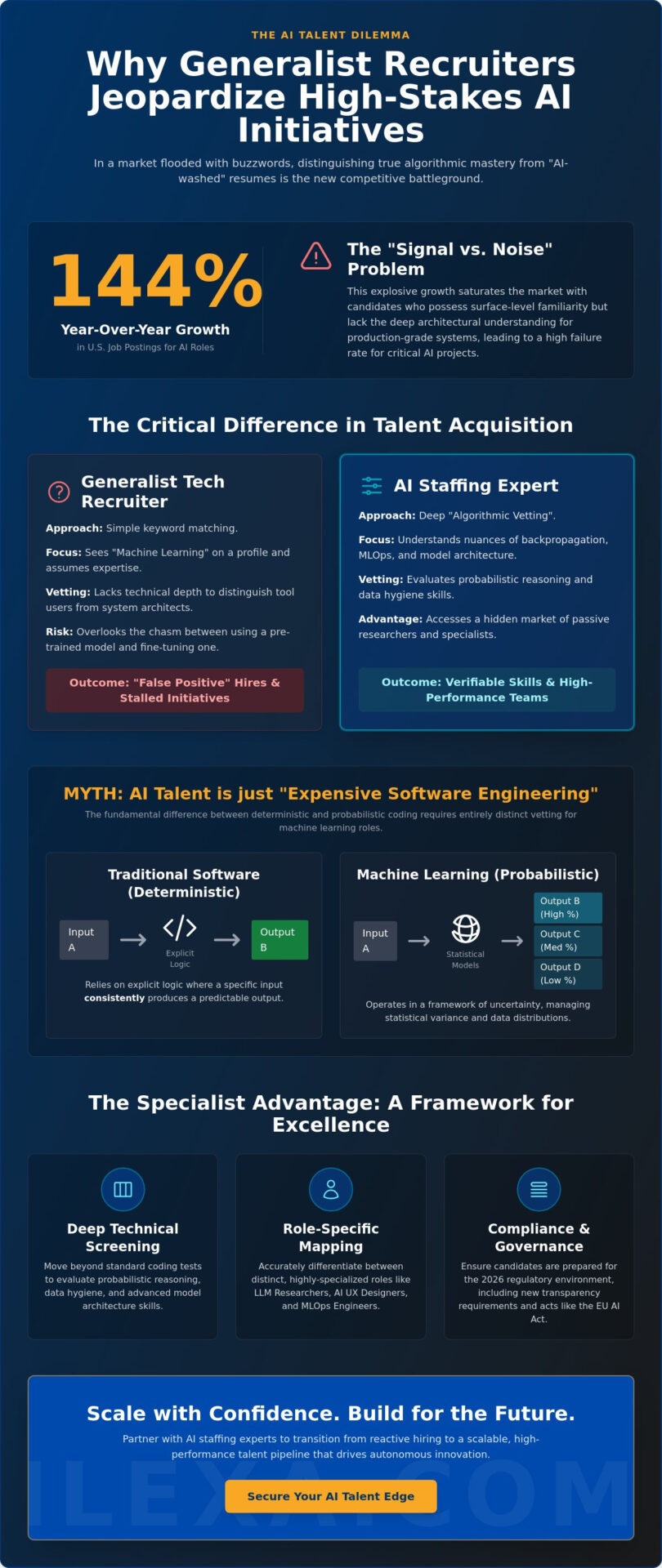
The most expensive mistake a modern enterprise can make isn’t investing in the wrong technology, but trusting the wrong hands to build it. You’ve likely seen the fallout: ambitious machine learning initiatives that stall because a generalist recruiter delivered a standard software developer instead of a specialized MLOps engineer. With U.S. job postings for AI roles growing 144% year-over-year, the market is saturated with candidates who adopt the right buzzwords but lack the algorithmic mastery to deliver results. You understand that your competitive advantage depends on precision, yet the high failure rate of AI projects suggests that traditional talent acquisition is failing the executive suite.
This article will debunk the most persistent myths about AI recruitment and explain why specialized ai staffing experts are now the only reliable gatekeepers for high-performance data talent. We’ll examine how to mitigate the risk of a multimillion-dollar failed initiative while addressing the strict transparency requirements of the 2026 regulatory environment. You’ll gain a clear framework for building a scalable talent pipeline that prioritizes verifiable skills over inflated resumes, ensuring your organization leads the next wave of autonomous innovation.
Key Takeaways
- Identify the specific technical thresholds that differentiate AI recruitment from general IT staffing to eliminate the “signal vs. noise” problem in candidate selection.
- Recognize the fundamental shift from deterministic to probabilistic coding and why senior software engineers require distinct vetting for machine learning roles.
- Partner with ai staffing experts to access a hidden talent market of passive researchers and specialists who operate outside traditional job boards.
- Implement a rigorous vetting framework using five critical questions to evaluate an agency’s technical depth and screening methodology accurately.
- Leverage global talent solutions and strategic workforce planning to transition from reactive hiring to a scalable, high-performance AI talent pipeline.
Beyond the Buzzword: Why Generalist Tech Recruiters Fail in AI
The transition from 2024’s experimental phase to the rigorous execution standards of 2026 has fundamentally altered the talent landscape. Two years ago, mentioning “Generative AI” on a resume was a differentiator. Today, it’s a distraction. As U.S. job postings requiring these skills grow 144% year-over-year, the market is flooded with “AI-washed” candidates. These individuals often possess surface-level familiarity with tools but lack the deep architectural understanding required for production-grade systems. Generalist recruiters, used to the deterministic world of standard software development, often fail to see the difference. They see a candidate who can call an API and assume they can build a proprietary Large Language Model (LLM). This oversight is not just a minor error; it’s a strategic liability that jeopardizes high-stakes initiatives.
The Definition of True AI Staffing Expertise
True expertise in this field transcends simple keyword matching. It requires a profound understanding of the mathematical foundations and specific model architectures that drive modern business value. Professional ai staffing experts don’t just look for “Machine Learning” on a LinkedIn profile. They employ “Algorithmic Vetting” to ensure a candidate understands the nuances of backpropagation, gradient descent, or the specific requirements of MLOps. This level of scrutiny is essential because the role of Artificial intelligence in hiring has become a double-edged sword. While automated tools help process volume, they also allow unqualified candidates to bypass basic filters using optimized resumes. Only a partner with deep technical literacy can distinguish between a practitioner who understands the “why” and a coder who only knows the “how.”
Why Generalist Agencies Miss the Nuance
Generalist agencies typically lack the internal technical infrastructure to conduct specialized interviews. They often overlook the chasm between a developer who uses a pre-trained model and an engineer who can fine-tune weights for a specific enterprise use case. This lack of nuance leads to “false positive” hires. In a high-stakes environment where a failed AI initiative can represent a $2M loss in capital and opportunity, the cost of a bad hire is astronomical. Organizations that rely on generalists often find themselves overpaying for talent that cannot deliver scalable results. To avoid these pitfalls, elite firms now look to ai staffing experts who provide the following advantages:
- Deep Technical Screening: Moving beyond coding tests to evaluate probabilistic reasoning and data hygiene skills.
- Role-Specific Mapping: Differentiating between LLM researchers, AI UX designers, and MLOps engineers.
- Compliance Awareness: Ensuring candidates are prepared for the 2026 regulatory environment, including the EU AI Act.
Precision is the new currency of the AI era. When the stakes involve your organization’s future competitive edge, settling for a generalist’s “best guess” is no longer a viable strategy. You need a partner that functions as an authoritative strategic guide, ensuring every hire is a building block for long-term excellence rather than a temporary fix for a buzzword-driven trend.
Myth #1: AI Talent is Just “Expensive Software Engineering”
A common misconception among corporate leadership is that a high-performing Senior Full Stack Developer can seamlessly pivot into a Lead ML Engineer role. This assumption is not only incorrect; it’s dangerous for your project’s timeline. The core of the issue lies in the fundamental difference between deterministic and probabilistic coding. Traditional software engineering relies on explicit logic where a specific input consistently produces a predictable output. Machine learning, however, operates within a probabilistic framework. It requires engineers who can manage uncertainty, interpret statistical variances, and understand how data distributions impact model behavior. Partnering with ai staffing experts ensures that your leadership understands this distinction before the first line of code is written.
AI roles require a much deeper integration with business strategy and data governance than standard IT positions. An ML engineer isn’t just building a feature; they’re building an asset that evolves based on the data it consumes. This necessitates a workforce that understands the long-term implications of data quality and architectural integrity. For a comprehensive look at how these foundations impact your hiring strategy, see our guide on Strategic Staffing for Big Data Projects. Without this strategic alignment, you’re simply hiring expensive talent to solve the wrong problems.
The Shift from Code to Models
The 2026 AI skill gap represents a significant move from “building” to “optimizing.” While DevOps focuses on the reliability of software deployments, MLOps is a distinct discipline dedicated to model lifecycle management. It involves monitoring for data drift, retraining models, and ensuring performance doesn’t decay over time. AI roles are inherently research-heavy. They demand a tolerance for experimentation that standard agile sprints often don’t accommodate. As analyzed in recent reports on AI and the Workforce, the shift in required competencies is creating a high-stakes environment where generalist recruitment simply cannot keep pace with the need for specialized optimization skills.
The Importance of Domain-Specific AI Knowledge
AI expertise isn’t generic. A specialist who has mastered fraud detection in Fintech won’t necessarily understand the clinical nuances or regulatory hurdles of Healthcare AI. Each industry carries its own set of ethical considerations and compliance requirements, particularly as we approach the mid-2026 enforcement of new transparency standards. Professional ai staffing experts recognize that technical skill must be paired with domain intelligence to be effective. Vailexa leverages diversity and inclusion consulting to build balanced teams that reflect these complexities. By prioritizing a mix of perspectives and specialized backgrounds, we help you mitigate bias and ensure your AI initiatives are both high-performing and ethically sound.
Myth #2: Internal Sourcing is Sufficient for High-Stakes AI Projects
Internal HR departments are often ill-equipped for the hyper-competitive AI sector. Most corporate teams rely on a “Post and Pray” strategy, waiting for candidates to apply to public job boards. This reactive approach is fundamentally insufficient when the demand for AI skills grows 20 times faster than the rest of the job market. Specialized ai staffing experts operate with a proactive mindset. They utilize talent mapping to identify the specific researchers and engineers driving innovation at competing firms. While internal teams often struggle with a time-to-fill average of 4-6 months for niche roles, an expert agency typically reduces this window to 3-6 weeks. This speed isn’t just about efficiency; it’s about securing critical talent before a competitor closes the gap.
Relying on internal sourcing often means missing the “Hidden Talent Market.” The most elite AI researchers don’t browse job boards. They’re deeply embedded in research labs or high-growth startups, and they only respond to recruiters who demonstrate a high level of technical literacy. Engaging this passive talent requires a sophisticated outreach strategy that internal teams rarely have the time or specialized knowledge to execute. By the time an internal post gains traction, the most qualified candidates have already been placed by agencies that maintain a constant pulse on the industry’s top performers. Enterprises serious about closing this gap must adopt AI staffing solutions that go beyond title-based hiring to identify specialists by their actual technical contributions and domain expertise.
The Passive Talent Advantage
Top-tier candidates aren’t looking for a job; they’re looking for the right challenge. Specialized ai staffing experts maintain long-term relationships with these non-active candidates, positioning your organization as the logical next step in their career trajectory. This is particularly vital for high-level leadership. When a role requires total discretion, our Executive Search methodology ensures you reach the world’s most capable AI architects without alerting the broader market. Navigating the challenges of AI in talent acquisition requires this level of precision to avoid the biases and delays common in traditional hiring funnels.
Predictive Workforce Planning vs. Reactive Hiring
Strategic success depends on hiring for where your AI roadmap is going, not just where it sits today. We help organizations transition from reactive hiring to predictive workforce planning. For firms scaling new prototypes, contingent staffing offers a flexible way to inject specialized talent into high-priority projects without long-term commitment. A significant trend for 2026 is the rise of “Fractional AI Leadership,” allowing mid-sized firms to access C-suite level expertise on a part-time basis. This agile model ensures that your technical strategy remains sound while your internal team grows at a sustainable, manageable pace.
How to Vet AI Staffing Experts: A Strategic Framework for 2026
Selecting a talent partner is a high-stakes decision that dictates the trajectory of your technological evolution. You aren’t just looking for a vendor; you’re securing a visionary architect for your organizational growth. To ensure your chosen ai staffing experts possess the depth required for the complex ecosystem of 2026, you must move beyond generic recruitment metrics. Evaluation should focus on technical literacy, global reach, and a documented track record of “Proof of Concept” placements that have successfully transitioned into scalable production systems.
Start your vetting process by challenging the agency’s technical core with these five critical questions:
- How does your screening process distinguish between a candidate who applies LLM APIs and one who can architect foundational models?
- What specific MLOps frameworks do you prioritize when vetting for production-readiness?
- How do you ensure candidate compliance with the August 2026 EU AI Act transparency standards?
- What is your methodology for mapping passive talent within specialized research labs?
- Can you demonstrate a successful placement history in emerging tech roles like AI Ethics Specialists or AI UX Designers?
Evaluating Technical Assessment Capabilities
The most sophisticated firms now use AI to screen AI. This creates a highly efficient initial filter, but it must be paired with human “Algorithmic Vetting” to be effective. You need to verify that the agency understands the granular differences between MLOps and Data Engineering. While a Data Engineer builds the infrastructure, the MLOps specialist ensures the model remains stable and performant within that environment. A true expert will provide case studies showing they’ve successfully navigated these distinctions in real-world scenarios. They should be able to explain their methodology for verifying a candidate’s mathematical foundations, rather than just their ability to write clean code.
Assessing Strategic Alignment
A sophisticated partner offers more than just resumes; they provide high-level strategy to ensure your long-term success. Look for agencies that offer Recruitment Process Outsourcing (RPO) for rapid scaling and global AI staffing solutions to access borderless expertise. Beware of agencies “AI-washing” their existing tech databases by simply rebranding standard software developers as ML specialists. In 2026, global reach is essential because the scarcity of high-tier talent requires a search strategy that transcends geographic limits. If you’re ready to secure the architects of your future, it’s time to partner with specialized AI recruitment leaders who understand the stakes.
Scaling with Vailexa: The Future of Specialized AI Workforce Solutions
The complexity of the 2026 technological landscape demands a partner that functions as an authoritative strategic guide rather than a transactional vendor. Vailexa doesn’t just fill seats; we architect high-performance teams that drive long-term organizational stability. While other agencies focus on the speed of placement, we prioritize strategic alignment, ensuring that every hire is equipped to navigate the rigorous demands of production-grade machine learning. By choosing specialized ai staffing experts, you move beyond the limitations of generalist recruitment and secure a competitive advantage rooted in technical precision and forward-thinking leadership.
Integrated AI Talent Ecosystems
Vailexa provides a comprehensive suite of workforce solutions designed to support the entire AI lifecycle. Whether you need contingent staffing for a rapid prototype or a permanent executive search for a Chief AI Officer, our ecosystem is built for flexibility. In a remote-first world, our global talent solutions allow you to source borderless expertise, ensuring that geographic constraints don’t limit your innovation. We support your journey from the initial data engineering phase through to model deployment and MLOps, providing the specific talent required at each critical juncture of the production cycle.
Your Partner in AI Transformation
The “Vailexa Difference” lies in our uncompromising standards for technical vetting accuracy. We understand that the high failure rate of AI projects is often linked to poor talent fit, which is why our algorithmic vetting process is so rigorous. Beyond technical prowess, our D&I consulting ensures that your teams are built with the diverse perspectives necessary for ethical AI development. This is especially vital as we approach the 2026 compliance deadlines for the EU AI Act, where transparency and bias mitigation are legally mandated. We empower bold innovators to challenge traditional methods and embrace a more sophisticated approach to growth. To begin your journey toward a resilient, high-performance workforce, Schedule your AI Workforce Strategy Consultation with Vailexa today.
Master the Machine Learning Talent Landscape
In 2026, the distinction between standard IT and specialized AI development has become the defining factor for corporate success. You’ve seen why generalist recruitment fails to bridge the gap between deterministic code and probabilistic models. Relying on internal sourcing or traditional tech agencies often results in costly “false positive” hires that stall innovation. True progress requires a partnership with ai staffing experts who possess the technical literacy to vet for algorithmic mastery and the strategic reach to map the world’s most elusive researchers.
Vailexa serves as your authoritative guide in this transformation. With a specialized AI and Data Analytics division and global reach across 50+ countries, we provide the precision your high-stakes initiatives demand. Our end-to-end RPO and Executive Search capabilities ensure your talent pipeline remains scalable and ethically sound. It’s time to move beyond the hype and build a workforce defined by excellence. Optimize your AI talent strategy with Vailexa’s specialized experts. Your path to sustainable AI leadership starts with a single, strategic decision.
Frequently Asked Questions
What is the difference between an IT recruiter and an AI staffing expert?
An AI staffing expert possesses the technical literacy to differentiate between standard software development and probabilistic machine learning architectures. While a traditional IT recruiter focuses on coding languages like Python or Java, ai staffing experts evaluate a candidate’s grasp of mathematical foundations and model lifecycle management. This distinction ensures that you hire engineers capable of building proprietary models rather than just calling external APIs.
How much does it cost to hire an AI specialist through an agency in 2026?
Industry standard contingency fees for specialized AI and machine learning roles typically range between 20% and 25% of the candidate’s first-year salary. For high-level executive search and C-suite positions, retained fees can reach 25% to 35% of total annual compensation. These rates reflect the extreme scarcity of elite talent in a market where AI job postings have grown 144% year-over-year as of April 2026.
Can AI staffing experts help with confidential executive searches for AI leadership?
Yes, specialized agencies provide discreet executive search services to secure high-level AI leadership without alerting the broader market. This process involves proactive talent mapping and direct engagement with passive candidates who are not actively browsing job boards. Vailexa acts as a strategic partner to ensure your confidential leadership transitions are handled with the highest level of professionalism and industry precision.
Why is the “failure rate” so high for AI hires made by generalist agencies?
Generalist agencies often fail because they lack the technical infrastructure to conduct specialized interviews or verify a candidate’s probabilistic reasoning. They frequently send “AI-washed” resumes where a software developer has simply added trending keywords. Without deep technical screening, organizations risk a “false positive” hire, which can lead to the failure of multimillion-dollar AI initiatives due to poor architectural choices.
Do AI staffing experts provide contract or permanent placement services?
Professional ai staffing experts provide a full spectrum of workforce solutions, including both contingent staffing and permanent recruitment. This flexibility allows organizations to scale prototypes using contract specialists or build long-term stability through permanent hires. Whether you require a fractional AI lead or a full-time MLOps team, our solutions are customized to align with your specific organizational roadmap and growth targets.
How does Vailexa verify the technical skills of machine learning candidates?
Vailexa employs a rigorous algorithmic vetting process that evaluates a candidate’s understanding of model architectures and data hygiene. We move beyond basic coding tests to assess proficiency in MLOps, data drift monitoring, and fine-tuning techniques. This methodology ensures that every candidate we present has been verified for production-readiness and technical accuracy by our specialized data analytics staffing division.
What industries do specialized AI staffing experts typically serve?
Specialized experts serve a wide range of sectors, including Fintech, Healthcare, and autonomous systems. Each industry requires unique domain knowledge, such as clinical data compliance in medicine or fraud detection algorithms in finance. Our global talent solutions ensure that your organization receives candidates who understand the specific regulatory and ethical hurdles of your particular market, including the latest 2026 transparency standards.
How long does it typically take to find a qualified AI researcher?
Finding a qualified AI researcher typically takes 3-6 weeks when partnering with a specialized agency, compared to 4-6 months through internal sourcing. This significant reduction in time-to-hire is achieved through proactive talent mapping and a pre-vetted database of passive candidates. Speed is a critical advantage in 2026, as the best researchers are often hired by competitors within days of entering the market. Organizations looking to build a complete analytics function should also review our 2026 strategic blueprint on how to hire a data analytics team to ensure every role from data engineer to analytics lead is filled with precision.