
Nearly 45% of data and analytics job postings now demand AI-related expertise, yet most organizations still struggle to find the right balance between technical mastery and business intuition. You likely recognize the frustration of sourcing candidates who can write perfect SQL but fail to translate those queries into a strategic advantage. In a market where high turnover is the norm and talent remains scarce, the challenge isn’t just finding a body to fill a seat; it’s about building a sustainable engine for organizational growth.
This guide provides the definitive 2026 blueprint on how to hire data analytics team members who bridge the gap between raw information and executive action. We’ll move beyond traditional job descriptions to help you master an architectural approach to team composition. You’ll gain a clear roadmap for identifying niche skills, accelerating your time-to-hire, and ensuring every data output aligns perfectly with your overarching business strategy. By shifting your focus from individual hires to a cohesive strategic unit, you can transform your data department from a cost center into a visionary driver of excellence.
Key Takeaways
- Transform your data department from a reactive service provider into a multi-disciplinary unit that converts raw information into high-value strategic assets.
- Avoid the trap of “unicorn” hiring by assembling a balanced quartet of specialists, including analytics engineers and data storytellers, who sustain long-term performance.
- Learn the modern architectural approach on how to hire data analytics team professionals using global sourcing and contingent staffing to scale rapidly in a competitive market.
- Adopt a rigorous evaluation framework that balances live technical screening with complex business case studies to ensure candidates possess both coding skills and commercial judgment.
- Future-proof your organizational infrastructure by integrating AI-ready data pipelines that bridge the growing divide between traditional analytics and advanced AI solutions.
Defining the Blueprint: Identifying Your Data Analytics Team Archetype
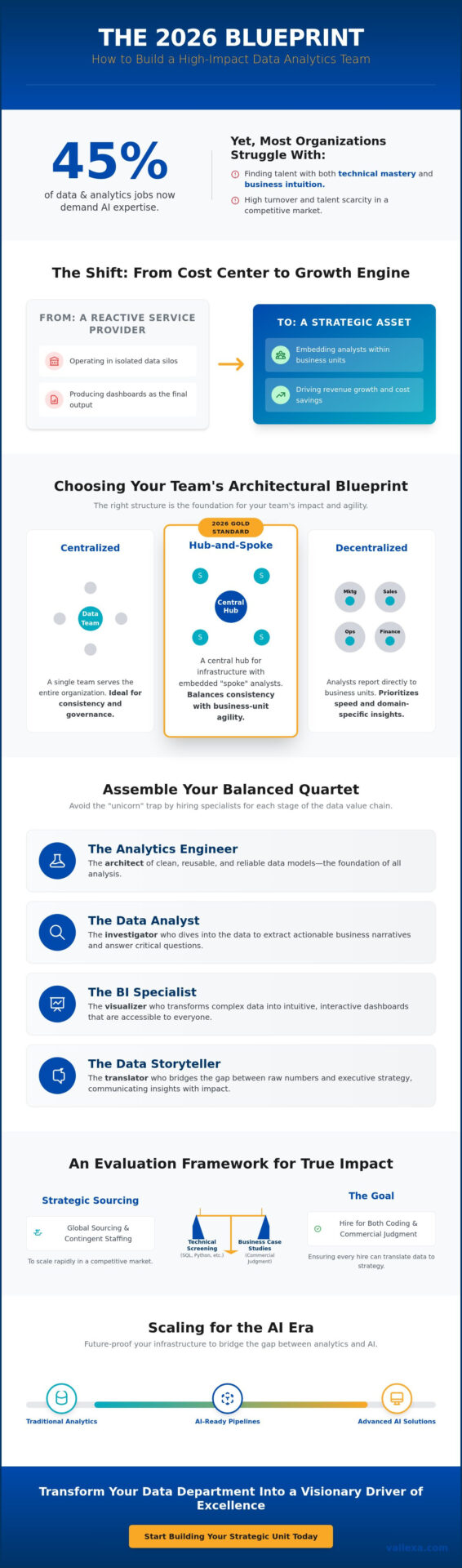
A high-performance data analytics team is far more than a collection of technical specialists. In 2026, we define this team as a multi-disciplinary unit specifically engineered to convert raw information into high-value strategic assets. The traditional model of isolated analysts working in silos is obsolete. We’ve seen a decisive shift toward embedded analytics, where data professionals operate directly within business units. This proximity ensures that every insight generated is immediately applicable to the specific challenges of marketing, finance, or supply chain operations.
Before you commit to how to hire data analytics team members, you must establish the primary “Why” behind the initiative. Are you building this engine to drive operational efficiency, fuel aggressive market expansion, or strengthen risk mitigation? Defining this purpose dictates the specific talent profiles you’ll need to source. Without a clear mission and unwavering executive sponsorship, even the most talented team will struggle to influence the C-suite. Success requires a champion who ensures that data-driven recommendations are integrated into the core of the business strategy.
Centralized vs. Decentralized vs. Hub-and-Spoke Models
The organizational structure you choose serves as the foundation for your team’s impact. A Centralized model offers the highest level of consistency, making it ideal for standardizing data governance and ensuring a single source of truth across the enterprise. Conversely, a Decentralized approach prioritizes speed and domain-specific insights by placing analysts directly under department heads. However, the Hub-and-Spoke model has emerged as the 2026 gold standard for global enterprise agility. This hybrid structure maintains a central “hub” to manage the foundations of data analysis and infrastructure, while “spoke” analysts are embedded in business units to drive localized, agile decision-making.
Aligning Team Objectives with Corporate ROI
Success metrics for data teams have evolved beyond the volume of dashboards produced. In a results-oriented environment, your primary KPIs must focus on predictive outcomes and prescriptive guidance. If the team cannot provide a clear path to revenue growth or cost savings, their value remains theoretical. We recommend utilizing strategic workforce planning to align your talent acquisition with long-term corporate goals. This ensures you aren’t merely reacting to immediate needs, but are instead building a sustainable talent pipeline that supports your organization’s vision for the next decade. When you understand how to hire data analytics team professionals through the lens of ROI, you transform the department from a cost center into a visionary driver of excellence.
The Critical Mix: Essential Roles for a Balanced Analytics Engine
Success in high-stakes data environments is not the result of finding a “unicorn” who can handle everything from cloud infrastructure to executive boardroom presentations. Chasing these rare, all-in-one candidates is a strategic mistake that frequently leads to rapid burnout and fragmented results. Instead, building a future-proof team requires an architectural approach. You need a balanced quartet of specialists, each focused on a specific segment of the data value chain:
- The Analytics Engineer: The architect of clean, reusable data models.
- The Data Analyst: The investigator who extracts actionable business narratives.
- The BI Specialist: The visualizer who ensures data is accessible and intuitive.
- The Data Storyteller: The translator who bridges the gap between numbers and strategy.
When you master how to hire data analytics team members, you realize that technical proficiency in SQL or Python is only half the battle. Domain expertise is the silent multiplier of team performance. An analyst who understands the nuances of your specific market will always outperform a technically superior candidate who lacks business context. Identifying these subtle differences in talent profiles requires a sophisticated eye. Collaborating with specialized AI staffing experts ensures your recruitment process distinguishes between these critical personas before they even reach the interview stage.
Data Analysts vs. Analytics Engineers: The Modern Divide
The distinction between the Analytics Engineer and the Data Analyst is the cornerstone of a modern, efficient workflow. The Analytics Engineer acts as the architect, focusing on upstream processes. They build clean, transformed, and well-documented data sets that serve as a reliable foundation. By applying software engineering best practices to data pipelines, they drastically reduce technical debt. The Data Analyst then steps in as the investigator, using these clean models to extract the business narrative. This partnership ensures that your analysts spend their time finding insights rather than cleaning messy spreadsheets. This synergy is essential for any organization learning how to hire data analytics team structures that actually scale.
The Rise of the Data Storyteller
The greatest failure in modern analytics is the inability to communicate. A brilliant insight that stays trapped in a complex dashboard has zero commercial value. This is why the Data Storyteller has become a vital role in 2026. These professionals possess the rare ability to translate complex p-values into clear profit margins. When evaluating senior hires, you must prioritize “Business Judgment.” Look for candidates who don’t just present numbers, but provide prescriptive guidance on what those numbers mean for the company’s future. If you’re ready to scale your internal capabilities, exploring data analytics staffing solutions can help you find the specific expertise needed to bridge this communication gap.
Strategic Sourcing: Global Talent, Contingent Labor, and RPO Models
The 2026 marketplace demands a departure from provincial hiring mindsets. Restricting your search to local talent pools is a strategic bottleneck that ignores the reality of a borderless data economy. To master how to hire data analytics team structures that truly compete, you must adopt a global sourcing perspective. This involves more than just posting on standard boards. It requires sophisticated talent mapping to identify passive candidates who aren’t actively seeking roles but possess the niche expertise your architecture demands. By visualizing the global talent landscape, you can pinpoint clusters of excellence in emerging tech hubs, ensuring your team is built on a foundation of world-class capability rather than geographical convenience.
Permanent vs. Contingent: When to Use Which
A sophisticated blueprint recognizes that not every role requires a permanent headcount. We recommend a “Core-and-Flex” model to maximize organizational agility. Permanent hires should be reserved for roles that define your core data governance and long-term strategic vision. These individuals act as the keepers of your institutional knowledge. However, for specialized machine learning model builds, seasonal audits, or large-scale data migration projects, contingent staffing offers superior financial and operational benefits. This approach allows you to inject high-level expertise into specific initiatives without the long-term overhead of a full-time salary. It ensures your team remains lean during standard operations while possessing the “flex” capacity to scale for intensive, high-impact projects.
Leveraging RPO for Scalable Analytics Functions
Building a comprehensive analytics department from the ground up is a monumental task that can strain internal HR resources. Recruitment Process Outsourcing (RPO) has become a primary tool for enterprises needing to scale rapidly without sacrificing quality. A dedicated RPO partner provides the infrastructure to reduce time-to-fill for complex roles like Data Architects or Lead Analytics Engineers. This model offers significant cost-per-hire advantages by utilizing specialized recruiters who speak the language of data. While traditional resources offer general advice on hiring data analysts, an RPO engagement provides a deeper, more technical vetting process. Vailexa’s global reach facilitates this diverse talent acquisition, allowing you to bypass the friction of international recruitment. When you understand how to hire data analytics team members through a managed service, you gain the speed required to capture market opportunities before they vanish.
The Evaluation Framework: Beyond Technical Proficiency to Business Judgment
Technical proficiency is merely the ticket to entry. To build a world-class unit, your evaluation process must pivot from measuring “can they code” to “can they lead.” If you’re refining your internal methodology for how to hire data analytics team experts, this framework provides the necessary rigor. We recommend a structured, four-step evaluation that filters for both technical precision and commercial intuition, ensuring your hires are ready for the complexities of the 2026 market.
Start with a technical screening in a controlled environment. Candidates should perform live SQL or Python coding to demonstrate their logic and efficiency under pressure. Once the baseline is established, move to a real-world business case study. Present the candidate with a significant revenue drop or a spike in customer churn. This reveals their ability to diagnose a problem rather than just reporting a number. The third phase involves a stakeholder communication simulation where the candidate presents findings to a non-technical manager. Finally, conduct a cultural and D&I alignment check to ensure diverse perspectives are represented. If you need to accelerate this process, our executive search and data analytics staffing services provide access to pre-vetted talent that meets these high standards.
Assessing the “So What?” Factor
The most common failure in hiring is selecting candidates who produce accurate reports that nobody uses. You must evaluate the “So What?” factor. A candidate demonstrates high value when they can link a data finding to a specific, high-impact business action. Evaluate their curiosity by observing if they ask “why” before they begin querying the database. Business judgment is the ability to prioritize insights by their impact on bottom-line revenue. This mindset ensures your team focuses on needle-moving initiatives rather than academic curiosities.
The Case Study Method: A 2026 Standard
Static interviews are a relic of the past. In 2026, the case study is the gold standard for assessing intuition. Provide a dataset with intentional “noise” or missing values to test their data cleaning instincts. Score candidates on their methodology and their use of structured problem-solving frameworks, such as MECE (Mutually Exclusive, Collectively Exhaustive). This approach is particularly critical when considering strategic staffing for big data projects, where the sheer volume of information can overwhelm those without a disciplined framework. When you master how to hire data analytics team members through this lens, you ensure that every hire is a strategic asset.
Scaling for the AI Era: Future-Proofing Your Analytics Infrastructure
By 2026, the boundary separating traditional business intelligence from advanced artificial intelligence has effectively vanished. Organizations can no longer afford to view these as distinct departments. A modern data team must be capable of more than just looking backward; they must be architects of the future. Determining how to hire data analytics team members who can navigate this convergence is the final step in future-proofing your organization. This requires a shift in focus toward professionals who can manage the complex data pipelines required for AI staffing solutions, ensuring that the underlying data is both accessible and high-quality.
As Large Language Models (LLMs) and generative tools become ubiquitous, your team must also serve as the primary guardians of data ethics and governance. It’s not enough to generate predictions; those predictions must be grounded in transparency and bias-mitigation. This elevated responsibility means your hiring criteria must include a deep understanding of regulatory compliance and the ethical implications of automated decision-making. Vailexa stands as the strategic partner that bridges the gap between traditional BI and advanced AI recruitment, providing the expertise needed to source these rare, dual-capable professionals. Working with a dedicated ai recruitment agency that specializes in niche roles like GenAI Architects and MLOps engineers can dramatically reduce your time-to-hire and ensure candidates are vetted for both technical depth and strategic alignment.
Integrating AI/ML Capabilities
Partnering with Specialized Talent Experts
Generalist recruiters often fail to identify the critical nuances between a data engineer and a data scientist. In a market defined by technical precision, you need a partner who understands the modern 2026 technology stack, including Snowflake, dbt, and Fivetran. These tools are the backbone of a future-ready infrastructure. A partner who speaks this language can vet candidates for their ability to integrate these technologies into a cohesive, automated ecosystem. When you’re ready to move beyond basic reporting and build a visionary data department, Vailexa provides the global reach and technical depth to make it happen. Build your future-ready team with Vailexa’s data analytics staffing solutions and secure your place at the forefront of the AI era.
Mastering the Future of Data-Driven Leadership
Building a high-performance analytics unit in 2026 requires more than a technical checklist; it demands a visionary architectural approach. We’ve explored how the shift toward embedded analytics and the “Core-and-Flex” model provides the agility needed to compete on a global scale. By prioritizing business judgment over mere technical proficiency, you ensure that every insight generated translates directly into a strategic advantage for your organization.
Understanding how to hire data analytics team structures that bridge the gap between raw information and executive action is the first step toward organizational transformation. Whether you’re scaling through RPO or sourcing niche AI expertise, the quality of your talent defines your competitive edge. Vailexa offers global reach with local expertise in 20+ markets, specializing in AI and Big Data recruitment through proven RPO models that facilitate rapid scaling.
Consult with our Data Analytics Staffing Experts to build your high-performance team today.
The path from raw data to visionary growth is complex, but with the right partners and a disciplined blueprint, your organization is well-positioned to lead the next era of innovation. We look forward to supporting your journey toward excellence.
Frequently Asked Questions
What is the first role I should hire for a new data analytics team?
A Data Engineer is the most critical first hire because they build the fundamental infrastructure required to collect and manage your information. Without a robust pipeline, your future analysts will spend the majority of their time cleaning fragmented datasets rather than delivering strategic insights. Establishing this technical foundation ensures that every subsequent hire can focus on high-value interpretation and decision-making.
How much does it cost to hire a full data analytics team in 2026?
Industry data from June 2026 indicates that the average annual salary for a mid-level Data Analyst in the United States ranges between $96,989 and $98,000. For senior-level professionals with over five years of experience, budget expectations should scale between $120,398 and $145,000 per year. Total team costs will vary significantly based on your specific mix of permanent headcount and contingent specialists.
Should I hire a data analytics team internally or outsource it?
The most effective strategy is often a hybrid “Core-and-Flex” model that balances internal governance with external agility. You should maintain a permanent internal core to manage data strategy and long-term governance. For specialized machine learning builds or rapid scaling, utilizing global talent solutions allows you to access niche expertise without the long-term overhead of a full-time department.
What is the difference between a data analyst and a data scientist when hiring?
Data Analysts are primarily investigators who derive actionable insights from existing data to solve immediate business problems. Data Scientists focus on the future, building predictive models and implementing machine learning logic to automate complex decision-making processes. Understanding this distinction is vital when determining how to hire data analytics team members who align with your specific organizational goals.
How do I attract top data talent in a competitive market?
Top professionals are drawn to organizations that offer a clear path to impact and a modern technology stack. Beyond competitive compensation, you can differentiate your brand by emphasizing a culture of data ethics and offering remote flexibility. Demonstrating that your data team has executive sponsorship and a direct influence on corporate ROI is a powerful motivator for high-level candidates.
What technical skills are non-negotiable for a modern data analytics team?
Proficiency in SQL remains the most essential technical skill, appearing in over 41% of data analyst job postings. Your team must also possess mastery of data visualization tools like Tableau or Power BI, alongside a strong foundation in Python or R for advanced modeling. In the current market, AI literacy and the ability to manage cloud data warehouses are also becoming standard requirements.
How can RPO help in building a data analytics team specifically?
Recruitment Process Outsourcing (RPO) provides the specialized infrastructure needed to identify and vet technical talent at scale. This model reduces your total time-to-hire by utilizing recruiters who understand the nuances of the 2026 technology stack. It’s a strategic way to master how to hire data analytics team professionals across multiple global markets while maintaining consistent quality and cultural alignment.
What is the average time-to-hire for specialized data roles?
The average time-to-hire for specialized data roles typically ranges from 45 to 60 days in a competitive market. You can accelerate this timeline by implementing proactive talent mapping and maintaining a pipeline of passive candidates. Utilizing a dedicated workforce solutions provider often reduces this window by providing immediate access to pre-vetted global talent pools.