
Your next big data failure won’t be caused by a software bug or an outdated Hadoop 3.5.0 instance. It will be caused by a talent gap. While the latest Apache Spark 4.1.1 release offers incredible processing power, that technology remains inert without the specialized engineers who understand how to harness it. Effective staffing for big data projects requires more than just filling seats; it demands a sophisticated alignment of technical depth and organizational vision.
You’ve likely experienced the frustration of high turnover and the extreme scarcity of talent that understands 2026 data privacy mandates like the SECURE Data Act. It’s a common struggle to bridge the gap between complex engineering needs and overarching business goals. This guide reveals how to architect a high-performance data team using strategic workforce models and specialized talent acquisition. We’ll examine the roadmap for hiring specialized roles, the optimal balance between permanent and contingent staff, and the vetting processes that ensure long term retention and strategic excellence.
Key Takeaways
- Identify the transition from broad IT support to hyper-specialized data roles required for modern enterprise success.
- Learn to integrate contingent staffing for big data projects to achieve rapid scalability while maintaining permanent recruitment for long-term strategic continuity.
- Enhance your acquisition strategy by combining rigorous technical assessments with specialized diversity and inclusion consulting for superior team performance.
- Architect a data-driven workforce plan that maps internal talent audits directly to your project’s most critical technical milestones.
The Evolving Landscape of Staffing for Big Data Projects
The era of the generalist IT professional has ended. As enterprises grapple with the sheer volume and velocity described in What is Big Data?, the demand for hyper-specialized talent has reached a fever pitch. Effective staffing for big data projects now requires a deep understanding of specific ecosystems, from Apache Spark 4.1.1 clusters to Kafka 4.2.0 streams. Traditional recruitment agencies often struggle here because they lack the technical vocabulary to distinguish between a data architect and a pipeline engineer. For visionary leaders, specialized data analytics staffing is no longer a back-office function; it’s a primary driver of competitive advantage. Forward-thinking organizations utilize talent mapping to anticipate project needs months before the first line of code is written, ensuring that their human capital scales alongside their infrastructure.
Building a modern data team is a strategic exercise in precision. It’s about finding individuals who don’t just write code but understand how that code impacts the bottom line. When technical skills align perfectly with business objectives, the results are transformative. However, achieving this alignment requires a move away from legacy hiring practices and toward a model that prioritizes specialized expertise over general technical proficiency.
The 2026 Big Data Talent Crunch
The supply of machine learning and AI specialists remains critically low, creating a market where top-tier candidates often receive multiple offers within days. In this environment, speed to hire is a secondary metric. The real priority is accuracy of fit. A hasty hire who doesn’t understand the nuances of the 2026 SECURE Data Act can cost an organization millions in compliance penalties. While remote-first global talent pools have expanded the candidate search area, they’ve also increased the complexity of vetting across different regulatory environments. Success requires a partner who can bridge these gaps with composure and precision.
Defining Project-Based vs. Operational Staffing
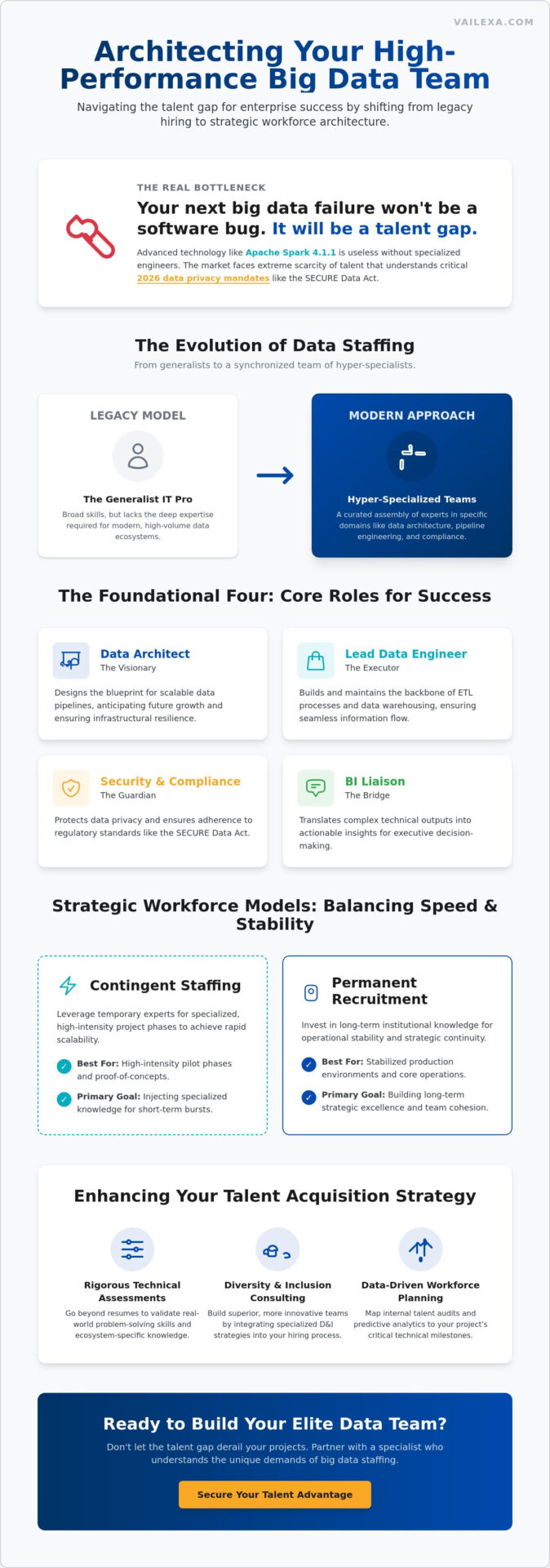
A big data project follows a distinct lifecycle, transitioning from a high-intensity pilot phase to a stabilized production environment. During the pilot, you need specialized bursts of knowledge that are often best served through contingent staffing. As the project matures, the focus shifts to operational stability and long-term maintenance. Identifying the right staffing for big data projects means recognizing when to lean on temporary experts and when to invest in permanent institutional knowledge. Every initiative requires what we call the “Foundational Four” roles:
- Data Architect: The visionary who designs the blueprint for scalable pipelines.
- Lead Data Engineer: The executor responsible for the backbone of ETL processes.
- Security Compliance Specialist: The guardian of data privacy and regulatory standards.
Prioritizing these roles ensures that your technical output remains aligned with your strategic business goals from day one. By architecting your team with this level of intentionality, you protect your investment and ensure long-term stability.
Essential Roles and Skill Sets for Modern Data Initiatives
Success in the current data economy isn’t a result of sheer computing power; it’s a product of human architecture. Strategic staffing for big data projects hinges on identifying the right mix of technical expertise and business acumen. As we move through 2026, the roles within a data team have become increasingly specialized, moving far beyond the generic “analyst” titles of the past. To build a resilient infrastructure, you must secure professionals who understand the nuances of Essential Big Data Roles and how they interconnect to drive enterprise value.
- Data Architects: These visionaries design the blueprint for scalable data pipelines. They don’t just manage current loads; they anticipate future growth and ensure the infrastructure can handle the 15% projected growth in data-driven roles through 2034.
- Data Engineers: They are the backbone of your operation. By managing complex ETL processes and data warehousing, they ensure information flows seamlessly from ingestion to analysis.
- Machine Learning Engineers: These specialists bridge the gap between theoretical data science and production-ready AI. They’re responsible for deploying models that remain stable and accurate in real-world environments.
- Data Governance Specialists: With the 2026 SECURE Data Act and new state-level privacy laws in Indiana and Kentucky, these experts are vital. They ensure every project remains compliant, ethical, and secure.
- BI Developers: They translate raw, unstructured data into strategic insights that executive leadership can actually use.
Securing this level of talent requires a sophisticated partner who understands the difference between a resume and a true cultural fit. If you’re looking to enhance your team’s perspective, consider how diversity and inclusion consulting can help you access a broader, more innovative talent pool.
The Technical Stack: Beyond the Resume
In 2026, a candidate’s value is tied to their proficiency with specific, modern ecosystems. It’s no longer enough to know “big data.” You need engineers who have mastered Apache Spark 4.1.1 and Kafka 4.2.0. Proficiency in NoSQL environments and cloud-native platforms like AWS or Azure is non-negotiable for any project aiming for scalability. Furthermore, certifications in MLOps and DataOps have become the gold standard, proving a professional can manage the entire lifecycle of a data initiative rather than just writing isolated code. Working with specialized AI staffing experts ensures you can accurately evaluate these advanced certifications and distinguish genuine algorithmic mastery from candidates who simply adopt the right buzzwords.
Soft Skills in a Data-Driven World
Technical brilliance fails without the ability to communicate. Data storytelling is now a core requirement for senior roles; professionals must be able to explain “the why” behind the numbers to non-technical stakeholders. This collaborative agility allows data teams to interact effectively with marketing and product departments, turning technical output into business growth. When staffing for big data projects, prioritize candidates who use structured problem-solving frameworks to tackle the chaos of unstructured data. These individuals don’t just find answers; they find the right questions to ask.
Strategic Workforce Models: Permanent vs. Contingent Talent
Building a high-performance team isn’t about choosing one employment type over another; it’s about orchestration. Relying on a binary choice between full-time hires and contractors is a relic of the past. Today’s leaders use a hybrid approach to maximize ROI and maintain operational flexibility. Effective staffing for big data projects requires a fluid strategy that adapts to the specific phase of the project lifecycle, ensuring that technical depth is present exactly when it’s needed most.
A hybrid workforce model offers the most robust defense against the volatility of the 2026 talent market. By blending the deep institutional knowledge of permanent staff with the specialized bursts of contingent expertise, organizations can scale without the burden of permanent overhead. This balance is critical for navigating the complexities of modern data ecosystems while maintaining a lean, results-oriented structure. Strategic workforce planning transforms talent from a variable cost into a resilient organizational asset.
When to Choose Contingent Staffing
Speed is the primary driver during infrastructure overhauls or massive cloud migrations. When you need to scale rapidly for a Proof of Concept (PoC), contingent staffing provides the necessary agility to meet aggressive deadlines. This model allows you to inject niche skills, such as expertise in the latest Apache Hadoop 3.5.0 release, for specific project milestones. It’s a surgical approach to talent acquisition that fills immediate gaps without disrupting your long-term headcount strategy. Utilizing contingent professionals also allows your internal teams to focus on core competencies while external specialists handle the heavy lifting of short-term technical surges.
The Case for Permanent Data Leadership
Long-term vision requires institutional roots. Permanent recruitment is essential for roles that define your data culture and oversee long-range strategy. High-value data scientists and senior architects who remain with the firm for years build the foundational memory that prevents repetitive mistakes and ensures architectural consistency. For the highest levels of leadership, such as a Chief Data Officer (CDO), executive search remains the gold standard for finding visionaries who can align technical roadmaps with corporate objectives. These leaders are the guardians of your data-driven future, ensuring that every project contributes to a cohesive business vision.
Managing risks in data-sensitive environments is paramount. With the implementation of new consumer privacy laws in Rhode Island and Kentucky as of January 1, 2026, the vetting of all staff must be rigorous. A hybrid model balances the innovation of external specialists with the oversight of permanent leadership. This alignment is reflected in the Federal Big Data R&D Strategic Plan, which emphasizes the need for diverse, expert talent to maintain a competitive and secure data ecosystem. By architecting your workforce with this level of intentionality, you protect your investment and ensure long-term stability.
Navigating the Vetting Process and Diversity Mandates
Standard interviews often fail to reveal the true depth of a candidate’s technical mastery. They don’t expose how a professional will react when a production pipeline fails or how they’ll handle the complexities of 2026 data privacy mandates. When staffing for big data projects, relying on a resume alone is a high-risk strategy that your organization cannot afford. You need a rigorous, multi-layered vetting process that includes live coding exercises and deep technical assessments tailored to specific environments like Apache Kafka 4.2.0. This precision ensures that every new hire possesses the exact skills required to drive your project forward without costly course corrections.
Beyond technical proficiency, the human element of your team architecture is equally critical. Integrating diversity and inclusion consulting into your recruitment strategy is no longer just a social initiative; it’s a technical necessity. Diverse teams are demonstrably better at identifying and mitigating algorithmic bias. This is essential as automated decision-making technology faces stricter disclosure requirements under the updated California Consumer Privacy Act effective January 1, 2026. Innovation thrives where varied perspectives challenge traditional methods, leading to more robust and ethical data solutions.
Advanced Vetting Techniques for 2026
The modern search for talent leverages AI-driven talent mapping to identify passive candidates who aren’t actively browsing job boards but possess the niche skills your project demands. Portfolio audits have replaced generic skill lists, allowing hiring managers to evaluate how a candidate handled real-world infrastructure challenges in previous roles. In a global, distributed workforce, identity verification and risk mitigation protocols are non-negotiable. These steps protect your organization from the security vulnerabilities that can arise in remote staffing environments, ensuring that your team remains both high-performing and secure.
The Strategic Value of Inclusive Data Teams
Top-tier Recruitment Process Outsourcing (RPO) and staffing contracts now prioritize D&I as a core deliverable. Building inclusive pipelines for underrepresented tech talent doesn’t just expand your candidate pool; it directly correlates with higher project success rates. Teams that reflect a wide range of backgrounds are more resilient and better equipped to solve unstructured data challenges. By prioritizing inclusivity, you aren’t just filling roles. You’re architecting a future-proof workforce that is prepared for the social and technical demands of the next decade. To ensure your next initiative is built on a foundation of excellence and equity, partner with a workforce solutions provider that prioritizes diversity and inclusion consulting as a strategic advantage.
Optimizing Big Data Staffing with Strategic Workforce Planning
Effective staffing for big data projects transcends the simple act of recruitment. It requires a comprehensive methodology that views talent as a dynamic component of project architecture. While previous sections focused on identifying specific roles and hybrid models, true optimization occurs when you align your human capital strategy with your technical roadmap. This proactive approach ensures that your initiative never stalls due to a lack of specialized capacity or a sudden talent bottleneck. It’s about moving beyond reactive hiring to build a resilient, forward-looking organization.
To achieve this level of operational excellence, follow these five strategic steps:
- Conduct a Comprehensive Talent Audit: Evaluate your current internal capabilities to identify hidden strengths and immediate skill gaps before looking externally.
- Map Project Milestones to Capacity: Align your hiring timeline with specific technical deliverables to ensure the right experts are on-site exactly when they’re needed.
- Integrate Recruitment Process Outsourcing (RPO): Leverage external expertise to manage high-volume needs without straining your internal HR department’s resources.
- Establish a Continuous Feedback Loop: Create a direct communication channel between project leads and recruiters to refine candidate profiles based on real-time project shifts.
- Leverage Predictive Workforce Planning: Use data-driven insights to anticipate future needs, allowing you to secure talent before the market tightens for a specific skill set.
Scaling with Recruitment Process Outsourcing (RPO)
The Future of AI Staffing Solutions
The next era of data initiatives will be defined by quantum computing and edge analytics. Generalist agencies aren’t equipped to vet for these emerging disciplines. Specialized AI staffing solutions outperform generalists because they possess the industry knowledge required to evaluate complex technical portfolios and code quality. As organizations navigate this landscape, partnering with AI staffing experts who can distinguish genuine machine learning mastery from surface-level familiarity becomes a critical competitive differentiator. As a visionary workforce solutions provider, Vailexa serves as an equal partner in architecting your success. We don’t just fill seats; we build the high-performance teams that drive long-term stability and innovation. By partnering with Vailexa for your staffing for big data projects, you ensure your organization is prepared for both the challenges of 2026 and the breakthroughs of the next decade.
Architecting a Future-Proof Data Workforce
Navigating the complexities of the 2026 data economy requires a departure from legacy hiring. Precision is the new standard. You’ve seen how hyper-specialization and hybrid workforce models create a resilient team structure that adapts to shifting project milestones. Success in staffing for big data projects isn’t just about finding engineers; it’s about aligning those experts with your long-term strategic vision and ethical standards. By integrating rigorous technical vetting with a commitment to inclusive innovation, your organization can transform raw data into a primary competitive advantage.
The path to operational excellence is built on precision and partnership. Partner with Vailexa for Specialized Data Analytics Staffing to access our global talent mapping expertise and dedicated AI staffing vertical. We integrate expert diversity and inclusion consulting into every search, ensuring your team is as ethically sound as it is technically brilliant. Your next major breakthrough is waiting for the right architects to unlock it. Let’s build that future together.
Frequently Asked Questions
What are the most in-demand roles for big data projects in 2026?
The most critical roles include Data Architects, Machine Learning Engineers, and Data Governance Specialists. Organizations are specifically seeking professionals proficient in the latest stable releases, such as Apache Spark 4.1.1 and Kafka 4.2.0. There’s also a high demand for Solutions Architects who can navigate the complexities of the SECURE Data Act and other 2026 privacy mandates.
How long does it typically take to staff a full big data team?
Staffing a comprehensive permanent team usually requires three to six months to ensure high search accuracy and cultural alignment. However, contingent staffing for big data projects can significantly accelerate this timeline. Technical surges or proof-of-concept phases are often supported by specialized contractors who can be integrated into your workflow within a few weeks.
Should I use contingent staffing or permanent hires for my data project?
The choice depends on your project’s lifecycle and strategic goals. Utilize contingent staffing for rapid scaling, specialized technical bursts, or short term infrastructure overhauls. Permanent recruitment is the superior choice for building long term institutional knowledge and securing C-suite leadership through executive search. A hybrid model often provides the best balance of agility and stability.
What is the average cost of staffing for big data projects?
Total investment varies based on the specialization of the roles and the chosen workforce model. Market data from early 2026 indicates that senior roles like Solutions Architects command salaries ranging from $118,000 to $184,000. Organizations must also factor in the strategic value of reduced turnover and improved project success rates when evaluating the ROI of specialized recruitment services.
How do specialized recruiters vet big data candidates for technical skills?
Specialized partners move beyond the resume by utilizing live coding sessions and environment specific technical assessments. They evaluate a candidate’s ability to manage real world challenges within Apache Hadoop 3.5.0 or NoSQL clusters. Portfolio audits and talent mapping are also used to verify past performance and ensure the candidate’s methodology aligns with your specific business goals.
Why is diversity important in big data and AI staffing?
Diversity is a technical requirement for mitigating algorithmic bias and improving innovation. Inclusive teams bring varied perspectives that are essential for identifying ethical risks in automated decision making technology. This is particularly relevant given the new CCPA regulations effective January 1, 2026, which demand greater transparency in how sensitive personal information is processed.
Can RPO help with specialized tech recruitment for data projects?
Recruitment Process Outsourcing (RPO) is highly effective for managing high volume needs during massive data migrations. It provides the scalability that internal HR departments often lack when searching for niche technical talent. By leveraging a dedicated RPO provider, organizations can implement a global talent acquisition strategy that maintains high standards while reducing the overall time to hire.
What are the risks of using generalist staffing agencies for big data?
Generalist agencies often lack the deep industry knowledge required to distinguish between nuanced technical roles. This leads to a misalignment between technical skills and business objectives, which frequently results in high turnover. Without a specialized partner, you risk hiring individuals who aren’t current with 2026 regulatory changes or the latest big data software versions, jeopardizing project stability.