
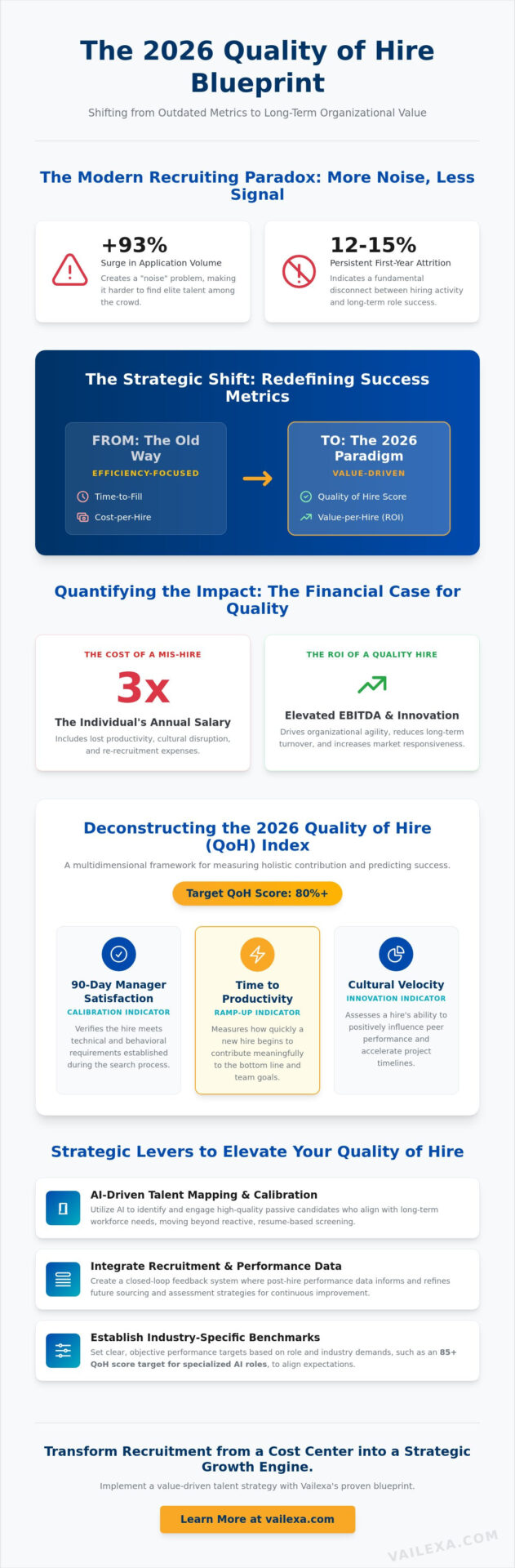
If your recruiting team is filtering through a 93% increase in applications only to see first-year attrition persist between 12% and 15%, you’re likely feeling the strain of a broken metric system. Most executive leaders recognize that traditional KPIs like time-to-fill don’t reflect the true value of a new hire; instead, they often mask deeper disconnects between recruitment activity and business unit performance. This guide delivers the definitive quality of hire benchmarks 2026 to help you transition from transactional hiring to a model focused on long-term organizational impact and ROI.
You’ll discover a standardized framework for measuring post-hire success, gain access to industry-specific benchmarks for your next board presentation, and learn how AI-driven talent mapping creates a more resilient workforce. We’ll show you how to bridge data silos. This process ensures talent acquisition becomes a high-precision engine for corporate growth. By shifting your focus toward a Quality of Hire score above 80%, you can transform recruitment from a cost center into a strategic driver of excellence.
Key Takeaways
- Transition your talent strategy from recruitment efficiency to long-term organizational value by adopting a “Value per Hire” framework that prioritizes impact over volume.
- Identify industry-specific performance targets, such as the 85+ target score for specialized AI roles, using our definitive quality of hire benchmarks 2026.
- Establish a multidimensional Quality of Hire Index that leverages 90-day manager satisfaction and cultural velocity to accurately predict first-year retention.
- Utilize advanced Talent Mapping and AI-driven calibration to secure high-quality passive candidates who align with your long-term strategic workforce planning.
- Learn how integrating these metrics into your RPO or Global Talent Solutions bridges the gap between immediate staffing needs and sustained corporate excellence.
Beyond Efficiency: Why Quality of Hire is the Definitive North Star for 2026
The talent acquisition landscape has undergone a fundamental transformation. For years, executive leaders obsessed over minimizing the expense of recruitment. Now, the conversation has pivoted toward maximizing the contribution of the individual. This shift defines the quality of hire benchmarks 2026, where “Value per Hire” replaces “Cost per Hire” as the primary metric of organizational health. It’s no longer enough to fill a seat; the goal is to secure a contributor who accelerates the business trajectory from day one.
Recent data from platforms like Greenhouse reveals a troubling paradox. While application volumes have surged by 93%, this abundance often functions as a threat to quality. It creates a “noise” problem that can drown out elite talent. Without proactive strategic workforce planning, recruiting teams find themselves reacting to volume rather than selecting for fit. Identifying the signal within this noise requires a move away from static resumes toward predictive talent mapping and multi-layered assessment strategies.
The ROI of Quality: Financial Impact of High-Performing Hires
Quantifying the impact of a hire goes beyond the initial onboarding phase. In 2026, the financial cost of a mis-hire is estimated at 3x the individual’s annual salary when accounting for lost productivity, cultural disruption, and re-recruitment expenses. High-quality hires do more than just perform; they elevate the EBITDA by reducing turnover and driving innovation. Organizations that hit their quality benchmarks see a direct correlation with increased organizational agility and market responsiveness. Talent Density is the primary driver of 2026 competitive advantage.
Efficiency vs. Quality: The Great RecOps Rebalancing
Modern Recruiting Operations (RecOps) must find a new equilibrium. While Ashby’s “Time to First Fill” remains a useful internal efficiency metric, it must be balanced against “First Year Performance” to ensure long-term success. Optimizing for speed alone often results in a lack of cultural alignment, leading to the 12% to 15% first-year attrition rates currently seen across the industry. To understand the broader context of Quality of hire, leaders are now integrating recruitment data directly with performance management systems. This integration allows for a closed-loop feedback system where post-hire performance informs future sourcing strategies. It’s a disciplined approach that ensures every hire is a building block for excellence rather than a temporary fix.
Deconstructing the 2026 Quality of Hire Index: Performance, Retention, and Cultural Velocity
The evolution of talent acquisition demands a more nuanced measurement than simple retention or performance scores. The 2026 Quality of Hire (QoH) Index represents a multidimensional framework that captures the holistic contribution of an individual to the enterprise. By synthesizing specific data points into a unified score, organizations can finally move past anecdotal success and rely on objective quality of hire benchmarks 2026. This index doesn’t just look at whether a hire stayed. It evaluates how effectively they propelled the business forward.
To build a robust index, three core metrics serve as the foundation. First, 90-Day Manager Satisfaction acts as the calibration indicator, verifying that the hire meets the technical and behavioral requirements established during the search. Second, Time to Productivity measures the ramp-up indicator, tracking how quickly an individual contributes to the bottom line. Finally, Cultural Velocity serves as the innovation indicator, assessing the hire’s ability to inspire peer performance and accelerate project timelines. These three pillars ensure that quality is measured by impact rather than mere presence; to help automate this tracking, you can visit Benchmarcx and utilize their platform for real-time talent experience benchmarking.
Measuring Post-Hire Impact
Standardizing manager surveys is essential to reduce the subjective bias that often plagues QoH scores. Leaders should move toward 360-degree feedback loops to distinguish between “Cultural Fit,” which often leads to stagnation, and “Cultural Add,” which fuels progress. Tracking the internal mobility rate provides a clear proxy for hire quality. High-quality talent typically ascends or pivots within the organization within 18 months. Consulting a comprehensive guide to quality of hire can help you refine these specific scoring methodologies.
Retention Benchmarks: The 12-Month Stability Test
Retention remains the ultimate validation of a successful search. For 2026, first-year attrition between 12% and 15% is considered the danger zone. This level of turnover signals a failure in either the selection process or the initial onboarding experience. It’s vital to differentiate between regrettable turnover, where top-tier talent departs, and non-regrettable turnover, which may actually improve talent density. Integrating diversity and inclusion consulting into your talent strategy directly correlates with higher 24-month retention rates by fostering an environment of belonging and psychological safety. To maintain these high standards, many organizations partner with a strategic workforce solutions provider to ensure their talent pipeline is both resilient and high-performing.
Global Benchmarks: Comparing Quality of Hire Performance Across Industries
Context is the most critical variable when evaluating talent impact. A “strong” score in a high-volume logistics environment looks radically different from the metrics required in a specialized research lab. To effectively utilize quality of hire benchmarks 2026, leaders must look beyond general averages and align their expectations with industry-specific realities. While a universal score above 80% is often considered a baseline for excellence, the path to achieving that number varies based on sector demands and organizational maturity.
In the Technology and AI sectors, the bar for quality has reached an all-time high. Because of the specialized nature of these roles, organizations now target a QoH score of 85 or higher. In this niche, quality is defined by technical precision and the ability to navigate rapid innovation cycles. Conversely, Professional Services firms must balance “Billable Readiness” with long-term cultural fit. For these organizations, a high-quality hire is one who can contribute to revenue within the first 30 days while demonstrating the leadership potential required for partnership tracks. In Manufacturing and Logistics, the focus shifts toward stability; here, retention serves as the primary validator of hire quality due to the high cost of operational disruption.
We often observe an “Enterprise Gap” where large organizations typically score 5% to 10% lower on quality indices than agile startups. This discrepancy usually stems from data silos and fragmented communication between decentralized business units. While startups benefit from high-visibility hiring where every individual’s impact is immediately felt, global enterprises must work harder to maintain a unified view of talent performance across thousands of hires.
Quality of Hire Benchmarks by Organization Size
Startups with fewer than 200 employees often exhibit high-risk, high-reward hiring patterns, where a single mis-hire can derail a product launch. Mid-market companies frequently struggle to standardize quality as they outgrow their initial “gut-feeling” recruitment processes. For Global Enterprises, the solution lies in leveraging Recruitment Process Outsourcing (RPO) to instill disciplined, data-driven standards across the entire talent lifecycle. This approach ensures that quality remains consistent even as hiring volumes scale.
Contingent vs. Permanent: Quality Benchmarks 2026
One of the most significant shifts in 2026 is the realization that quality benchmarks apply equally to the contingent workforce. High-performing organizations now use “Contract-to-Hire” conversion rates as a primary validator of their sourcing accuracy. By treating contingent talent as a strategic asset rather than a temporary fix, companies can build a more resilient talent pipeline. Utilizing specialized AI staffing solutions allows firms to maintain exceptionally high quality in technical niches, ensuring that even temporary contributors meet the rigorous standards expected of permanent executive leadership.
Strategic Levers to Move the Needle: Improving Your Quality of Hire Score
Elevating your performance against the quality of hire benchmarks 2026 requires a departure from reactive, tactical adjustments. True optimization happens when talent acquisition is treated as a high-precision engineering problem rather than a volume game. By pulling specific strategic levers, organizations can shift the bell curve of their workforce toward higher productivity and long-term stability. This process begins with a move away from “Signal” interference, ensuring that every stage of the funnel is calibrated to identify excellence.
Structured interviewing remains one of the most effective tools for reducing bias and increasing the “Signal” in candidate assessment. When interviewers use a standardized rubric aligned with core business outcomes, they create a data set that is actually comparable across candidates. This alignment is further strengthened by diversity-first sourcing. In 2026, diversity is no longer just a metric of compliance; it’s an innovation multiplier that directly impacts a hire’s ability to solve complex, non-linear problems. Organizations that prioritize inclusive sourcing see a measurable lift in their overall Quality of Hire Index by bringing in fresh perspectives that challenge the status quo.
The Role of Talent Mapping in Quality Assurance
Moving from a “Post-and-Pray” model to proactive talent pipeline building is essential for securing elite contributors. Recent data indicates that sourced candidates are eight times more likely to be hired than those from general applicant pools. This is why benchmarking “Source-to-Hire” conversion for outbound candidates is a critical exercise. By identifying the top 5% of industry talent before a role even opens, firms can ensure they aren’t just hiring who is available, but who is best. Vailexa utilizes advanced Talent Mapping to create these high-fidelity pipelines, ensuring a steady flow of “Passive Quality” into the enterprise.
AI Staffing Solutions: Calibrating for Future-Proof Skills
In 2026, the value of a candidate isn’t defined by what they know today, but by how quickly they can master what they’ll need to know tomorrow. Modern AI Staffing Solutions now assess “Learnability” and “Adaptability” as core competencies. Predictive Quality is the ability of AI to forecast 12-month performance based on interview data. These systems automate the first-pass screening without losing the human element of executive search, allowing recruiters to focus on the nuanced behavioral alignment that machines can’t yet replicate. This high-tech, high-touch approach ensures your talent strategy remains resilient in a volatile market.
Vailexa’s Blueprint: Orchestrating High-Quality Hires Through Strategic Workforce Planning
Vailexa’s blueprint transforms the theoretical quality of hire benchmarks 2026 into a functional reality for global enterprises. By integrating these metrics directly into our Recruitment Process Outsourcing (RPO) framework, we ensure that every sourcing decision aligns with long-term business objectives. Our Global Talent Solutions are designed to bridge the gap between immediate operational efficiency and sustained organizational impact. We don’t just fill vacancies. We act as a strategic partner, moving beyond transactional recruitment to build high-density talent pools that drive competitive advantage. Most organizations have mastered the art of efficient hiring, yet many still struggle with the science of impactful hiring. Our model solves this by treating Strategic Workforce Planning as the foundation of every engagement.
We transition your talent acquisition from a cost-per-hire focus to a value-per-hire model. This shift is essential for leaders who want to see their teams consistently exceed industry standards and contribute to EBITDA growth. By auditing your current state against established benchmarks, we help you identify the specific friction points where quality is being lost in the volume of modern applications.
Why Specialized RPO Beats Generalist Staffing
Generalist staffing firms often prioritize speed over precision. However, high-quality technical hiring requires deep domain expertise. Vailexa’s specialized AI recruitment services significantly elevate technical QoH scores by identifying candidates with the exact cognitive agility required for 2026’s complex roles. By aligning talent mapping with specific business unit performance data, we’ve helped clients reduce first-year attrition by 30%. This reduction is achieved through rigorous calibration and cultural velocity assessments that ensure a candidate’s long-term fit before the offer is extended. It’s a disciplined approach that turns recruitment into a predictable engine for excellence.
Action Plan: Implementing Your Quality Dashboard
Auditing your talent strategy is the first step toward excellence. To move your organization closer to the quality of hire benchmarks 2026, follow this structured action plan:
- Step 1: Define your internal QoH formula. Secure stakeholder buy-in across HR, finance, and operations to ensure the metric reflects actual business value rather than just hiring speed.
- Step 2: Integrate ATS and HRIS data. Create a single source of truth by linking recruitment activity to post-hire performance and retention data to close the feedback loop.
- Step 3: Partner for scale. Collaborate with a workforce solutions provider to implement these standards across global regions and diverse business units consistently.
Success in the current market requires more than just a reactive approach. It demands a disciplined, data-driven architecture that prioritizes the human element of growth. Optimize your 2026 talent strategy with Vailexa’s expert consulting.
Mastering the Future of Talent Impact
The transition from transactional recruitment to a value-driven talent strategy is no longer optional for organizations aiming for market leadership. By adopting the quality of hire benchmarks 2026, your enterprise can effectively bridge the gap between high-volume application noise and high-impact performance. You’ve seen how a multidimensional index, supported by predictive AI and proactive talent mapping, transforms the recruitment lifecycle into a predictable engine for growth. This evolution requires a disciplined focus on long-term stability rather than just immediate seat-filling.
Success depends on having a partner that possesses deep industry knowledge and a meticulous eye for detail. Vailexa offers Global RPO and Strategic Workforce Planning expertise, supported by specialized AI and Data Analytics staffing specialists. Our proven track record in Diversity & Inclusion consulting ensures your talent strategy remains both modern and inclusive. Elevate Your Talent Strategy: Partner with Vailexa for High-Impact Global Staffing. The path to organizational excellence starts with a commitment to quality. We’re ready to help you architect that future today.
Frequently Asked Questions
What is a good Quality of Hire score in 2026?
A score above 80% is generally considered strong for most organizations. However, specialized sectors like Technology and AI often target a benchmark of 85% or higher to account for the technical precision and innovation required in those roles. This score reflects a holistic view of an individual’s performance, cultural alignment, and long-term stability within the enterprise.
How do I calculate Quality of Hire for my organization?
You calculate this metric by averaging several key indicators, typically including 90-day manager satisfaction ratings, time to productivity, and first-year retention. By weighting these factors according to your specific business goals, you create a standardized index. This formula allows you to compare your internal results against the global quality of hire benchmarks 2026 to identify areas for strategic improvement.
Why is first-year attrition considered a quality benchmark?
First-year attrition serves as a critical indicator of selection accuracy and cultural alignment. When a new hire leaves within twelve months, it often suggests a disconnect between the candidate’s capabilities and the role’s requirements. High attrition rates signal that the recruitment process is failing to identify individuals who are truly equipped for long-term organizational impact and ROI.
Can AI staffing solutions actually improve the quality of my hires?
Yes, AI staffing solutions improve quality by identifying “Learnability” and “Adaptability” traits that traditional resumes often overlook. These tools analyze behavioral data to forecast how a candidate will perform over a twelve-month period. By automating high-volume screening, your team can focus on the nuanced human assessment necessary for securing elite executive talent that fits your culture.
What is the difference between Time to Fill and Time to Productivity?
Time to Fill measures the speed of the recruitment cycle from the job opening to the signed offer. In contrast, Time to Productivity tracks how long it takes for a new hire to reach full operational efficiency and start delivering measurable ROI. While Time to Fill highlights process efficiency, Time to Productivity is a far more accurate measure of true hire quality.
How does diversity and inclusion impact Quality of Hire benchmarks?
Diversity and inclusion function as innovation multipliers that directly elevate hire quality. Teams with diverse perspectives are statistically more likely to solve complex problems and drive creative breakthroughs. Integrating D&I consulting into your sourcing strategy ensures that your quality of hire benchmarks 2026 reflect a workforce capable of navigating a global, non-linear market with agility and resilience.
Why should enterprises use Talent Mapping to improve hire quality?
Talent Mapping allows enterprises to identify and engage high-performing passive candidates before a vacancy even exists. This proactive approach ensures you aren’t limited to the active applicant pool, which often represents only a fraction of available talent. By building strategic relationships with the top 5% of industry professionals, you consistently raise the performance bar for every new hire you bring on board.
What are the top recruitment metrics to track in 2026?
Beyond Quality of Hire, you should track Time to Productivity, Candidate Net Promoter Score (cNPS), and Source-to-Hire conversion for outbound candidates. Monitoring the internal mobility rate also provides insight into how well your hires are developing within the firm. These metrics collectively provide a 360-degree view of your talent acquisition effectiveness and its direct impact on organizational growth.