
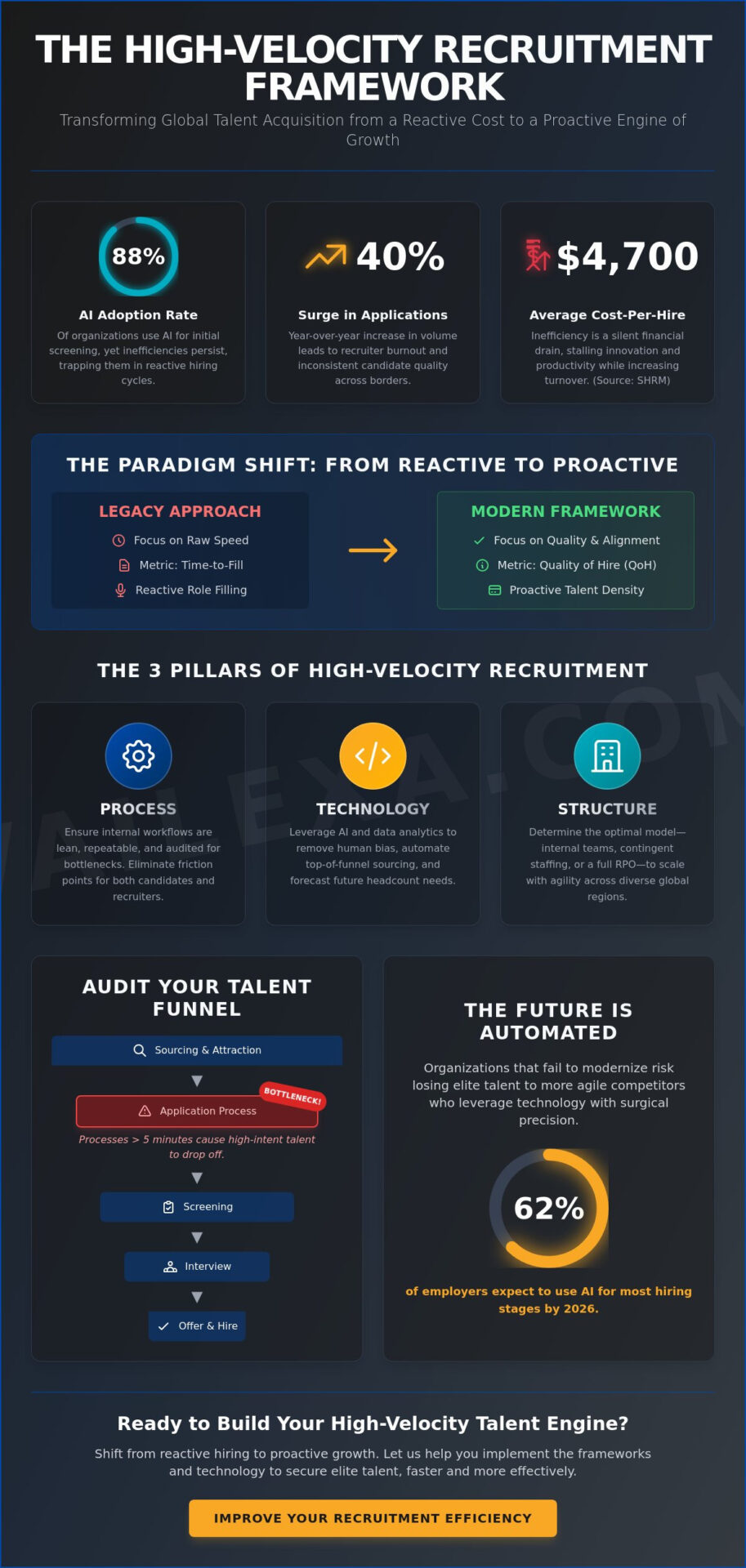
While 88% of organizations now utilize AI for initial candidate screening, many global enterprises remain trapped in a cycle of reactive hiring and escalating time-to-fill metrics. You’ve likely seen your teams struggle with application volumes that have surged 40% year-over-year, leading to recruiter burnout and inconsistent candidate quality across international borders. It’s clear that simply working harder is no longer a viable strategy to improve recruitment efficiency in a market defined by rapid technological shifts and complex regional regulations.
We understand the pressure to deliver elite talent while reducing the average cost per hire, which SHRM reports has reached approximately $4,700. This guide provides the strategic methodologies and high-velocity frameworks required to transform your recruitment function into a proactive engine of growth. You’ll master the integration of AI staffing solutions, the nuances of global RPO, and the precision of talent mapping. We’ll demonstrate how to synchronize modern recruitment technology with strategic workforce planning to ensure your talent acquisition aligns with executive objectives, maintains high organizational standards, and drives sustainable growth.
Key Takeaways
- Shift your focus from raw speed to a quality-first paradigm that aligns talent acquisition with long-term organizational excellence.
- Identify and eliminate critical friction points by conducting a comprehensive audit of your end-to-end talent acquisition lifecycle.
- Integrate AI and predictive analytics to automate top-of-funnel sourcing while accurately forecasting future headcount requirements.
- Evaluate the strategic benefits of RPO versus contingent staffing models to sustainably improve recruitment efficiency across diverse global regions.
- Deploy talent mapping and strategic workforce planning to move beyond reactive hiring toward a proactive, high-velocity talent engine.
Defining Recruitment Efficiency in the Modern Global Enterprise
Efficiency in 2026 isn’t found in a stopwatch. While legacy platforms often emphasize speed as the primary indicator of success, true efficiency is the synergy of precision, alignment, and resource optimization. A high-velocity hiring process that lacks strategic depth only accelerates the rate of costly attrition. To improve recruitment efficiency, global leaders must shift their perspective from reactive filling to proactive talent density. This paradigm shift requires a deep understanding of foundational recruitment concepts viewed through the lens of modern, data-driven strategy.
The modern Efficiency Ratio balances the immediate cost-per-hire against the long-term value a candidate brings to the organization. This isn’t a simple calculation of dollars spent; it’s an assessment of how well your talent acquisition function supports business growth. This strategy rests on three distinct pillars. Process ensures your internal workflows are lean and repeatable. Technology leverages AI and data to remove human bias and manual labor. Structural strategy determines whether you utilize internal teams, contingent staffing, or a full RPO model to scale with agility.
Key Metrics Beyond Time-to-Fill
Quality of Hire (QoH) is the most critical metric for any enterprise seeking to improve recruitment efficiency. It measures the first-year performance and cultural integration of new recruits, ensuring that “fast” hires are also “right” hires. Additionally, monitoring Recruiter Capacity Utilization prevents your internal teams from becoming over-leveraged, which is a primary driver of burnout and errors. Finally, the Candidate Net Promoter Score (cNPS) provides a window into your employer brand’s health. A seamless candidate experience reduces the effort required to close top-tier talent in a competitive market.
The Cost of Recruitment Inefficiency
Inefficiency acts as a silent financial drain on the balance sheet. When critical roles remain vacant, the impact isn’t just a missing salary; it’s a loss of momentum, stalled innovation, and decreased productivity across the entire department. This creates a ripple effect where existing employees take on excessive workloads, leading to a decline in morale and potential secondary turnover. In a global market where 62% of employers expect to use AI for most hiring stages by 2026, the opportunity cost of maintaining manual, sluggish processes is too high to ignore. Organizations that fail to modernize their approach risk losing elite talent to more agile competitors who can identify and secure high-potential candidates with surgical precision.
Auditing Your Talent Acquisition Lifecycle for Bottlenecks
Optimization begins with visibility. You can’t fix what you haven’t measured. A comprehensive audit reveals the structural fractures that impede your ability to improve recruitment efficiency. Most global enterprises operate with legacy processes that haven’t evolved alongside their technology, creating a friction-heavy experience for both recruiters and candidates. This audit isn’t merely a checklist; it’s a deep dive into the mechanics of how talent moves through your organization.
Identifying where candidates drop out of your funnel is essential. If your application process takes longer than five minutes, you’re likely losing high-intent talent to more agile competitors. Recent insights into AI in talent acquisition highlight how automated screening and engagement tools can maintain momentum, yet these tools only work if your underlying funnel is sound. You must evaluate whether your ATS is a bridge or a barrier. If your recruiters are spending hours on manual data entry between systems, your tech stack is actively working against your growth goals.
Step 1: Mapping the Candidate Journey
Begin by reviewing the clarity of your job descriptions. Vague requirements often lead to the 40% surge in application volume many organizations are seeing in 2026, which ironically makes finding the right person harder. Assess your interview-to-offer ratio across different departments. A high ratio often indicates a lack of alignment on candidate personas or poor initial screening. While employee referrals can reduce hiring time by 55%, relying solely on them without a structured journey audit can lead to stagnant innovation and missed talent pools. Identifying every manual task that can be eliminated will free your team to focus on high-value human interaction.
Step 2: Stakeholder Alignment Audit
Internal friction between the recruitment team and hiring managers is a primary cause of bloated time-to-fill metrics. Standardizing interview scorecards reduces subjective decision-making and prevents “analysis paralysis” at the final stage. You should also focus on streamlining the approval process for new requisitions. If an offer requires five levels of sign-off, the candidate has likely already accepted another position. Integrating diversity and inclusion consulting principles ensures that bias doesn’t create artificial delays or narrow your talent pool unnecessarily.
A strategic workforce solutions provider can offer the external perspective needed to spot these internal blind spots. By auditing these touchpoints, you move from a reactive posture to a controlled, high-velocity operation that prioritizes precision over sheer activity.
Leveraging AI and Data Analytics to Automate High-Value Outcomes
Harnessing the power of intelligent automation is no longer an optional upgrade; it’s the standard for organizations that intend to improve recruitment efficiency in 2026. With 62% of employers now utilizing AI for most or all stages of the hiring lifecycle, the competitive advantage has shifted from those who simply use these tools to those who master their strategic application. By integrating advanced technology, your talent acquisition function moves from a cost-heavy administrative department to a high-velocity growth engine that anticipates business needs before they become critical gaps.
Automation excels at removing the friction of high-volume tasks that traditionally lead to recruiter burnout. Intelligent systems now manage complex interview scheduling across multiple time zones and ensure consistent candidate follow-ups without manual intervention. These tools also play a vital role in maintaining compliance with evolving regional regulations, such as the AI-specific disclosure requirements effective in 2026 across Illinois, Texas, and Colorado. By automating these baseline operations, your team can redirect their focus toward the sophisticated human interactions that define an elite employer brand.
AI-Powered Talent Sourcing
Machine learning algorithms now scan vast digital footprints to identify passive candidates who possess the exact skill sets required for niche roles. This technology significantly reduces time-to-slate by performing automated skill validation and initial screening with surgical precision. AI unearths high-potential candidates by analyzing digital footprints and career trajectories to identify top-tier talent that remains invisible to traditional manual search methods. This capability allows your organization to build a robust pipeline of qualified individuals long before a requisition is even opened.
Data Analytics for Strategic Decision Making
85% of HR professionals recognize that data analytics is now a critical component of successful recruitment. Strategic workforce planning relies on this data to move beyond historical reporting into the realm of predictive forecasting. Utilizing real-time market insights allows you to adjust salary benchmarks and offer packages dynamically, ensuring you remain competitive in a landscape where pay scale transparency is increasingly mandated. To achieve this level of sophistication, many global firms choose to partner with specialized AI staffing solutions to build the internal data capabilities necessary for long-term stability.
While technology provides the speed, human oversight remains the guardian of organizational standards. Data analytics can track diversity metrics in real-time to ensure equitable pipeline growth, but it’s the human recruiter who fosters the relationships and cultural alignment that technology cannot replicate. True efficiency is found at the intersection of machine-driven precision and human-led strategy, creating a recruitment process that is both technologically advanced and deeply personal.
Structural Shifts: RPO vs. Contingent Staffing for Scalable Growth
Internal recruitment teams frequently encounter a ceiling where application volume outpaces human capacity. When your internal resources are stretched too thin, the quality of hire inevitably declines and time-to-fill metrics begin to bloat. To improve recruitment efficiency at a global scale, you must decide when to transition from a purely internal model to a more agile, structural partnership. This decision hinges on your need for rapid scalability and the specific technical specializations required by your 2026 growth targets.
The Recruitment Process Outsourcing (RPO) market is expanding by 18.5% annually, as organizations seek to mitigate the rising costs of traditional hiring. With the average cost-per-hire reaching approximately $4,700 in 2026, enterprises are increasingly turning to externalized models to protect their margins. This model offers a comprehensive transformation of the talent function, providing access to sophisticated tech stacks and global compliance frameworks that are often cost-prohibitive to build internally. By leveraging an RPO partner, you ensure that your hiring standards remain consistent across diverse regions, adhering to the strict pay transparency laws in California or the new AI-governance regulations in Texas.
Maximizing ROI with RPO
Recruitment Process Outsourcing (RPO) serves as a strategic extension of corporate HR, integrating specialized expertise and enterprise-grade technology into the existing organizational framework. This alignment allows enterprises to capitalize on the provider’s economies of scale, often resulting in a more predictable cost structure than traditional internal methods. Beyond cost, RPO providers offer the stability needed to maintain a high-velocity hiring engine during periods of rapid expansion or reorganization, ensuring that your talent pipeline never runs dry. For global organizations seeking to build lasting talent density at scale, enterprise RPO solutions provide the architectural framework to reduce cost-per-hire by up to 50% while cutting time-to-fill nearly in half.
The Agility of Contingent Staffing
While RPO focuses on the permanent workforce, contingent staffing provides the flexibility necessary to manage project-based needs and market volatility. This model reduces long-term overhead and commitment risks, allowing you to scale up for specific initiatives without increasing permanent headcount. Integrating contingent labor into your broader strategic workforce plan ensures that your organization remains lean and responsive to shifting economic conditions, providing a buffer against the uncertainty of global markets.
The most successful global enterprises often adopt a hybrid model. This approach combines the deep cultural knowledge of an internal team with the specialized reach of a professional workforce solutions provider. By balancing internal insights with external agility, you create a resilient infrastructure that can pivot as quickly as the market demands. This structural synergy ensures that your talent acquisition is never a bottleneck, but rather a catalyst for organizational excellence and long-term stability.
Why Strategic Workforce Planning is the Ultimate Efficiency Tool
True efficiency isn’t found in the speed of a reaction, but in the depth of a plan. While previous sections explored process audits and AI integration, the most sustainable way to improve recruitment efficiency is through the rigorous application of strategic workforce planning. This methodology shifts the focus from filling immediate vacancies to architecting a multi-year talent roadmap. By aligning human capital strategy with 3-5 year business growth objectives, you eliminate the frantic, high-cost cycles of emergency hiring that often lead to sub-optimal placements. It’s about moving from a reactive cost center to a proactive engine of organizational excellence.
Reactive hiring is inherently inefficient because it forces decision-makers to choose from whoever is available in the market at a specific moment. In contrast, a strategic approach allows you to audit current team capabilities and forecast future headcount needs with precision. This foresight ensures that your recruitment efforts are always synchronized with your broader corporate trajectory. When you anticipate a skill gap twelve months before it impacts productivity, you gain the luxury of time to secure the highest quality talent without the premium costs associated with desperation hires.
The Power of Talent Mapping
Talent mapping serves as the tactical edge of a proactive strategy. It involves identifying and nurturing potential leaders before a vacancy even exists, creating a state of perpetual readiness. This approach allows your organization to build a comprehensive competitive intelligence database of industry talent, effectively reducing executive search timelines through pre-vetted pipelines. When a critical role opens, you aren’t starting from zero; you’re activating a relationship that has already been cultivated. This level of precision is what separates high-velocity growth engines from organizations that are merely busy with administrative tasks.
Implementation and Next Steps
Developing a roadmap for multi-year workforce evolution requires a commitment to data-driven insights and a willingness to challenge traditional hiring cycles. You must measure the success of your efficiency initiatives through meticulous ROI tracking, looking beyond simple activity metrics to evaluate long-term talent density and retention. Partnering with a global workforce solutions provider like Vailexa bridges the gap between vision and execution. We provide the search accuracy and industry depth required to turn a complex workforce plan into a tangible competitive advantage. By treating recruitment as a strategic investment rather than an administrative expense, you secure your organization’s future and improve recruitment efficiency in an increasingly volatile global landscape.
Architecting Your Future Talent Engine
Transitioning from reactive hiring to a high-velocity growth engine requires more than just faster software. It demands a holistic commitment to auditing your lifecycle for friction, integrating intelligent automation, and aligning every hire with long-term business objectives. Organizations that successfully improve recruitment efficiency in 2026 will be those that treat talent acquisition as a core strategic pillar rather than an administrative necessity. Success in this new landscape depends on your ability to anticipate needs before they become critical gaps.
Realizing this vision requires a partner who combines global reach with localized expertise. Vailexa provides the specialized AI and data analytics staffing, along with proven RPO and contingent workforce models, necessary to navigate a complex international landscape with precision. By moving beyond simple activity metrics, you secure the talent density required for sustainable excellence and long-term stability. The future of your enterprise is built on the strength of its people.
Optimize your global talent strategy with Vailexa today and transform your workforce into a resilient, proactive asset.
Frequently Asked Questions
What is the fastest way to improve recruitment efficiency?
The most immediate way to improve recruitment efficiency is to conduct a friction audit of your application funnel and automate administrative touchpoints like interview scheduling. By removing manual data entry and streamlining the approval process for requisitions, you eliminate the primary causes of delay. This tactical shift allows your recruiters to focus on high-value candidate engagement rather than logistical coordination, resulting in a faster, more precise hiring cycle.
How does AI actually help in the recruitment process?
AI enhances the recruitment process by performing high-velocity candidate matching and predictive talent forecasting. These systems scan vast digital footprints to identify passive talent with surgical precision, reducing the time required to build a qualified slate. Additionally, automated screening tools ensure that only the most aligned candidates reach the interview stage, protecting your hiring managers’ time and ensuring that human interaction is reserved for high-potential prospects.
Is RPO more efficient than having an in-house recruitment team?
RPO is often more efficient for global enterprises because it offers immediate access to specialized technology and scalable resources that an in-house team may lack. While internal teams possess deep cultural knowledge, an RPO partner provides the structural agility to handle sudden surges in volume. This model ensures consistent hiring standards and regulatory compliance across diverse international regions without increasing permanent internal headcount or overhead costs. To understand the full scope of what this model entails, exploring what is RPO and how it functions as a strategic talent engine can help clarify whether it is the right fit for your organization.
How can we improve recruitment efficiency without increasing our budget?
You can improve recruitment efficiency on a fixed budget by optimizing your employee referral program and refining your job descriptions to deter unqualified applicants. Referrals often reduce hiring time by 55% while maintaining a high quality of hire. Additionally, standardizing interview scorecards reduces the time lost to subjective decision-making, ensuring that your existing resources are utilized with maximum precision and strategic alignment.
What are the most important recruitment KPIs to track in 2026?
In 2026, the most critical KPIs shift from raw speed to strategic alignment, focusing on Quality of Hire and Candidate Net Promoter Score. Measuring the first-year performance of new recruits ensures that your process delivers long-term value rather than just quick fills. Tracking Recruiter Capacity Utilization is also vital to prevent team burnout and ensure that your talent acquisition function remains a sustainable growth engine for the organization.
Can contingent staffing help with recruitment efficiency for permanent roles?
Contingent staffing supports permanent recruitment by providing a flexible talent pool for immediate project needs while you evaluate long-term cultural fit. This “temp-to-perm” approach allows organizations to maintain productivity without the risks of a premature permanent commitment. It also serves as a vital component of talent mapping, ensuring you have a pre-vetted pipeline of experts ready for future organizational shifts and permanent vacancies.
How do we maintain candidate experience while increasing hiring speed?
Maintaining a premium candidate experience while accelerating the process requires a strategic balance between automated communication and personalized human interaction. Automation should handle the immediate, logistical updates that candidates crave, while recruiters focus on building relationships during the interview and offer stages. This hybrid approach ensures candidates feel valued and informed without sacrificing the momentum of a high-velocity hiring process that respects their time.