
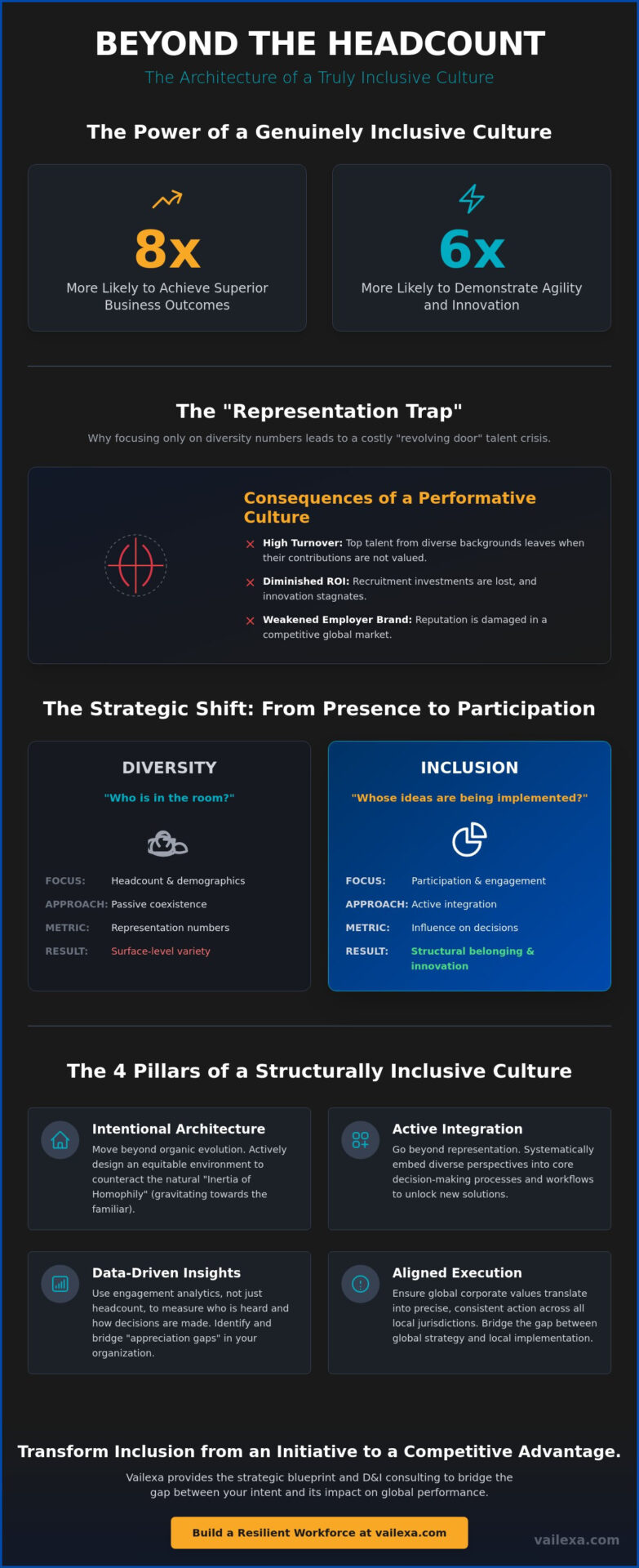
Organizations with inclusive cultures are eight times more likely to achieve superior business outcomes and six times more likely to demonstrate agility. Yet, for many global enterprises, the reality of building an inclusive culture remains elusive. You likely recognize the friction that arises when diversity hiring does not lead to true integration, often resulting in high turnover among top talent and a nagging perception that DEI efforts are merely performative. It is a common challenge for leaders who possess the vision for growth but lack the structural architecture to sustain it.
We understand that your goal is to transform these initiatives into a genuine competitive advantage. This article provides a sophisticated roadmap to move beyond optics and toward a structurally inclusive environment that drives global performance. You will discover a scalable framework designed to improve retention and align your corporate values with precise execution across diverse jurisdictions. We will explore how to bridge the gap between intent and impact; ensuring your workforce remains as resilient as it is representative.
Key Takeaways
- Identify why representation is only the first step and learn to transition toward the active integration of diverse perspectives in core decision-making.
- Analyze the “Inclusion Premium” to resolve the perceived conflict between high-performance standards and diverse talent acquisition.
- Discover the four non-negotiable structural pillars necessary for building an inclusive culture that scales across global jurisdictions.
- Learn how to leverage data-driven insights to bridge appreciation gaps and move from performative DEI to systemic organizational stability.
- Understand the importance of aligning global values with local execution through strategic workforce architecture and D&I consulting.
Decoding the Inclusion Mandate: Why Diversity Numbers Are Only Half the Story
High-performance organizations frequently mistake a diverse headcount for a functional culture. While achieving demographic variety is a significant milestone, it remains a hollow victory if those individuals don’t feel empowered to influence the organization’s trajectory. True inclusion isn’t a passive state of coexistence; it’s the active integration of diverse perspectives into the very fabric of core decision-making. When organizations adopt Diversity, equity, and inclusion frameworks, they often focus heavily on the first pillar while neglecting the critical mechanics of the second. This oversight creates a “Representation Myth” where surface-level variety masks a deeper lack of cultural belonging.
Failure to bridge this gap leads to a “revolving door” talent crisis. Highly skilled professionals from underrepresented backgrounds quickly identify when their presence is merely performative. If their insights aren’t sought or their expertise is sidelined, they will seek environments where their contributions carry weight. This churn is costly. It erodes morale and damages your reputation in a competitive global market. In contrast, building an inclusive culture acts as a catalyst for global workforce agility, allowing teams to pivot faster and solve complex problems with greater precision.
Diversity vs. Inclusion: The Strategic Distinction
Diversity identifies the participants, but inclusion governs the participation. In the 2026 corporate environment, sophisticated enterprises must move beyond basic headcount metrics and embrace engagement analytics that measure how effectively different voices are being heard. It’s no longer enough to know who is in the room; you must understand who is speaking and whose ideas are being implemented. This is where specialized diversity and inclusion consulting becomes indispensable for defining a clear path from simple metrics to strategic excellence. By analyzing interaction patterns and decision-making flows, leaders can identify where their culture is thriving and where it is stagnating.
The High Cost of the “Representation Only” Approach
The financial impact of an exclusionary culture is often hidden but always substantial. When hidden biases permeate your talent mapping processes, they undermine any surface-level diversity gains by capping the growth of your most innovative employees. This leads to diminished ROI on recruitment and a weakened employer brand that struggles to attract top-tier global talent. Organizations that prioritize optics over architecture find themselves constantly replacing talent rather than developing it. Ultimately, we must view inclusion as the structural optimization of cognitive diversity. By building an inclusive culture that prioritizes systemic integration, you ensure that every hire becomes a long-term asset rather than a temporary statistic.
Myth vs. Reality: Why Inclusive Cultures Don’t Evolve Organically
A common misconception among executives is the belief that hiring talented, well-meaning individuals will naturally result in a cohesive, equitable environment. This assumption ignores the psychological phenomenon known as the “Inertia of Homophily.” Humans possess an innate tendency to gravitate toward those who share similar backgrounds, experiences, and communication styles. Left to its own devices, a group won’t evolve into an inclusive unit; it will likely calcify into a series of exclusionary silos that reinforce existing power dynamics. This organic evolution doesn’t just stall progress; it actively preserves the status quo by rewarding familiarity over innovation.
Building an inclusive culture requires more than hope. It demands intentional structural intervention. Without a deliberate framework, the “natural” growth of a company often mirrors the biases of its founders and earliest employees. This is why global talent solutions must be architected with precision. We must move beyond the idea that culture is a byproduct of social interactions and recognize it as a result of disciplined workforce design. Following specific steps to building an inclusive culture helps ensure that your organization doesn’t fall back on comfortable, yet limiting, patterns of behavior. If you’re ready to move beyond these patterns, our strategic workforce planning experts can help you design a more resilient organizational structure.
The Fallacy of the “Natural” Cultural Fit
For years, “culture fit” served as a standard metric in recruitment. However, this term often acts as a proxy for unconscious bias, rewarding candidates who mirror the current team rather than those who challenge it. Sophisticated organizations are now transitioning from “culture fit” to “culture add.” This shift focuses on what a candidate brings to the table that the organization currently lacks. Implementing inclusive hiring practices is essential for disrupting these feedback loops. It’s about auditing every micro-experience in the employee lifecycle to ensure that merit, not similarity, drives advancement.
Leadership Modeling: Beyond the Mission Statement
True cultural transformation begins at the top, yet it’s often where the greatest disconnect exists. A polished mission statement is meaningless if daily managerial behaviors don’t reflect those stated values. Executive search must evolve to prioritize “inclusive intelligence” as a core competency for C-suite candidates. Leaders need the ability to navigate complex global values while executing local inclusion mandates with precision. When building an inclusive culture, the gap between corporate values and daily actions must be closed through rigorous accountability. Aligning global leadership with local execution ensures that inclusion becomes a lived reality rather than a corporate slogan.
The Performance Paradox: Debunking the Conflict Between Inclusion and Excellence
The persistent myth that inclusion compromises excellence is not just inaccurate; it’s a strategic liability. Critics often suggest that prioritizing diversity dilutes candidate quality, yet data suggests the opposite is true. According to research from Paradigm published in June 2025, companies with diverse leadership are 48% more likely to report increased financial performance. This “Inclusion Premium” exists because diverse perspectives accelerate problem-solving and provide a broader understanding of global markets. When organizations commit to building an inclusive culture, they aren’t lowering the bar. They’re expanding the field of vision to identify excellence that was previously obscured by systemic bias.
Inclusive cultures actually sharpen meritocracy by removing the invisible barriers that prevent top talent from contributing at their highest level. In a traditional, homogenous environment, “merit” is often conflated with “familiarity,” leading to a stagnation of ideas. By contrast, a structurally inclusive framework ensures that every individual’s expertise is leveraged based on its objective value. This approach is particularly critical when implementing modern AI staffing solutions. Without an inclusive foundation to oversee algorithmic inputs and outputs, AI tools can inadvertently replicate the very biases that high-performing enterprises seek to eliminate.
Reframing Meritocracy in a Global Context
A sophisticated definition of merit must account for diverse cognitive approaches and cultural intelligence. Standardized hiring processes often miss “hidden gems” in the global talent pool because they rely on narrow, localized definitions of success. By broadening these criteria, you capture a wider range of talent that brings unique problem-solving capabilities to the table. Inclusion is the ultimate realization of a true meritocracy. It ensures that the most effective ideas rise to the top, regardless of where they originated or who presented them.
Innovation as a Result of Psychological Safety
Innovation thrives in environments where employees feel safe to “fail fast” and challenge the status quo. When building an inclusive culture, you create a buffer against groupthink, which is the primary killer of agility in strategic workforce planning. Inclusive teams are 1.7 times more likely to be innovation leaders, as noted by eduMe in August 2021. This performance boost is directly measurable through innovation output and speed-to-market metrics. By fostering psychological safety, you unlock the full creative potential of your workforce, transforming individual differences into a collective competitive advantage.
- Increased Financial Performance: 48% higher likelihood of success with diverse leadership.
- Better Business Outcomes: 8 times more likely to achieve superior results in inclusive cultures.
- Agility and Innovation: 6 times more likely to be agile and innovative.
From Performative to Systemic: Structural Pillars of a Truly Inclusive Culture
Moving beyond the performance paradox requires a shift from superficial initiatives to a robust, systemic architecture. In 2026, building an inclusive culture is no longer a discretionary HR project; it’s a core operational discipline. To achieve this, organizations must anchor their efforts in four non-negotiable pillars: data-driven accountability, strategic workforce alignment, inclusive infrastructure, and radical transparency. These pillars ensure that inclusion isn’t just a sentiment but a measurable outcome that drives global performance. By identifying appreciation gaps through rigorous analysis, leaders can pinpoint exactly where their culture is leaking talent and where their values are failing to translate into daily practice.
Systemic inclusion demands that every employee, regardless of their background or location, experiences the same level of support and opportunity. This level of consistency is only possible when inclusion is woven into the very fabric of strategic workforce planning. When your workforce architecture accounts for diverse needs from the outset, you eliminate the friction that typically derails global teams. Transparent communication and continuous feedback loops then serve as the nervous system of this structure, allowing the organization to adapt and refine its approach in real time.
Data-Driven Inclusion: Auditing the Employee Journey
Sophisticated enterprises are moving away from the limitations of annual surveys in favor of real-time inclusion pulse checks. By using advanced data analytics, you can track promotion parity, sentiment, and retention across various demographics with surgical precision. This data-driven approach reveals the “hidden” barriers that often go unnoticed by leadership. Partnering with specialized DEI consulting firms allows you to conduct these strategic audits with an objective lens, ensuring that your interventions are based on facts rather than assumptions. This level of insight is essential for building an inclusive culture that stands up to the scrutiny of both internal stakeholders and external regulators.
Inclusive Infrastructure: Policies That Empower
Infrastructure is the often-overlooked backbone of cultural transformation. It involves designing flexible work policies that accommodate diverse life stages, religious practices, and physical needs. It also requires ensuring equitable access to mentorship and high-visibility global assignments, which are often the gatekeepers of career advancement. Key elements of inclusive infrastructure include:
- Customized Flexibility: Policies that account for neurodiversity and varying caregiving responsibilities.
- Global Mentorship Programs: Structured pathways that connect underrepresented talent with executive leadership.
- Integrated Contingent Staffing: Ensuring your temporary and contract workforce is fully immersed in your inclusive values.
If you’re ready to transform your organizational architecture, explore how our Diversity & Inclusion Consulting can align your global workforce strategy with measurable excellence.
Navigating the Cultural Transformation: How Vailexa Bridges the Strategy Gap
Execution remains the primary hurdle for organizations attempting to move from inclusive intent to systemic reality. While many firms offer software or surface-level training, Vailexa acts as a visionary architect of high-performance workforces. We recognize that building an inclusive culture is an exercise in structural precision, requiring the seamless integration of Diversity & Inclusion (D&I) Consulting with everyday operational functions. Our approach ensures that your cultural values aren’t just decorative statements on a website but are active drivers of your global performance. We transform inclusion from a perceived liability or “check-box” exercise into a formidable competitive advantage.
Our methodology focuses on the “inclusive intelligence” of your leadership tier. Through our specialized executive search services, we identify and secure leaders who possess the rare ability to manage diverse cognitive approaches while maintaining a commitment to excellence. These leaders serve as the anchors for your cultural transformation, ensuring that the structural changes we implement are mirrored in daily managerial behaviors. By bridging the gap between high-level strategy and granular execution, we help you build a workforce that is as resilient as it is representative.
The Vailexa Approach to Inclusive Talent Acquisition
Talent acquisition is the first point of contact for any cultural shift. We utilize customized talent mapping to prioritize cognitive and background diversity, ensuring your pipeline is rich with perspectives that drive innovation. Our global RPO models embed inclusion at every stage of the recruitment funnel, from the initial sourcing algorithms to the final offer stage. This systematic approach has yielded significant results for our partners. In a recent engagement, we helped a global enterprise realize a 30% reduction in turnover among diverse talent by implementing these structural inclusion frameworks. We don’t just find people; we architect environments where those people can excel.
Your Strategic Partner in Global Inclusion
Navigating the complex regulatory landscape of 2026 requires a partner with deep industry knowledge. Whether you’re adapting to the U.S. EEOC’s National Enforcement Plan for 2025–2029 or transposing the EU Pay Transparency Directive, our consultative support ensures your practices remain compliant and progressive. There is also a powerful synergy between our AI staffing solutions and inclusive culture building. We ensure that your technological tools are configured to eliminate bias, providing a data-driven foundation for equitable growth. It’s time to move beyond performative DEI and secure your organization’s future. Partner with Vailexa to build your inclusive future.
Architecting the High-Performance Global Workforce
Transitioning from a “representation-only” mindset to a structurally inclusive environment is the defining challenge for today’s global leaders. We’ve explored how building an inclusive culture requires more than just goodwill; it demands a disciplined approach to workforce architecture that removes systemic barriers and prioritizes cognitive diversity. By debunking the performance paradox and embracing intentional design, you ensure that excellence remains the standard across every level of your organization. This shift from performative metrics to systemic integration is the only sustainable path to global agility in 2026.
Vailexa stands ready as your high-level strategic partner to bridge the gap between vision and execution. We offer a sophisticated combination of global reach with localized D&I expertise, supported by a data-driven methodology that measures true cultural belonging. Our integrated talent solutions, ranging from contingent staffing to executive search, are designed to align your corporate values with measurable performance outcomes. Secure your organization’s future with a bespoke inclusion strategy from Vailexa. It’s time to transform your workplace into a resilient, innovation-led engine of growth.
Frequently Asked Questions
How do you measure the success of an inclusive culture?
Measuring success requires a transition from demographic headcount to sophisticated engagement analytics and promotion parity metrics. Organizations must track sentiment across various demographics to identify exactly where talent is stagnating or thriving. By auditing the employee journey in real time, you can quantify cultural belonging and its impact on performance. This data-driven approach ensures that your efforts result in long-term stability rather than surface-level variety.
What is the first step in building an inclusive culture for a global team?
The first step is a comprehensive structural audit to identify existing appreciation gaps within your workforce. You must analyze how diverse perspectives are currently integrated into core decision-making processes across different jurisdictions. This foundational assessment allows you to align global values with local execution mandates effectively. By establishing this baseline, you can design a roadmap for building an inclusive culture that addresses specific organizational frictions.
Does building an inclusive culture require a large budget?
Structural realignment often yields more significant results than a massive capital injection. While resources are necessary for specialized consulting and data tools, much of the work involves auditing existing policies and training leaders in inclusive intelligence. You don’t need a large budget to transition from culture fit to culture add in your recruitment processes. It’s about intentional workforce architecture and the disciplined application of inclusive principles.
How can AI help in building an inclusive workplace culture?
AI serves as a powerful tool for identifying hidden biases in recruitment and promotion pathways that human oversight might miss. Sophisticated AI staffing solutions analyze interaction patterns and decision-making flows to pinpoint where specific demographics might be sidelined. By leveraging these data-driven insights, organizations can implement targeted interventions that ensure equitable growth. This technological oversight provides a level of objectivity that fosters a more meritocratic environment. To explore how AI and semantic analysis are evolving to support these goals, you can learn more about Ubestream Inc..
What are the most common barriers to workplace inclusion in 2026?
The Inertia of Homophily remains a primary barrier, as groups naturally gravitate toward familiarity over diversity. Additionally, the 2026 regulatory environment, such as the U.S. EEOC’s National Enforcement Plan, requires companies to move beyond performative DEI toward legally compliant, merit-based frameworks. Overcoming these barriers requires a shift from superficial social initiatives to disciplined, systemic workforce design. Building an inclusive culture in this climate demands a proactive approach to pay transparency and digital accessibility.
How does inclusive hiring differ from regular recruitment?
Inclusive hiring prioritizes culture add by actively seeking candidates who bring unique cognitive approaches that the current team lacks. Regular recruitment often defaults to culture fit, which inadvertently rewards similarity and reinforces existing biases. Inclusive practices involve rigorous talent mapping and the auditing of every micro-experience to ensure merit drives advancement. This approach transforms recruitment from a simple replacement function into a strategic engine for organizational innovation.
Why do many DEI initiatives fail to produce a truly inclusive culture?
Most initiatives fail because they treat inclusion as a soft HR project rather than a core structural discipline. When efforts are detached from core decision-making and executive accountability, they become performative optics. These programs often focus on representation numbers without addressing the underlying cultural architecture that prevents true integration. Without systemic alignment, organizations suffer from a revolving door talent crisis where diverse hires exit due to a lack of genuine belonging.
Can an inclusive culture be maintained in a 100% remote workforce?
Maintaining an inclusive culture in a remote environment is entirely possible through intentional digital infrastructure and transparent communication. You must ensure equitable access to high-visibility assignments and mentorship, regardless of an employee’s physical location. Digital accessibility standards, such as those required by the European Accessibility Act, play a critical role in fostering an environment where all employees can contribute. Remote inclusion requires proactive engagement and the use of analytics to prevent exclusionary silos.