
Most organizations treat talent acquisition as a perpetual fire drill, yet the most agile global leaders recognize that predictive workforce planning is no longer a data science experiment. It has become the essential bridge between market intelligence and organizational survival. You’ve likely felt the frustration of a high-cost bad hire or the budget strain that occurs when reactive contingent staffing becomes your default setting. In a market where turnover in AI roles remains volatile and the EU AI Act now mandates strict transparency for recruitment systems as of August 2026, staying ahead of the curve requires more than just intuition.
We’re here to help you transform that dynamic. By mastering predictive workforce analytics, you can move beyond the “hiring-on-demand” trap and build a proactive engine for strategic growth. This article outlines a 2026 roadmap to help you achieve accurate 12-month talent forecasting, significantly lower your time-to-fill for critical roles, and ensure your HR strategy is perfectly aligned with your most ambitious business objectives. We’ll move from high-level vision to the granular execution required to maintain a competitive edge in the global talent market.
Key Takeaways
- Shift from reactive gap analysis to a sophisticated modeling approach that synthesizes AI-driven forecasting with high-level strategic alignment.
- Utilize machine learning to detect flight risk patterns early, allowing you to secure your human capital before attrition disrupts your momentum.
- Expand your vision beyond internal data by integrating external market intelligence and talent mapping into your organizational planning.
- Adopt a disciplined five-step roadmap to elevate your HR capabilities from standard reporting to high-impact predictive workforce planning.
- Achieve superior business-HR alignment by transforming your recruitment process into a proactive driver of long-term global agility.
The Evolution of Workforce Planning: From Reactive to Predictive in 2026
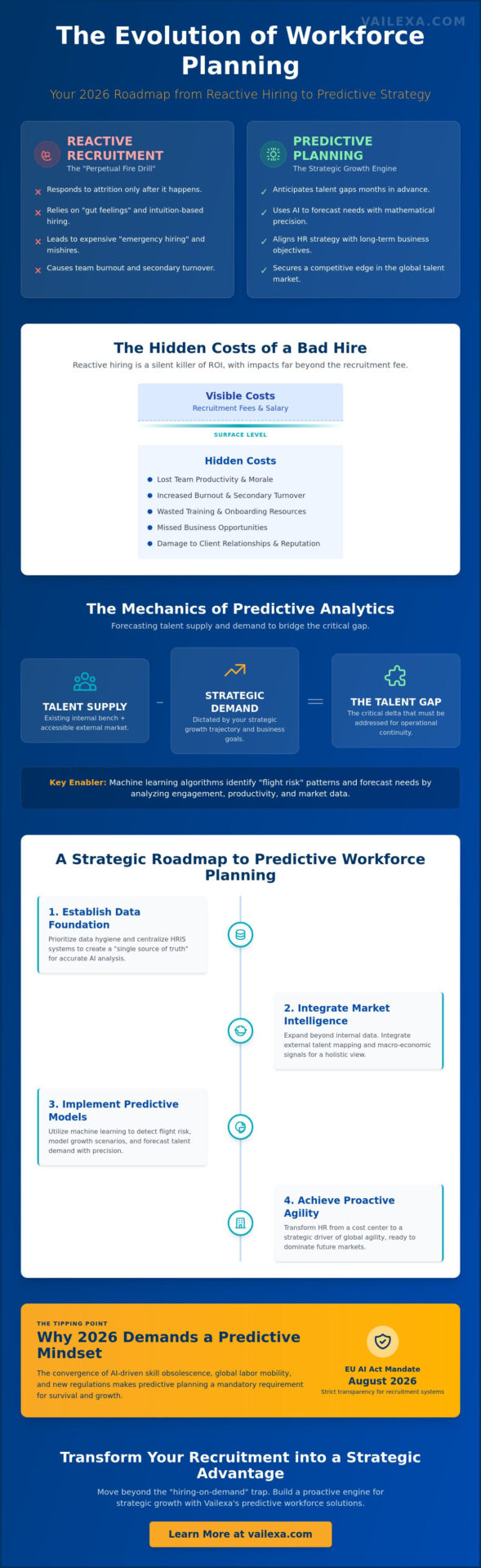
For decades, human resources operated as a reactive support unit, responding to attrition only after a resignation letter hit the desk. In 2026, this static paradigm has effectively collapsed. Modern predictive workforce planning represents a sophisticated synthesis of AI-driven forecasting and intentional strategic alignment. It moves beyond the flat spreadsheets of the past to create a dynamic, living model of an organization’s future capabilities. This approach doesn’t just count heads; it evaluates the velocity of change within your industry.
While traditional models relied on historical “gap analysis” to identify current shortages, modern Strategic human resource planning utilizes predictive modeling to anticipate those gaps months before they manifest. This transition transforms the HR function from a traditional cost center into a profit-driving strategic partner. By integrating macro-economic signals, such as shifting global trade regulations or the emergence of new tech hubs, decision-makers can shape their headcount requirements with mathematical precision through predictive workforce planning rather than hopeful estimation.
The High Cost of Reactive Recruitment
“Emergency hiring” serves as a silent killer of organizational ROI. When a critical leadership or technical role remains vacant, the financial impact extends far beyond the immediate recruitment fee. Team productivity often plummets as remaining members shoulder an unsustainable burden, frequently leading to burnout and secondary turnover. In high-growth sectors, particularly within AI and data analytics, relying on intuition-based hiring is a high-risk strategy. The sheer velocity of the 2026 market renders “gut feelings” obsolete. This often results in expensive mishires that can cost an enterprise significantly more than the initial salary, factoring in lost opportunity costs and the friction of repeated onboarding.
Why 2026 Demands a Predictive Mindset
The acceleration of AI-driven skill obsolescence has reached a definitive tipping point. Technical competencies that were considered cutting-edge just eighteen months ago are now either baseline requirements or entirely automated. When you couple this with unprecedented global labor mobility, retention is no longer a localized concern; it’s a global competition for excellence. Adopting a predictive mindset is no longer a luxury for the elite. It has become a mandatory requirement for strategic workforce planning. Organizations that fail to forecast their talent needs will find themselves perpetually behind, while those who embrace data-driven foresight will secure the agility required to dominate their markets.
The Mechanics of Predictive Analytics: Forecasting Talent Supply and Demand
Understanding the architecture of predictive workforce planning requires a disciplined look at three core pillars: supply, demand, and the resulting gap. Supply refers to your existing internal bench and the accessible external market, while demand is dictated by your strategic growth trajectory. The gap represents the critical delta that must be addressed to maintain operational continuity. By utilizing AI to simulate diverse business growth scenarios, executives can visualize the immediate staffing impact of a market expansion or a product pivot before committing capital. This foresight allows for a level of precision that traditional budgeting simply cannot match.
Machine learning algorithms now provide the precision needed to identify “flight risk” patterns long before a resignation is tendered. These models analyze subtle shifts in engagement, productivity, and even external market demand for specific skill sets. To achieve this level of foresight, organizations must prioritize data hygiene and centralized HRIS systems. Without a “single source of truth,” even the most advanced AI will produce flawed results. Implementing effective strategic workforce planning ensures that your data architecture supports these high-level insights rather than obscuring them with fragmented information.
Forecasting Internal Mobility and Turnover
Predicting leadership gaps involves more than tracking tenure. It requires analyzing historical performance data to identify high-potential individuals ready for advancement. By monitoring behavioral markers, such as participation in cross-functional projects or voluntary upskilling, leadership can spot the quiet signals of both ambition and disengagement. Flight risk modeling is a proactive intervention tool that leverages historical behavioral data to forecast employee attrition before it impacts the bottom line. This methodology allows HR leaders to offer targeted retention incentives to the right people at the right time.
Skill-Gap Analysis in the Age of AI
Mapping current employee skill sets against 2026 technology requirements is a complex but vital exercise. As technical competencies evolve at breakneck speed, organizations must calculate the “half-life” of specific skills to decide whether upskilling the current team or pursuing fresh talent is more cost-effective. Integrating AI staffing solutions allows enterprises to bridge technical voids with precision, ensuring that the talent pipeline remains robust even as roles are redefined by automation. For organizations seeking to master these complexities, partnering with a workforce solutions provider can turn these analytical challenges into a distinct competitive advantage.
Beyond Internal Metrics: Integrating Market Intelligence and Talent Mapping
Relying solely on internal HRIS data creates a strategic vacuum. While internal metrics tell you who you have, they can’t tell you who’s available in the global market. Effective predictive workforce planning must incorporate external intelligence to be truly effective. This means analyzing competitor hiring patterns, which often serve as a leading indicator of where a market is heading before official announcements are made. If a major competitor begins aggressive hiring in a specific emerging tech hub, your model should flag this as a potential shift in talent demand and cost. Understanding the full scope of global talent acquisition challenges is essential to building models that account for the structural barriers organizations face when scaling into new markets.
Integrating geopolitical and economic data is equally critical for global enterprises. Changes in visa regulations, regional economic shifts, or local labor laws can transform a talent-rich area into a high-risk zone almost overnight. When these external variables are layered into your workforce models, your planning moves from reactive headcount management to true global agility. This broader perspective ensures that your growth isn’t throttled by localized talent shortages or unforeseen economic hurdles in key regions. Organizations navigating these complexities at scale often turn to talent strategy consulting to translate market intelligence into a coherent, executable workforce transformation roadmap.
The Power of Global Talent Mapping
The talent mapping process functions as a proactive scouting mechanism for the modern enterprise. It allows you to identify “passive” talent pools, consisting of individuals who aren’t actively seeking roles but possess the exact competencies your 2026 strategy requires. By mapping these professionals before a vacancy even exists, you drastically reduce the time-to-fill for critical leadership positions. Additionally, mapping salary benchmarks across different global regions helps optimize labor costs without sacrificing quality. This ensures your compensation strategy remains competitive in diverse markets such as Singapore, Berlin, or Austin.
External Supply Forecasting
Accurate forecasting requires a deep dive into university pipelines and regional migration patterns. If a specific region is producing a high volume of data science graduates but lacks local industry demand, it becomes a prime target for remote talent acquisition. predictive workforce planning uses this market intelligence to anticipate the difficulty and cost of future executive searches. By evaluating the impact of remote work trends on global talent accessibility, organizations can decide whether to build a local hub or maintain a distributed team. This level of foresight prevents budget shocks when specialized talent suddenly becomes scarce or significantly more expensive.
Building a Predictive Framework: A Strategic Implementation Guide
Transitioning from basic headcount reporting to true predictive maturity requires a disciplined, phased approach. Organizations often hesitate because they believe their data is too fragmented or incomplete. However, predictive workforce planning doesn’t require a perfect global dataset on day one. It begins with a focused pilot and scales as accuracy improves. Success in this area isn’t just an HR achievement. It demands deep cross-functional collaboration between HR, Finance, and Operations to ensure talent needs are viewed through a financial and operational lens. This alignment ensures your human capital strategy supports your bottom line with mathematical precision.
To measure the impact of your framework, you must look beyond traditional metrics. A primary KPI for predictive success is the reduction in “Time-to-Productivity.” By anticipating a role’s requirements six months in advance, you can initiate upskilling or specialized recruitment earlier. This ensures new hires or internal moves hit peak performance faster. This strategic foresight directly correlates with organizational ROI and long-term stability, allowing you to empower your leadership with actionable intelligence rather than vague estimates.
Step 1-3: Data Foundation and Scenario Modeling
Your roadmap starts with a rigorous audit of current data sources. You should aggregate performance reviews, historical turnover rates, and average time-to-fill across different regions. Rather than attempting a global overhaul, select a pilot department facing high turnover or critical growth needs, such as your AI or data engineering teams. Once the data is centralized, develop three distinct staffing scenarios: “Best Case,” “Worst Case,” and “Most Likely.” These simulations provide a safety net for executive decision-making during periods of market volatility.
Step 4-5: Strategic Alignment and Execution
The final phases involve aligning your predictive model with the 2026 corporate growth strategy. This ensures every hire is a calculated move toward a specific business milestone. To maintain agility, you should implement a contingent staffing buffer. This allows your organization to scale rapidly during volatile demand periods without the long-term risk of over-hiring. Finally, establish a continuous feedback loop where actual hiring outcomes are compared against your predictions to refine the model’s accuracy. Building this framework is a complex undertaking that requires a partner who understands the intersection of data and human capital. If you’re ready to move from reactive hiring to a data-driven growth strategy, explore how our strategic workforce planning services can transform your global talent roadmap.
Navigating the Future: Vailexa’s Approach to Predictive Workforce Solutions
Vailexa serves as the catalyst that bridges the gap between sophisticated forecasting and tangible organizational results. While many firms offer software, we provide the strategic execution required to turn predictive workforce planning into a sustainable competitive advantage. Our deep expertise in AI staffing solutions and data analytics staffing ensures that your organization doesn’t just predict the future; you own it. By integrating high-level strategy with precise technical recruitment, we help you navigate the complexities of the 2026 labor market with absolute confidence.
Prediction without execution is merely a theory. Our Recruitment Process Outsourcing (RPO) and contingent staffing solutions provide the operational muscle needed to match your data-driven forecasts. Whether you’re scaling a new department or managing a sudden shift in market demand, our workforce solutions provider model offers the flexibility and precision your enterprise demands. We move beyond the role of a service provider to act as a dedicated partner in your growth, ensuring that your talent acquisition engine is always aligned with your long-term vision.
The Vailexa Advantage in Global Markets
In an era defined by global mobility, a partner with a Global Talent Solutions perspective is indispensable. Vailexa recognizes that predictive workforce planning must be inclusive to be truly effective. Our commitment to Diversity and Inclusion (D&I) consulting ensures that your talent models are not only sustainable but also representative of the global markets you serve. We also possess the specialized capability to execute complex executive search processes. This ensures that your leadership bench is always prepared for the next strategic pivot, regardless of geographic boundaries or market volatility.
Next Steps for Strategic Leaders
Waiting for a talent gap to manifest before taking action is a luxury no leader can afford in 2026. The financial and operational costs of reactive hiring have become too high to ignore. Proactive organizations are already leveraging predictive insights to secure their future market position. We invite you to initiate a strategic workforce consultation to audit your current planning maturity and identify untapped opportunities for growth.
Explore our specialized service pages to learn how our permanent recruitment and talent mapping capabilities can be customized to your unique organizational standards. Success in the next decade will belong to those who build their talent pipelines with precision today. Don’t let your growth be dictated by the market; define your own trajectory through disciplined, data-driven foresight.
Securing Your Strategic Advantage in a Volatile Market
We’ve explored how transitioning from reactive hiring to a disciplined, data-driven model ensures long-term agility. By integrating internal performance metrics with external global talent mapping, your organization can anticipate market shifts before they disrupt your operational momentum. Implementing predictive workforce planning is no longer a futuristic goal; it’s a fundamental requirement for leaders who intend to dominate the 2026 landscape. Precision in human capital management is the ultimate differentiator between organizations that merely survive and those that define their industry’s future.
Vailexa stands ready to support this transformation through our specialized AI and data analytics staffing expertise. Whether you require global RPO and contingent workforce capabilities or strategic D&I and talent mapping consulting, we provide the execution needed to match your strategic vision. Optimize your 2026 talent strategy with Vailexa’s expert workforce solutions. Your path to organizational excellence begins with a single, data-driven decision today. We look forward to building your future together.
Frequently Asked Questions
What is the difference between workforce planning and predictive workforce planning?
Traditional workforce planning typically addresses immediate gaps through historical analysis; however, predictive workforce planning utilizes machine learning to anticipate future talent requirements before they manifest. It shifts the focus from current headcount management to long-term strategic readiness by synthesizing internal metrics with external market intelligence. This transition allows your organization to move from a defensive posture to a proactive growth strategy that anticipates market volatility.
How much data do I need to start predictive workforce planning?
You don’t need a comprehensive global dataset to begin; high-quality data from a single pilot department is often sufficient for initial modeling. Focus on aggregating clean records of turnover rates, performance reviews, and time-to-fill metrics within a specific high-growth area. Starting with a focused pilot allows your team to refine the predictive framework and demonstrate measurable value before scaling the methodology across the entire enterprise.
Can predictive analytics really forecast employee turnover?
Yes, predictive analytics can accurately forecast turnover by identifying subtle “flight risk” patterns within your behavioral data. Algorithms analyze shifts in employee engagement, productivity, and even external market demand for specific skill sets to flag potential departures months in advance. This foresight enables leadership to implement targeted retention strategies, effectively securing critical human capital before attrition impacts your bottom line or disrupts team productivity.
What tools are required for predictive workforce planning in 2026?
Success in 2026 requires a centralized HRIS that serves as a single source of truth for all employee data. You’ll also need specialized AI staffing solutions that can simulate diverse growth scenarios and integrate external talent mapping data. These tools must be capable of processing real-time market signals, such as competitor hiring trends and regional economic shifts, to maintain a truly agile and responsive workforce model.
How does predictive planning improve recruitment ROI?
Predictive workforce planning improves recruitment ROI by drastically reducing time-to-productivity and minimizing the budget strain caused by reactive contingent staffing. By anticipating role requirements six months in advance, you can initiate targeted talent mapping and upskilling programs much earlier. This disciplined approach ensures that every new hire is a calculated investment that aligns perfectly with your 2026 corporate growth strategy.
What role does AI play in modern workforce forecasting?
AI serves as the engine of modern forecasting by automating the processing of vast datasets that would be impossible for human teams to analyze manually. It enables sophisticated “what-if” scenario modeling, allowing executives to visualize the staffing impact of market expansions or technological pivots with high precision. Additionally, AI-driven assistants now help bridge the gap between raw data insights and immediate, actionable strategic decisions.
How often should a predictive workforce model be updated?
Your predictive model should be treated as a dynamic, living asset that requires continuous updates rather than a static annual review. In the volatile 2026 market, monthly data refreshes are recommended to account for rapid shifts in global labor mobility and technical skill obsolescence. Establishing a constant feedback loop ensures that your forecasts remain accurate and your organizational agility remains high throughout the entire fiscal year.