
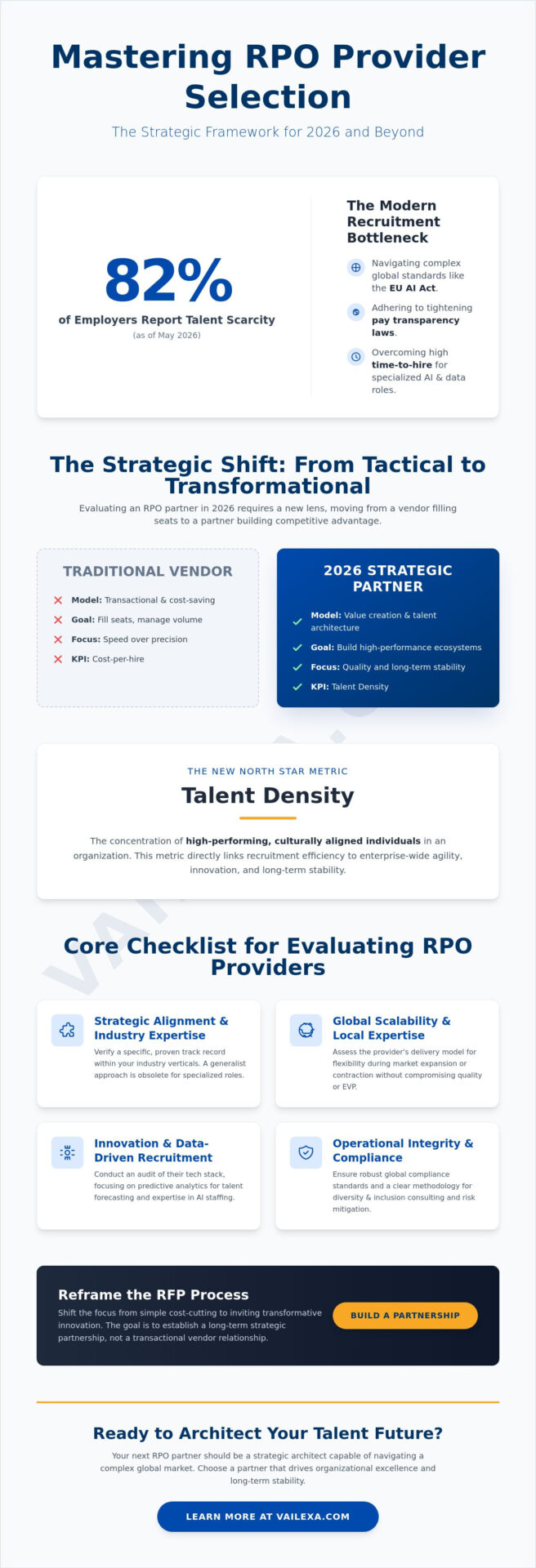
With 82% of employers reporting a struggle to secure the talent they need as of May 2026, the margin for error in your recruitment strategy has effectively vanished. When you’re evaluating RPO providers, you aren’t just looking for a vendor to fill seats. You’re seeking a strategic architect capable of navigating a landscape defined by the EU AI Act and tightening pay transparency laws like California’s SB 642. You already know that high time-to-hire for specialized AI roles and inconsistent global standards are throttling your ability to scale. It’s a systemic bottleneck that demands more than a traditional agency approach.
This article provides the framework to master the selection of a partner who moves beyond basic fulfillment to architecting true talent density. We’ll examine a rigorous, data-driven evaluation model designed for the complexities of the current market. You’ll learn how to identify partners that offer a scalable global recruitment model and elite access to data analytics talent. We will preview the essential 2026 benchmarks, from bias-mitigating technology audits to measurable ROI, ensuring your next partnership drives organizational excellence and long-term stability.
Key Takeaways
- Transition from transactional hiring models to a strategic architecture that prioritizes talent density and organizational growth.
- Master the process of evaluating RPO providers by using a data-driven framework that balances global scalability with industry-specific precision.
- Conduct a thorough innovation audit to verify a partner’s expertise in AI staffing solutions and their use of predictive analytics for talent forecasting.
- Ensure operational integrity by assessing a provider’s global compliance standards and their methodology for diversity and inclusion consulting.
- Reframe the RFP process to invite transformative innovation rather than simple cost-cutting, establishing the foundation for a long-term strategic partnership.
The Strategic Shift: Why Evaluating RPO Providers Requires a 2026 Lens
Strategic decision-makers are moving beyond the era of transactional recruitment. The focus is no longer on how many people a provider can source, but on how those individuals will transform the business trajectory. This shift requires a rigorous framework for evaluating RPO providers that accounts for technological maturity and global compliance standards. In 2026, the complexity of the labor market means that a standard approach is insufficient. You need a partner that understands the nuances of cross-border hiring and the intricacies of the EU AI Act.
The traditional recruitment model is undergoing a radical metamorphosis. For years, organizations viewed outsourcing as a tactical lever to manage fluctuating requisition volumes; however, this perspective is dangerously obsolete. Capacity is no longer the primary driver for outsourcing. In a market where 82% of employers struggle to find specific skills, the goal has shifted from filling seats to securing a competitive advantage. Specialized RPO partners function as visionary architects who build high-performance ecosystems, whereas generalist staffing firms often prioritize speed over precision. This evolution reflects a broader corporate shift toward long-term stability and meticulous quality over short-term headcount metrics.
The Move from Cost-Saving to Value-Creation
Modern enterprises leverage Recruitment process outsourcing (RPO) to bridge the widening global skills gap, particularly in AI and data science. Understanding what is RPO in the current high-volatility market reveals a fundamental truth: it’s a mechanism for value creation. A 2026 provider acts as an Authoritative Strategic Guide, aligning talent acquisition with long-term corporate objectives. They don’t just execute; they empower by optimizing internal processes and enhancing candidate experience. This partnership transforms recruitment from a cost center into a strategic engine that fuels innovation and sustains market leadership.
Defining Talent Density in the RPO Context
Talent Density is the concentration of high-performing, culturally aligned individuals within an organization. This metric has replaced cost-per-hire as the ultimate KPI for RPO success. Through meticulous talent mapping, providers ensure organizational stability by identifying and securing future leaders before a vacancy exists. This proactive approach links recruitment efficiency directly to enterprise-wide agility, allowing your business to pivot with precision when market conditions shift. By focusing on talent density, you prioritize the quality of your human capital, ensuring that every new hire contributes significantly to the collective intelligence and output of the firm.
Core Checklist: Strategic Alignment and Global Scalability
Precision is the hallmark of a high-level partnership. When evaluating RPO providers, you must look beyond their general reputation to their specific track record within your industry verticals. A provider who excels in retail may lack the specialized networks required for high-stakes AI engineering, making industry-specific expertise a non-negotiable criterion when evaluating RPO providers. Beyond industry knowledge, their methodology for strategic workforce planning serves as the foundation for your long-term growth. This involves more than just reacting to open roles; it requires a predictive approach that anticipates turnover and skills gaps before they impact your bottom line.
Scalability remains a non-negotiable requirement for modern enterprises. Your partner must possess a delivery model that flexes alongside rapid market expansion or contraction without compromising quality. This agility ensures that your Employer Value Proposition (EVP) remains consistent and compelling, regardless of the hiring volume. A disciplined RPO partner will audit your current EVP and suggest refinements to ensure it resonates across diverse geographic regions while remaining rooted in your core corporate identity.
Auditing Global Reach vs. Local Expertise
True global talent solutions require a sophisticated balance between centralized strategy and localized execution. Ask your prospective partner how they conduct regional talent mapping and if they possess real-time insights into local labor market trends. Do they understand specific regional requirements, such as the New York Credit Check Limitations (S.B. 3072) effective April 18, 2026, or the cultural nuances in every market you operate in? Efficiently managing contingent staffing alongside permanent hires is essential for maintaining a unified brand voice. This hybrid approach allows you to secure elite talent for short-term projects while building a robust permanent foundation. If you’re looking for a partner that excels in this balance, exploring our Global Talent Solutions can provide the clarity you need.
Customization and Cultural Integration
A generic approach is the enemy of excellence. You need to determine if an RPO provider can authentically replicate your internal culture to attract candidates who truly align with your values. In the context of enterprise RPO solutions, the choice between dedicated and shared resource models is pivotal. Dedicated teams offer deeper integration and a more personalized candidate experience, which is critical for high-level strategic roles. Finally, assess their transition and change management expertise. A smooth implementation is the first test of a provider’s reliability and their commitment to your organizational standards. They should demonstrate a disciplined process for onboarding their team into your systems, ensuring no loss of momentum during the handoff.
The Innovation Audit: AI Staffing and Data-Driven Recruitment
Innovation is the heartbeat of modern recruitment. When evaluating RPO providers, you must look past basic automation features to identify true technological maturity. A partner’s proficiency in AI staffing solutions is no longer optional; it’s a fundamental requirement for companies aiming to lead in the digital economy. You require a partner that doesn’t just use AI tools, but one that deeply understands the underlying mechanics of the high-complexity roles they are tasked to fill. This technical depth ensures that your talent pipeline isn’t just full, but filled with the right caliber of experts.
Efficiency shouldn’t come at the cost of candidate experience. While you seek to improve recruitment efficiency, your RPO partner must maintain the high-touch engagement that elite talent expects. This balance is achieved through a tech stack that prioritizes predictive analytics over simple keyword matching. By forecasting talent needs based on market volatility and internal growth projections, an innovative provider moves your organization from a defensive, reactive posture to an offensive, proactive one. They use data to empower your leadership, not just to automate your tasks.
Security is the final pillar of this innovation audit. With the EU AI Act establishing strict boundaries for high-risk AI systems in recruitment, your provider must demonstrate absolute compliance. Their ethical AI usage policies should be transparent and rigorous, protecting your brand from the legal and reputational risks of algorithmic bias. A disciplined partner will provide clear documentation of their bias audits and data encryption standards, ensuring that your pursuit of talent density remains ethically sound and legally secure. This level of diligence distinguishes a visionary architect from a standard service provider.
Hiring for the Future: AI and Data Expertise
Specialized AI staffing experts outperform generalist recruiters by utilizing technical vetting processes that go beyond a standard resume review. When evaluating RPO providers, ask for their specific criteria for sourcing niche technical roles. They should employ specialized assessment tools that verify a candidate’s practical coding ability and data modeling proficiency. This level of scrutiny is essential in high-growth sectors where the cost of a bad hire is compounded by the speed of technological change.
Predictive Analytics and Talent Forecasting
Data-driven insights empower your leadership to make informed decisions about future headcount. A top-tier RPO provider uses real-time reporting dashboards to move your strategy from reactive to proactive. By analyzing historical hiring patterns and external market trends, they provide the visibility required to align recruitment spend with actual business outcomes. This foresight leads to better long-term retention and workforce stability, as your hiring strategy becomes a mirror of your long-term corporate vision.
Operational Integrity: Compliance, Diversity, and Risk Mitigation
Excellence in talent acquisition is inseparable from operational integrity. When evaluating RPO providers, you’re delegating more than a process; you’re entrusting your organization’s legal and ethical standing to an external partner. In 2026, the regulatory landscape has become significantly more complex, with the EU Pay Transparency Directive implementation deadline of June 7, 2026, and California’s SB 642 already in full effect. A provider’s global compliance framework must be beyond reproach, especially when managing offshore teams or complex contingent labor programs where worker classification and data privacy risks are highest.
Risk mitigation extends into the highest levels of your organization. Robust protocols in the executive search process are vital for protecting your C-suite’s reputation and ensuring long-term leadership stability. Beyond legalities, evaluating RPO providers requires a deep dive into their candidate care standards. A partner who fails to maintain a steady, polished voice during candidate interactions can cause irreparable harm to your Glassdoor rating and overall employer brand. Every touchpoint must reflect your brand’s commitment to quality and professionalism.
Navigating Global Compliance and Labor Laws
A disciplined RPO partner maintains a rigorous checklist for auditing data privacy standards like GDPR and CCPA alongside localized employment regulations. They should demonstrate a clear strategy for navigating the New York Credit Check Limitations (S.B. 3072), which became effective April 18, 2026. Top providers mitigate risk in contingent workforce programs by ensuring all third-party vendors meet your specific insurance and classification standards. Their communication in these matters should be authoritative and precise, reflecting the composure of a seasoned strategic partner who understands the high stakes of global labor law.
D&I as a Strategic Business Driver
Modern enterprises view diversity as a catalyst for innovation rather than a compliance burden. When assessing a partner’s diversity and inclusion consulting capabilities, look for a methodology that builds inclusive talent pipelines from the ground up. This involves moving beyond surface-level quotas to address systemic biases through diverse recruitment strategies and mandatory bias audits, as now required by Colorado’s 2026 AI hiring rules. Success should be measured through tangible data, such as improved talent density and retention rates among diverse cohorts. If you require a partner that treats diversity as a core strategic pillar, discover how our Workforce Solutions Provider model integrates these values into every hire.
Navigating the Selection Process: From RFP to Strategic Partnership
The final phase of evaluating RPO providers is a meticulous journey from discovery to a high-level alliance. This isn’t a simple vendor procurement; it’s the selection of a partner who will safeguard your organizational standards and drive global growth. The process typically unfolds across three critical stages: Discovery, the Request for Proposal (RFP), and the Finalist Presentation. During Discovery, you must define your specific talent gaps and strategic goals with absolute clarity. This internal alignment ensures that when you reach the RFP stage, you’re inviting transformative innovation rather than just soliciting cost-cutting measures.
A sophisticated RFP should challenge providers to demonstrate their visionary architect capabilities. Instead of focusing solely on transactional metrics like cost-per-hire, ask how they will improve talent density and navigate the complexities of the 2026 labor market. Once you’ve narrowed the field, the Finalist Presentation serves as a vital “chemistry check.” You’re looking for alignment between your leadership and the RPO account team. This human element is the foundation of a successful partnership; without mutual trust and a shared commitment to excellence, even the most advanced tech stack will fail to deliver long-term value.
Finalizing the Service Level Agreement (SLA) is the last step in securing strategic alignment. A disciplined SLA moves beyond basic speed-to-fill targets to include quality-of-hire, diversity benchmarks, and data accuracy. It should be a living document that evolves as your business scales, ensuring the provider remains a reliable guardian of your talent ecosystem. By setting these high standards early, you establish a framework for measurable ROI and sustainable enterprise agility.
Evaluating RPO Pricing Models
Selecting the right financial structure is essential for long-term stability. You must compare transactional, management fee, and hybrid RPO pricing models to find the best fit for your hiring volume. Transactional models often suit project-based surges, while a monthly management fee is typically more effective for steady, ongoing needs. Be cautious of “low-cost” bids that may hide significant implementation fees, which often range from $15,000 to $40,000. Aligning your investment with business goals ensures you’re paying for value and precision, not just volume.
The Implementation Roadmap
The first 90 days of an RPO partnership are transformative. This phase involves the seamless integration of technology, the alignment of recruitment processes, and the finalization of communication protocols. You should expect a structured transition that prioritizes candidate experience and minimizes operational disruption. Defining clear success metrics for this period—such as hiring manager satisfaction and initial time-to-fill benchmarks—is critical for establishing momentum. If you’re ready to secure your competitive advantage, Partner with Vailexa to architect your global talent future with precision and authority.
Securing Your Competitive Advantage in the 2026 Talent Market
The process of evaluating RPO providers in 2026 requires a transition from tactical headcount management to a sophisticated architecture of talent density. A data-driven framework and an innovation-focused audit distinguish a visionary partner from a standard recruiter. By prioritizing global compliance and specialized AI expertise, your organization doesn’t just fill roles; it secures a sustainable competitive advantage in a volatile market. Success depends on aligning your recruitment engine with your long-term corporate vision through a disciplined selection process that emphasizes quality and strategic fit.
Vailexa stands as your authoritative strategic guide in this journey. With a global footprint and localized compliance expertise, we navigate the world’s most complex labor markets with composure. Our specialized AI and Data Analytics staffing vertical ensures you access elite technical talent, while our data-driven workforce planning methodology provides the clarity needed for executive decision-making. It’s time to transform your talent acquisition into a value-creation engine.
Architect Your Global Talent Density with Vailexa
The future of your organization is defined by the excellence of your people. We’re ready to help you build a workforce that inspires progress and sustains market leadership.
Frequently Asked Questions
How long does it typically take to implement an RPO solution?
Implementation typically requires between 60 to 90 days to ensure a seamless integration of technology and processes. This period allows for a disciplined audit of your current workflows and the establishment of robust communication protocols. While smaller, project-based launches may occur faster, a comprehensive global solution requires this timeframe to guarantee operational integrity and long-term stability.
Can an RPO provider work alongside our existing internal recruitment team?
Yes, most modern providers operate effectively within a hybrid model that complements your internal staff. This collaborative structure allows your internal recruiters to focus on high-level cultural alignment and internal mobility while the RPO partner manages specialized technical sourcing or high-volume surges. This synergy maximizes recruitment efficiency and ensures that your strategic goals remain the primary focus of every hire.
What is the primary difference between an RPO and a traditional staffing agency?
The distinction lies in the depth of strategic ownership and process integration. A traditional staffing agency typically provides reactive, transactional support for individual vacancies. An RPO partner acts as a visionary architect of your entire talent ecosystem, taking full responsibility for the methodology, technology, and outcomes of the recruitment process. They prioritize long-term talent density over simple headcount fulfillment.
How do RPO providers handle niche or high-level executive search?
Top-tier providers utilize specialized verticals and dedicated research teams to identify elite talent for niche and C-suite roles. By employing sophisticated talent mapping and deep industry networks, they reach passive candidates who are often invisible to generalist recruiters. This rigorous approach ensures that high-level placements align perfectly with your organizational standards and future leadership requirements.
What metrics should we use to evaluate our RPO provider after the first year?
You should prioritize strategic KPIs such as quality-of-hire, long-term retention rates, and hiring manager satisfaction. When evaluating RPO providers after twelve months, it is essential to look beyond basic speed-to-fill metrics. Assess the accuracy of their predictive analytics and their impact on your overall talent density to determine the true ROI of the partnership.
Is RPO suitable for mid-sized companies, or is it only for large enterprises?
RPO is an excellent solution for mid-sized companies aiming to scale rapidly without the fixed costs of a large internal HR department. Modular solutions provide these firms with access to global talent solutions and sophisticated AI staffing tools that were once exclusive to large enterprises. This scalability empowers mid-market organizations to compete for elite talent with precision and authority.
How does an RPO provider ensure they represent our employer brand accurately?
A disciplined provider begins the partnership with a deep dive into your corporate values and internal culture. They adopt your brand voice across all candidate touchpoints, acting as a seamless extension of your organization. This alignment ensures that your Employer Value Proposition remains consistent and compelling, protecting your reputation and attracting candidates who are truly aligned with your mission.
What happens to our data if we decide to end the RPO partnership?
Your organization typically retains full ownership of all candidate data and recruitment analytics generated during the contract. When evaluating RPO providers, it is vital to review their data portability and security standards. A transparent partnership includes a clear transition plan to ensure organizational stability and continued compliance with global data privacy regulations if the relationship concludes.