
The traditional transactional approach to recruitment is dead. In 2026, your talent acquisition budget is either a precise strategic investment or a significant source of organizational waste. Many global leaders struggle with hidden costs and inflexible contracts that don’t scale when market demands shift. You’ve likely seen the friction caused when provider fees don’t match the actual quality of your hires. Understanding the nuances of modern RPO pricing models is the first step toward transforming your recruitment function into a high-performance engine.
This guide empowers you to master the financial architecture of Recruitment Process Outsourcing to ensure your costs align perfectly with long-term growth. We’ll explore how organizations are achieving a 30% to 50% reduction in recruiting costs through smarter, data-driven model selection. You’ll gain a clear framework for evaluating hybrid structures, securing scalable global talent solutions, and optimizing your recruitment ROI for the year ahead. By the end of this article, you’ll possess the insights needed to select a model that balances cost predictability with exceptional performance.
Key Takeaways
- Shift your perspective from viewing recruitment as a simple expense to a sophisticated financial architecture that drives long-term organizational growth.
- Evaluate the nuances of various RPO pricing models to determine whether a fixed management fee or a transaction-based approach best serves your current hiring volume.
- Identify the true “Total Cost of Ownership” in your recruitment process by accounting for hidden vacancy costs and the long-term impact of hiring quality.
- Utilize a structured decision framework to audit your historical data and align your internal capacity with the need for specialized global expertise.
- Discover how integrating advanced AI staffing and global talent mapping into your cost structure creates a more resilient and scalable workforce solution.
Navigating the Strategic Landscape of RPO Pricing Models in 2026
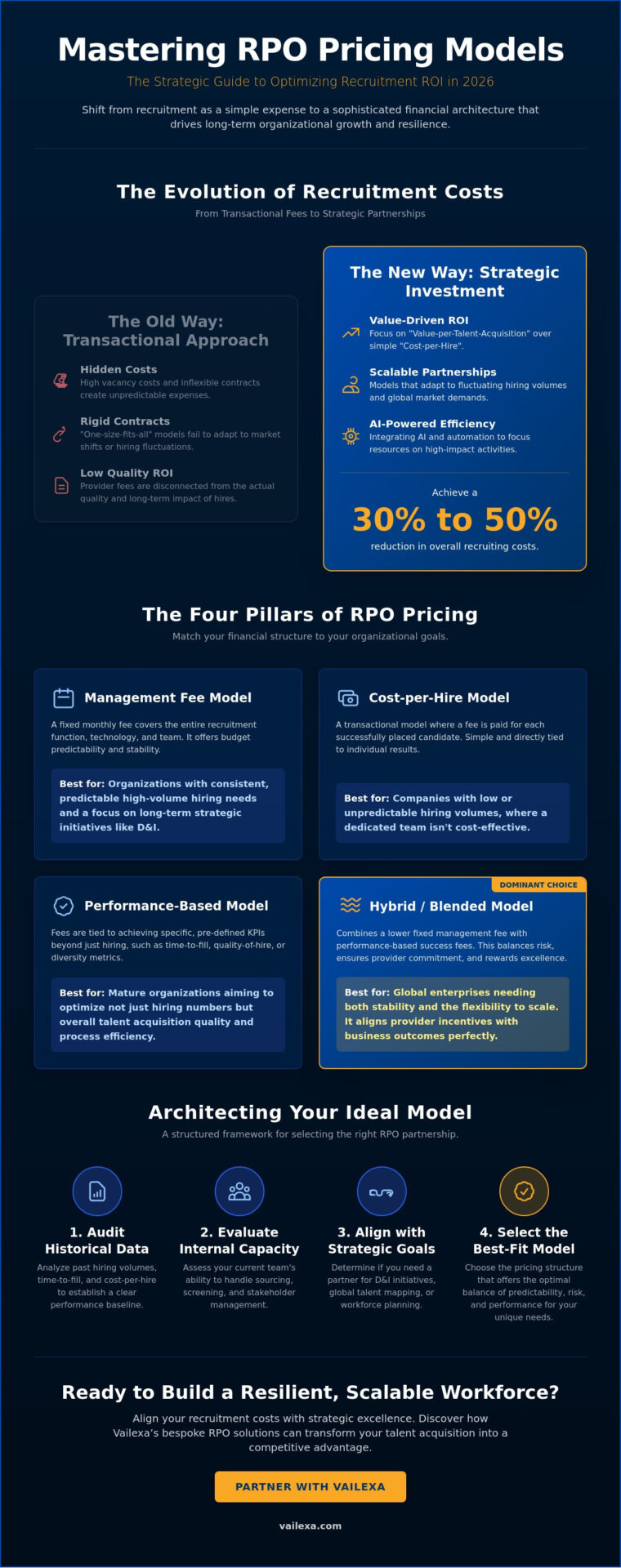
RPO pricing is no longer a line item on an expense report. It’s a sophisticated financial architecture designed to drive organizational excellence. Global talent leaders in 2026 recognize that static fees are incompatible with a dynamic global economy. Instead, Recruitment Process Outsourcing (RPO) structures must act as a lever for growth. They balance immediate hiring needs with long-term strategic goals. This evolution marks a definitive shift from the antiquated “cost-per-hire” metric toward a more comprehensive “value-per-talent-acquisition” philosophy. By embracing risk-sharing models, enterprises and providers enter into true partnerships. Incentives are aligned with actual business outcomes rather than just filling seats.
Why One-Size-Fits-All Pricing Fails Global Enterprises
Rigid financial structures can’t withstand the volatility of modern markets. When hiring volumes fluctuate across different regions, a fixed, inflexible model becomes a liability. Traditional recruitment agencies often rely on high-margin, transactional fees that ignore the broader organizational context. In contrast, modern RPO pricing models are built to support complex initiatives like Diversity & Inclusion (D&I) and Strategic Workforce Planning. These programs require sustained investment. They need a level of nuance that “one-size-fits-all” approaches simply cannot provide. A rigid contract often stifles innovation. It prevents leaders from pivoting their talent strategies when new opportunities arise in emerging markets.
The Evolution of Recruitment Process Outsourcing Costs
The path from transactional fees to strategic partnership has been accelerated by technological integration. While early outsourcing focused on reducing administrative burdens, today’s models emphasize high-level talent mapping and AI-driven efficiency. AI staffing solutions are fundamentally reshaping the cost of sourcing. They automate repetitive tasks and allow recruiters to focus on high-touch candidate engagement. This shift ensures that every dollar spent contributes to a higher standard of talent quality. For those beginning this journey, understanding what is RPO provides the necessary context. It shows how these strategic costs translate into a competitive advantage. The focus has moved toward creating a scalable, resilient workforce that can adapt to any challenge.
The Four Pillars: Standard RPO Pricing Frameworks Explained
Selecting the ideal financial structure for talent acquisition is a decision that defines your organizational agility. It’s not merely about cost; it’s about matching your recruitment engine to your operational maturity. In 2026, the market has coalesced around four primary frameworks. Each offers distinct advantages based on your hiring volume, internal capacity, and long-term objectives. Understanding these RPO pricing models is essential for any leader who views talent as a competitive differentiator rather than a overhead expense.
Management Fee Models: Predictability for Mature Workforces
The Management Fee, or fixed-fee model, provides a steady monthly cost that covers the core recruitment team, the underlying technology stack, and end-to-end process management. This structure is the preferred choice for organizations with consistent, predictable hiring needs. It eliminates the volatility of monthly budget fluctuations, allowing for more disciplined financial planning. Because the provider isn’t incentivized solely by the number of “placements,” they can focus on high-impact initiatives like diversity and inclusion consulting. These long-term cultural shifts require a sustained, strategic effort that transactional models often overlook. In 2026, this model frequently includes the costs of maintaining a sophisticated AI-driven sourcing environment, ensuring your brand remains at the forefront of candidate experience.
Performance-Based and Hybrid Models: Balancing Risk and Reward
The Hybrid or Blended model has emerged as the dominant choice for global enterprises in 2026. It combines a lower monthly base fee with a “success fee” paid upon the completion of a hire. This structure creates a powerful incentive alignment. The provider receives enough guaranteed income to maintain a dedicated, high-quality team, while the performance-based component ensures they remain focused on speed and quality of hire. Success in this model depends heavily on robust Service Level Agreements (SLAs). These agreements define the standards for time-to-fill, candidate satisfaction, and retention rates. By sharing the risk, you ensure your partner is as invested in your growth as you are. If you’re looking to refine your long-term roadmap, integrating these models into your strategic workforce planning can provide the necessary flexibility to scale up or down without financial penalty.
For more specific, time-bound needs, two other models provide tactical support. The Transaction-Based model is purely per-hire, making it ideal for rapid, high-volume scalability during seasonal peaks. Conversely, Project-Based RPO serves as a surgical tool for specific market expansions or technology launches. It allows you to deploy a specialized team for a defined period, ensuring you have the expertise required for a new territory without committing to a multi-year contract. In 2026, the most successful leaders don’t just pick a model; they architect a solution that leverages these pillars to drive maximum ROI.
Beyond the Invoice: Evaluating Risk and ROI Across Models
A common hesitation among talent leaders involves the perceived premium of outsourcing compared to maintaining an internal function. This skepticism usually stems from a focus on the upfront invoice rather than the comprehensive Total Cost of Ownership (TCO). When you analyze the efficiency of various RPO pricing models, the conversation shifts from “what does this cost” to “what value does this protect.” Internal recruitment budgets often mask secondary expenses like recruiter churn, underutilized tech stacks, and the significant financial drag of slow time-to-fill metrics. A strategic partner doesn’t just fill roles; they optimize the entire financial ecosystem of your talent acquisition.
Global scalability also plays a decisive role in the cost-to-value ratio. Attempting to build internal teams in every emerging market is prohibitively expensive and operationally complex. RPO providers offer a shared infrastructure that allows you to scale up or down without the burden of fixed local overhead. This agility ensures that your cost per hire remains optimized regardless of regional market fluctuations. By centralizing your efforts, you gain a level of data transparency that internal teams often struggle to replicate, leading to more informed, cost-effective hiring decisions.
The Hidden Costs of Inflexible Recruitment Models
Inflexible hiring processes create a financial drain through poor sourcing alignment. When candidates don’t match the organizational culture or technical requirements, turnover rates spike. This leads to expensive replacement cycles and lost productivity. High-performance enterprise RPO solutions mitigate these risks by using advanced talent mapping to ensure a high-quality match from the start. Vacancy Cost is the daily revenue loss from an unfilled critical role. By reducing the time-to-fill, an RPO partner directly protects your bottom line from these invisible but substantial losses.
Leveraging AI Staffing to Drive Down Long-Term Costs
Technology is the primary driver of recruitment efficiency in 2026. Predictive analytics and automated sourcing reduce the manual hours typically billed in a management fee model. This automation allows your partner to focus on high-value activities like candidate engagement and employer branding. Integrating AI staffing solutions is particularly beneficial for tech-heavy organizations that require specialized, hard-to-find talent. These tools reduce “false starts” and replacement costs by identifying the best-fit candidates with surgical precision. Over time, the data insights generated by these systems allow for continuous process improvement, further driving down the long-term cost of talent acquisition.
Architecting Your Model: A Decision Framework for Global Leaders
Selecting the right RPO pricing models for your organization is an architectural process that requires a meticulous audit of your organizational DNA. It’s a five-step journey that transitions from historical analysis to future-state readiness. First, audit your historical hiring data and your 2026 growth projections to identify volume patterns. Second, determine your internal capacity against the need for specialized expertise. You shouldn’t pay for capabilities you already possess in-house. Third, define your risk tolerance regarding volume fluctuations. If your hiring is cyclical, a high-fixed-fee model might drain resources during downtime. Fourth, evaluate the technology stack included in the pricing. Many modern RPO pricing models now bundle advanced AI tools that would be cost-prohibitive as standalone purchases. Finally, align the model with your strategic workforce planning milestones to ensure the contract matures alongside your business evolution.
Assessing Global Scalability and Market Nuance
Pricing RPO across diverse geographies demands an understanding of local labor laws and economic realities. A “follow-the-sun” sourcing model can significantly reduce your cost-per-hire by leveraging global talent pools in different time zones. This 24-hour recruitment cycle ensures momentum never stalls. For specific, high-urgency projects, you might deploy contingent staffing alongside your core RPO model. This hybrid approach provides the ultimate safety net for global enterprises facing unpredictable market shifts. It allows you to maintain a lean core while scaling rapidly when opportunity strikes. By balancing these elements, you ensure your global talent strategy remains both agile and cost-effective.
Key Metrics to Include in Your RPO Pricing Negotiation
Financial transparency is the bedrock of a successful partnership. During negotiations, move beyond the base fee and focus on performance-linked KPIs. Critical indicators include your time-to-submit, the offer acceptance rate, and 90-day retention. These metrics prove the provider’s ability to sell your employer brand and identify cultural fits. You can build “malus” or “bonus” clauses into your performance-based pricing to ensure true incentive alignment. If the provider exceeds retention targets, a bonus is justified. If time-to-fill lags, a malus clause protects your budget. When you’re evaluating RPO providers against a rigorous, data-driven checklist, demand a clear breakdown of how these metrics impact your final invoice. A partner that hides behind vague fees isn’t a partner; they’re a vendor.
Vailexa’s Bespoke RPO Solutions: Aligning Cost with Strategic Excellence
At Vailexa, we believe that standardized, “cookie-cutter” RPO pricing models are a disservice to the modern enterprise. We reject the notion that a global organization can be squeezed into a pre-defined financial box. Instead, we architect bespoke solutions that mirror your unique strategic objectives. By integrating high-level AI staffing and comprehensive global talent mapping into a single, cohesive cost structure, we eliminate the fragmentation that often plagues large-scale recruitment. Our commitment to radical transparency ensures that every dollar spent is visible. Every outcome is measurable through rigorous, data-driven ROI reporting. We don’t just provide a service. We build a financial engine that powers your organizational growth through every phase of the business cycle.
Our methodology focuses on the alignment of provider fees with your actual hiring quality. We understand that a low per-hire cost is meaningless if the resulting talent doesn’t stay or perform. This is why we prioritize long-term stability and cultural fit in our pricing architecture. We share the risk with our partners, ensuring that our success is directly tied to your organizational excellence. By moving away from transactional interactions, we foster a partnership based on mutual trust and high-level strategy. This approach ensures that your talent acquisition budget is always working toward your most critical business milestones.
The Vailexa Advantage: Global Reach, Local Expertise
Our global workforce solutions deliver cost-efficiencies that local firms simply can’t replicate. We leverage a distributed network to provide the “follow-the-sun” sourcing models discussed earlier, reducing the time-to-fill for even the most complex roles. We specialize in AI and data analytics staffing, ensuring your technical teams are built with the highest caliber of talent available in the 2026 market. Vailexa acts as a Strategic Advisor, providing the vision and discipline required to safeguard your organizational standards across every market you enter. This dual focus on global scale and local nuance ensures your talent strategy remains both expansive and precise, regardless of regional labor law complexities.
Next Steps: From Cost Center to Growth Engine
Transitioning from a purely contingent staffing model to a strategic RPO partnership is a transformative move for any talent leader. During the first 90 days, we focus on deep process integration and the deployment of our advanced technology stack. You’ll see an immediate stabilization of recruitment costs and a significant uplift in candidate quality as our AI-driven sourcing begins to take hold. This period marks the shift from reactive hiring to proactive talent acquisition. We invite you to schedule a strategic consultation to architect a custom model that fits your specific budget and ambitions. Partner with Vailexa to optimize your recruitment ROI today.
Transforming Talent Acquisition into a Strategic Competitive Advantage
Mastering the financial architecture of recruitment is no longer optional for global leaders; it’s the definitive factor between a stagnant budget and a scalable growth engine. You’ve discovered how the right RPO pricing models shift the focus from transactional costs to long-term organizational value. By evaluating the total cost of ownership and leveraging AI-driven efficiencies, your organization can protect its bottom line while securing elite talent across shifting markets.
Vailexa provides global workforce solutions spanning five continents, combining specialized AI and data analytics staffing expertise with data-driven ROI reporting. This ensures complete C-suite transparency and strategic alignment at every level. It’s time to move beyond rigid contracts and embrace a partnership built for the complexities of 2026. Architect Your Strategic RPO Model with Vailexa today. Your organization’s future depends on the talent you secure now. Let’s build a model that reflects that ambition and drives your progress forward.
Frequently Asked Questions
What is the most common RPO pricing model for global enterprises in 2026?
The hybrid model is the most prevalent structure for global enterprises in 2026. It combines a fixed monthly management fee with performance-based success fees. This approach aligns the provider’s incentives with your hiring results while maintaining a stable foundation for long-term strategy and infrastructure support.
How does RPO pricing compare to traditional recruitment agency fees?
RPO pricing focuses on the total cost of ownership rather than the high transactional margins typical of traditional agencies. While agencies charge a significant percentage per placement, RPO pricing models are designed to reduce overall recruitment spend by 30% to 50%. This shift prioritizes sustainable talent density over expensive, one-off hires.
Can I change my RPO pricing model if my hiring volume suddenly increases?
Modern RPO agreements are inherently scalable to accommodate sudden shifts in hiring demand. You can negotiate volume bands that allow your pricing structure to transition between fixed and transactional models as your needs evolve. This flexibility ensures you don’t overpay during quiet periods or lose momentum during rapid growth spurts.
What “hidden costs” should I look for in an RPO contract?
Look for implementation fees, technology integration costs, and the internal time required to manage the partnership. Some contracts may also include separate charges for third-party background checks or specialized sourcing credits. A transparent partner will outline these expenses upfront to ensure your budget remains predictable and fully optimized.
How does AI technology impact the cost of RPO services?
AI technology drives down long-term costs by automating repetitive sourcing and screening tasks. This efficiency allows recruiters to focus on high-touch candidate engagement, which fundamentally improves the quality of hire. By reducing “false starts” and mismatched candidates, AI staffing solutions significantly lower the financial burden of replacement cycles.
Is a management fee model better for high-volume or low-volume hiring?
A management fee model is most effective for organizations with consistent, high-volume hiring needs. It provides budget predictability and allows the RPO team to embed themselves deeply into your organizational culture. For low-volume or sporadic needs, a transaction-based or project-based approach is often a more cost-effective alternative.
Does RPO pricing include the cost of job board postings and recruitment technology?
Most comprehensive RPO engagements bundle the cost of recruitment technology and job board access into the base fee. This centralizes your tech spend and allows you to leverage the provider’s enterprise-level licensing and volume discounts. Always verify which specific tools are included to ensure your internal teams have the necessary data transparency.
How do SLAs influence the final cost of an RPO engagement?
Service Level Agreements (SLAs) define the performance standards that justify your financial investment. They often include “bonus” or “malus” clauses that adjust the final cost based on the provider’s ability to meet critical KPIs like time-to-fill and retention. This structure ensures your partner is financially accountable for the speed and quality of every hire.