
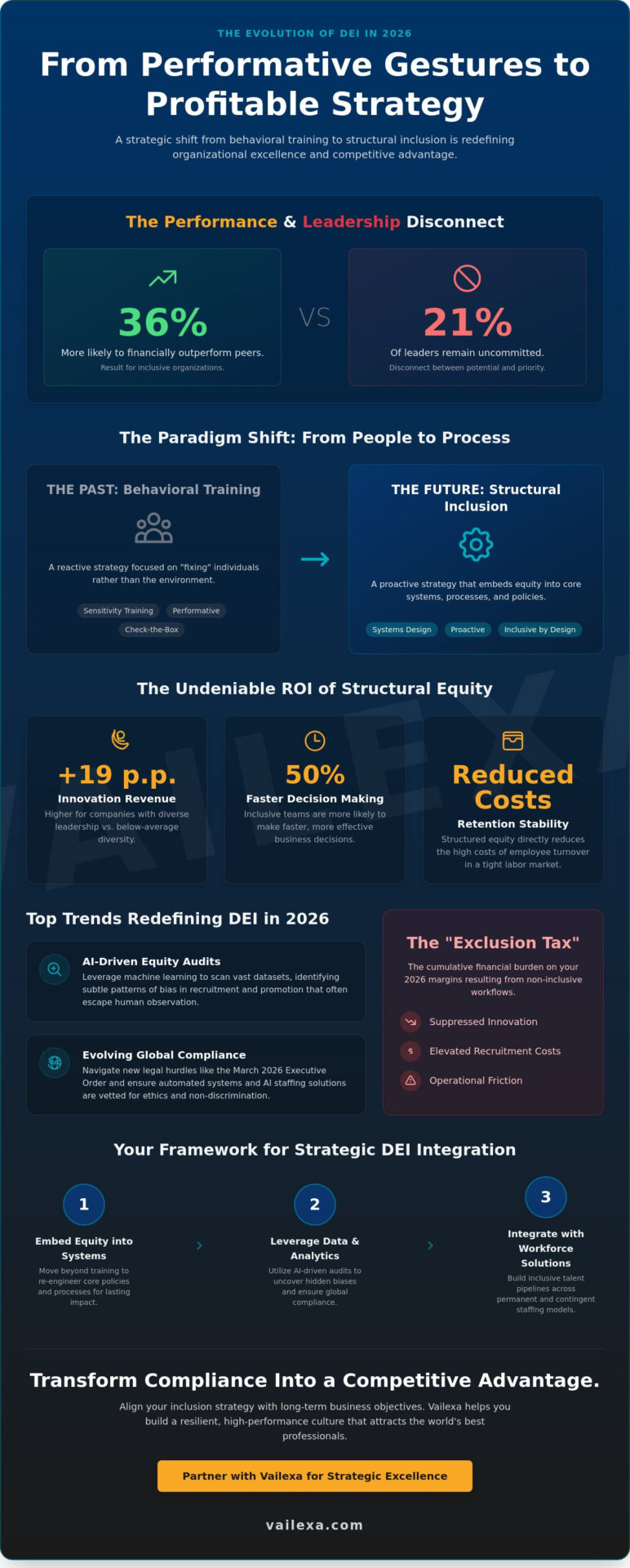
Inclusive organizations are 36% more likely to outperform their peers financially, yet a recent CIPD report reveals that 21% of leaders remain uncommitted to building a diverse workforce. This disconnect often stems from a growing skepticism toward performative initiatives that fail to deliver measurable impact on retention or innovation. Selecting from the top DEI consulting firms in 2026 requires a shift in perspective. You need a partner that moves beyond surface-level training to address the structural agility of your entire organization.
You’re likely facing the challenge of managing inclusion across diverse global jurisdictions while balancing new legal hurdles, such as the March 2026 Executive Order regarding federal contractors. We’ll provide a clear framework for comparing global partners and insight into the data-driven methodologies that are defining the market this year. This analysis ensures your DEI strategy aligns perfectly with your talent acquisition goals, transforming compliance requirements into a competitive advantage. You’ll gain the clarity needed to move from reactive gestures to a sophisticated, results-oriented workforce strategy.
Key Takeaways
- Identify the critical shift from behavioral training to structural inclusion, ensuring equity is embedded directly into your organizational systems and policies for lasting impact.
- Leverage AI-driven equity audits and sophisticated data analytics to uncover hidden biases and maintain compliance with evolving global pay transparency regulations.
- Utilize our strategic framework for evaluating DEI consulting firms to ensure your partner possesses the data maturity and local nuance required for global operations.
- Integrate diversity initiatives within your broader workforce solutions to build more inclusive talent pipelines across both permanent and contingent staffing models.
- Align your inclusion strategy with long-term business objectives by transforming DEI from a standalone program into a driver of innovation and organizational excellence.
The State of DEI Consulting Firms in 2026: Beyond Representation
The era of the “check-the-box” workshop has officially concluded. Global enterprises have recognized that performative gestures don’t just fail to drive change; they actively erode organizational trust. Modern DEI consulting firms have pivoted toward a model of systematic organizational transformation. This approach moves beyond simple representation quotas to address the foundational mechanics of how a business operates. It isn’t about individual behavior alone. It’s about ensuring that every process, from procurement to product development, reflects the core principles of Diversity, equity, and inclusion (DEI).
By 2026, the focus has shifted from behavioral inclusion to structural inclusion. While training aimed at changing mindsets has its place, it’s the systems that dictate long-term outcomes. Strategic consultants now prioritize the re-engineering of corporate architecture. This evolution is a direct response to the global talent scarcity and high attrition rates that define the current market. When inclusion is embedded into the structure, it becomes a self-sustaining driver of stability and growth.
From Sensitivity Training to Systems Design
Individual bias training has largely failed to produce long-term results because it attempts to fix people rather than the environments they inhabit. It’s a reactive strategy. In contrast, the most effective DEI consulting firms now utilize “Inclusive by Design” frameworks. These frameworks audit hiring algorithms for hidden bias and re-examine promotion pathways to remove systemic friction. By correcting the system, organizations create an ecosystem where diversity is inevitable rather than forced. This shift ensures that equity remains resilient, even as leadership teams or cultural trends evolve.
The ROI of Structural Equity
The financial argument for this systemic evolution is undeniable. Research indicates that inclusive organizations are 36% more likely to outperform their competitors financially. Beyond top-line growth, leading firms now quantify the specific costs associated with cultural misalignment and the failure to retain diverse talent. These metrics provide a clear view of how exclusion hampers market agility. Consider these performance indicators:
- Innovation Revenue: Companies with diverse leadership report innovation revenue 19 percentage points higher than those with below-average diversity.
- Better Decision Making: Inclusive teams are up to 50% more likely to make faster, more effective business decisions.
- Retention Stability: Structured equity directly reduces the high costs of employee turnover in a tight labor market.
The Exclusion Tax represents the cumulative financial burden on 2026 margins resulting from suppressed innovation, elevated recruitment costs, and the operational friction of non-inclusive workflows.
Strategic DEI consulting is now a primary tool for mitigating global talent scarcity. In an age where skilled professionals prioritize belonging as much as compensation, a robust inclusion strategy is a prerequisite for stability. It’s the difference between a revolving door of talent and a resilient, high-performance culture that attracts the world’s best professionals.
Top 2026 Trends Redefining DEI Consulting Services
The landscape of organizational strategy is shifting beneath our feet. While previous years focused on the “why” of inclusion, 2026 is defined by the “how” through advanced technological integration and rigorous regulatory compliance. In 2026, the most effective DEI consulting firms have moved beyond anecdotal evidence to embrace hard data and predictive modeling. This year marks a significant turning point where technology and ethics converge to create more equitable workplaces.
One of the most prominent shifts involves the implementation of AI-driven equity audits. These audits leverage machine learning to scan vast datasets, identifying subtle patterns of bias in recruitment and promotion that often escape human observation. The regulatory environment has also become more stringent. With the enforcement of new AI regulations, companies must ensure their automated systems don’t perpetuate discrimination. Leading consultants are now partnering with businesses to implement AI staffing solutions that are pre-vetted for ethical compliance. This proactive approach allows organizations to forecast diversity gaps before they manifest, moving from reactive mitigation to strategic prevention.
Global pay transparency has also emerged as a non-negotiable standard. As international wage laws evolve, DEI consulting firms provide the expertise necessary to navigate complex reporting requirements across different jurisdictions. This transparency is no longer just a legal hurdle; it’s a core component of the top 2026 trends in DEI consulting that link social impact directly to investor reporting and ESG frameworks. Simultaneously, we’re seeing neurodiversity at scale become a priority for high-tech sectors. Integrating neurodivergent talent isn’t just a social goal; it’s a strategic necessity to address the global shortage of specialized skills.
AI and Ethical Talent Acquisition
The rise of predictive analytics has transformed how enterprises view their talent pipelines. By analyzing historical data through a lens of equity, firms can pinpoint exactly where diverse talent drops out of the funnel. This level of precision is essential for maintaining compliance in a high-scrutiny environment. It’s about building a scrutiny-proof talent engine that withstands both legal challenges and public perception. Strategic partners help companies navigate complex AI bias regulations, ensuring that innovation doesn’t come at the cost of equity. Developing inclusive hiring practices for global enterprises is now a foundational requirement for any organization seeking to build a bias-free recruitment engine that delivers sustainable results.
Hyper-Personalized Employee Experiences
We’ve seen a decisive move away from “one-size-fits-all” benefit packages. Modern inclusion strategies now focus on hyper-personalization, supporting remote and global workforces through flexible work models tailored to individual needs. Consultants are increasingly using a “Belonging Index” to measure the effectiveness of hybrid environments. This data-backed approach ensures every employee feels valued, regardless of their physical location or cognitive style. Achieving this level of organizational maturity requires a partner that understands the intersection of technology and human potential. If you’re looking to refine your strategy, exploring comprehensive workforce solutions can help align your inclusion goals with your broader business objectives.
A Strategic Framework for Evaluating DEI Consulting Firms
Selecting a strategic partner in 2026 requires a rigorous assessment of operational alignment that goes far beyond a review of cultural credentials. High-level decision-makers must look for partners who act as visionary architects rather than temporary facilitators. The complexity of modern enterprise demands that DEI consulting firms possess the technical sophistication to synchronize with global business objectives. To ensure a high return on investment, your evaluation should center on four critical pillars of excellence.
- Data Maturity: The firm must demonstrate the ability to ingest and analyze complex, multi-jurisdictional data sets. They should provide more than just representation numbers; they should offer insights into the velocity of diverse talent through your pipeline.
- Global Reach vs. Local Nuance: A partner’s value is defined by their ability to translate high-level strategy into locally relevant actions. What succeeds in a North American context may fail in the Asia-Pacific region without deep cultural intelligence.
- Integration Capability: True impact occurs when inclusion is woven into the fabric of the business. Ensure the firm’s strategy aligns with established diversity and inclusion consulting pillars, specifically within recruitment and workforce planning.
- Sustainability: Evaluate whether their interventions are designed to be self-sustaining. The goal is to build internal capabilities that outlast the consulting contract, creating a resilient ecosystem of equity.
Traditional vs. Modern DEI Consulting Models
There’s a distinct divide between “prestige” firms that focus on broad executive coaching and “specialized” boutique agencies that prioritize structural re-engineering. While point-in-time audits were once the industry standard, 2026 demands continuous improvement partnerships. These modern models don’t just look at your permanent headcount. They apply the same rigorous inclusion standards to your contingent workforce and gig economy talent, ensuring a unified culture across all employment types. This holistic view is essential for maintaining brand integrity in a fragmented labor market.
The Decision-Maker’s Scorecard
During the RFP process, move beyond standard questions to uncover a firm’s true depth. Ask how they measure the long-term impact of their interventions on employee retention and innovation revenue. Be wary of red flags, such as an over-reliance on one-off training sessions or a lack of focus on structural policy changes. If a firm can’t explain how they will audit your hiring algorithms for bias, they aren’t prepared for the 2026 landscape. A data-first requirement in 2026 mandates that consultants utilize real-time analytics to prove that systemic changes are driving measurable improvements in retention and innovation. Choosing the right DEI consulting firms means finding an equal partner that values precision and accountability as much as you do.
Integrating DEI with Global Workforce Solutions
A truly global workforce strategy is incomplete if it only addresses permanent employees. In 2026, the most sophisticated DEI consulting firms are breaking down the silos between full-time staff and the contingent workforce. This integration is vital for maintaining cultural consistency and operational efficiency across a fragmented labor landscape. When you manage a vast network of gig workers and contractors, your inclusion metrics must extend across all labor categories to ensure brand integrity and mitigate legal risks. It’s about creating a unified experience that values every contributor, regardless of their contract type.
Building inclusive talent pipelines requires a synchronized approach to Recruitment Process Outsourcing (RPO). By embedding equity into the RPO framework, organizations can ensure that every candidate is evaluated through a bias-free lens from the very first touchpoint. This is particularly effective when leveraging contingent staffing to fill specialized, high-demand roles. It allows for a more agile and diverse workforce that can scale based on market demand without sacrificing the quality of the talent pool. Strategic DEI consulting firms help optimize these processes, ensuring that diversity isn’t an afterthought but a core component of the recruitment engine. A data-driven approach to inclusive hiring practices ensures that every stage of your talent pipeline reflects your organization’s commitment to equity and long-term workforce resilience.
DEI in the Contingent Workforce
Pay equity isn’t just a concern for the C-suite; it’s a fundamental requirement for every worker in your ecosystem. Strategic workforce planning now incorporates Vendor Management Systems (VMS) to track diversity metrics within the supply chain. This transparency allows firms to hold staffing vendors accountable and ensures that non-permanent staff receive equitable treatment and opportunities. It’s a disciplined, data-driven approach to ethics that strengthens the entire organizational structure. By prioritizing diversity across all labor categories, companies build a more resilient and innovative workforce.
Global Talent Mapping for Leadership Diversity
High-level talent mapping has become a cornerstone of modern succession planning. By using advanced data analytics to identify diverse executive talent in emerging markets, firms can build a leadership pipeline that reflects their actual global footprint. This process often involves confidential executive search to secure top-tier candidates who bring unique perspectives and cultural intelligence to the table. Inclusive leadership acts as a stabilizer, ensuring long-term organizational stability and helping the business navigate complex international markets with composure.
If you’re ready to unify your inclusion strategy with your broader business goals, explore our Global Talent Solutions to see how we bridge the gap between equity and execution.
Selecting Vailexa for Strategic DEI and Workforce Excellence
Most DEI consulting firms operate in a vacuum, focusing exclusively on cultural sentiment while neglecting the operational mechanics of the business. Vailexa breaks this mold. We occupy a unique position as both a global workforce solutions provider and a strategic advisor. This dual perspective allows us to bridge the gap between high-level inclusion goals and the practical realities of talent acquisition. We don’t just suggest change; we architect the systems that make it inevitable.
Our identity as an “Authoritative Strategic Guide” means we approach structural inclusion with a meticulous eye for detail. We recognize that every organization has a unique DNA. Therefore, we don’t offer off-the-shelf workshops. Instead, we develop customized DEI roadmaps that are deeply integrated with our AI staffing solutions and data analytics staffing. This ensures that every hire and every promotion is backed by objective data and aligned with your long-term growth strategy. We act as the reliable guardian of your organizational standards, ensuring that excellence and equity are never mutually exclusive.
The Vailexa Methodology: Data, Strategy, Execution
Success in 2026 requires more than good intentions. It demands measurable outcomes and a clear return on investment. Our methodology is built on a foundation of rigorous data analysis and disciplined execution. We integrate DEI principles into the full talent lifecycle, ensuring consistency across every touchpoint. When we manage your Recruitment Process Outsourcing (RPO), we embed bias-mitigation protocols into the sourcing engine. When we conduct an Executive Search, we use global talent mapping to find leaders who bring both expertise and diverse perspectives to your C-suite.
We’ve helped global enterprises transform their margins by driving innovation through structural equity. By fixing the system rather than the individual, we create environments where high-performance talent chooses to stay. This approach reduces the high costs of attrition and positions your brand as a preferred employer in a competitive global market. Our focus remains on creating long-term stability through precise, empowered workforce planning. Understanding the common misconceptions that derail these efforts is equally critical; building an inclusive culture requires debunking the myths of modern workplace integration that often cause well-intentioned initiatives to fall short of their potential.
Your Next Steps Toward Global Inclusivity
The journey toward systemic transformation begins with a clear, honest assessment of your current state. We invite you to begin this process by requesting a comprehensive workforce and DEI audit. This strategic audit goes beyond surface-level metrics to uncover the structural friction points that hinder your progress. We’ll help you align your 2026 talent strategy with the most rigorous global inclusion standards, ensuring your organization is both scrutiny-proof and future-ready.
Transforming your workforce isn’t a project; it’s a strategic evolution. With Vailexa as your partner, you gain access to the intelligence, accuracy, and commitment to quality required to lead in a complex world. It’s time to move beyond performative gestures and toward a future defined by excellence. Partner with Vailexa for visionary DEI consulting and workforce solutions.
Mastering the Future of Organizational Equity
The landscape of 2026 demands a departure from isolated initiatives in favor of a cohesive, systemic architecture. Success now hinges on the ability to integrate equity into the very fabric of your global talent lifecycle. By prioritizing data maturity and structural agility, organizations move beyond the surface level of representation to achieve genuine innovation and long-term stability. The most effective DEI consulting firms act as visionary architects, helping you navigate complex international regulations while optimizing both permanent and contingent labor pools.
Vailexa brings a proven track record in structural transformation, supported by specialized AI and Data Analytics staffing expertise. Our reach extends across 50+ markets, providing the local nuance and global scale necessary for modern enterprise. We don’t just advise on change; we provide the precision and reliability required to execute it at every level of your organization.
Elevate your global strategy with Vailexa’s DEI consulting expertise. Your commitment to excellence starts with a partner that values precision and human potential as much as you do. Let’s build a more resilient future together.
Frequently Asked Questions
What should I look for in a DEI consulting firm in 2026?
You should prioritize firms that emphasize structural re-engineering over basic sensitivity training. A strategic partner must possess the data maturity to handle complex, global datasets and the technical expertise to audit hiring algorithms for hidden bias. High-quality DEI consulting firms provide a clear roadmap for integrating inclusion into your broader business strategy rather than treating it as a standalone initiative.
How do DEI consulting firms measure ROI for global enterprises?
ROI is typically measured through key performance indicators such as reduced attrition costs, increased innovation revenue, and improved decision-making speed. Research indicates that inclusive organizations are 36% more likely to outperform financial targets. By quantifying the “Exclusion Tax” on your margins, consultants provide a clear view of how systemic equity drives long-term profitability and market agility across various jurisdictions.
Can DEI consulting help with my contingent workforce strategy?
Strategic DEI consulting is essential for managing a diverse contingent workforce and ensuring pay equity across all labor categories. By utilizing Vendor Management Systems to track inclusion metrics, you can hold staffing partners accountable and ensure your gig workers feel valued. This approach directly improves the stability and quality of your external talent pool while maintaining cultural consistency across your entire labor landscape.
What is the difference between behavioral and structural inclusion in DEI?
Behavioral inclusion focuses on individual mindsets and unconscious bias training, while structural inclusion addresses the systems and policies that govern an organization. While training is a common starting point, structural changes to promotion pathways and recruitment algorithms deliver more sustainable results. Modern DEI consulting firms prioritize fixing the environment to ensure equity remains resilient, regardless of individual leadership changes or shifting cultural trends.
How much does a typical DEI consulting engagement cost?
Investment levels for DEI engagements vary significantly based on the organization’s size, geographic reach, and the complexity of the structural audit. Industry professionals report that fees are typically structured as hourly rates, project-based milestones, or monthly retainers. You should check with individual providers for specific quotes that reflect your unique organizational requirements and the depth of the transformation required to achieve your goals.
How do DEI firms handle data privacy during global equity audits?
Leading firms manage data privacy by adhering to strict international regulations like GDPR and utilizing localized data residency solutions. They employ advanced anonymization techniques during equity audits to ensure individual identities remain protected while still uncovering systemic biases. This disciplined approach to data security is vital for maintaining employee trust and ensuring legal compliance across multiple global jurisdictions during the audit process.
Why is AI integration important for modern DEI consulting?
AI integration allows for the rapid identification of hidden biases in vast datasets that human observation might miss. It’s also critical for ensuring compliance with new regulations like the EU AI Act, which mandates ethical transparency in automated systems. Using AI staffing solutions helps forecast diversity gaps early, enabling you to move from reactive gestures to proactive, predictive talent management that protects your brand’s integrity.
How long does it take to see results from a DEI consulting partnership?
Initial results from process audits and system re-engineering can often be seen within three to six months. However, significant shifts in retention rates and organizational culture typically require a sustained partnership of twelve to eighteen months. The most successful transformations are those that treat inclusion as a continuous improvement journey rather than a one-time project, ensuring that equity becomes a permanent feature of your organizational DNA.