
With the average time-to-fill for high-demand roles reaching 44 days in 2026, can your organization truly afford to treat talent acquisition as a static cost center? Most executives realize that traditional hiring models are buckling under the weight of market volatility and the rapid integration of AI. You likely recognize that your current internal capacity can’t always scale with global demand or keep pace with the 62% of employers now utilizing advanced AI across the entire recruitment lifecycle. Building a compelling business case for recruitment process outsourcing is no longer just about reducing overhead; it’s about architecting a sophisticated engine for organizational agility.
This article provides the strategic blueprint you need to quantify ROI, secure C-suite alignment, and shift from reactive hiring to proactive talent mapping. We’ll examine how a structured RPO partnership delivers 30-40% savings compared to legacy staffing agencies while improving the quality of every hire. You’ll gain a clear framework to justify your budget and transform talent acquisition into a scalable, data-driven competitive advantage that supports long-term stability.
Key Takeaways
- Quantify the true impact of talent density by analyzing the hidden costs of productivity loss and turnover that internal teams often overlook.
- Construct a data-backed business case for recruitment process outsourcing that addresses the CFO’s need for risk mitigation and the CEO’s demand for global scalability.
- Access specialized AI staffing technologies and predictive data analytics that transform recruitment from a reactive function into a proactive competitive engine.
- Identify the core criteria for selecting a high-level strategic partner capable of integrating workforce planning with immediate operational excellence.
Beyond Cost Savings: The Strategic Imperative for RPO in 2026
Establishing a robust business case for recruitment process outsourcing requires a fundamental shift in perspective. In 2026, the value of a partnership isn’t found in merely filling seats; it’s found in the cultivation of talent density. Reactive hiring models, which wait for a resignation before initiating a search, are no longer viable in a high-velocity market. Successful leaders now view talent acquisition as a continuous strategic activity that builds a reservoir of elite candidates ready for immediate deployment. This transition from a defensive posture to an offensive strategy ensures your organization remains composed even during periods of intense market volatility.
Modern Recruitment Process Outsourcing (RPO) represents a fusion of global reach, specialized expertise, and enterprise-grade technology. While traditional in-house teams often struggle to maintain the expensive AI stacks and data analytics tools required to compete, an RPO provider absorbs that complexity. This allows your internal leadership to focus on core business objectives while the provider handles the intricate mechanics of global talent mapping and workforce optimization. It’s a method that replaces the ‘talent scarcity’ paradox with a predictable pipeline of qualified professionals.
The Evolution of Recruitment Process Outsourcing
The industry has evolved far beyond transactional, project-based assistance. Today’s models provide an end-to-end talent solution that integrates seamlessly with your existing culture. We don’t just act as a third-party vendor; we function as a sophisticated extension of your employer brand. By utilizing advanced talent mapping, we identify high-potential individuals months before a role opens, securing long-term organizational stability and reducing the pressure of sudden vacancies. This partnership ensures that every candidate interaction reflects your company’s values and excellence.
Why 2026 is the Year for Strategic RPO
As we navigate 2026, the skills gap in specialized sectors like AI and Data Analytics has reached a critical point. Traditional models can’t scale quickly enough to capture these elusive professionals. A scalable model is essential to survive a fluctuating economy where ‘gig’ and ‘contingent’ work have become standard. You need the ability to ramp up hiring for global expansion or scale back during market corrections without losing institutional knowledge. The 2026 RPO model is a strategic agility engine that converts recruitment from a logistical hurdle into a primary driver of global growth.
Quantifying the ROI: The Financial Case for Enterprise RPO
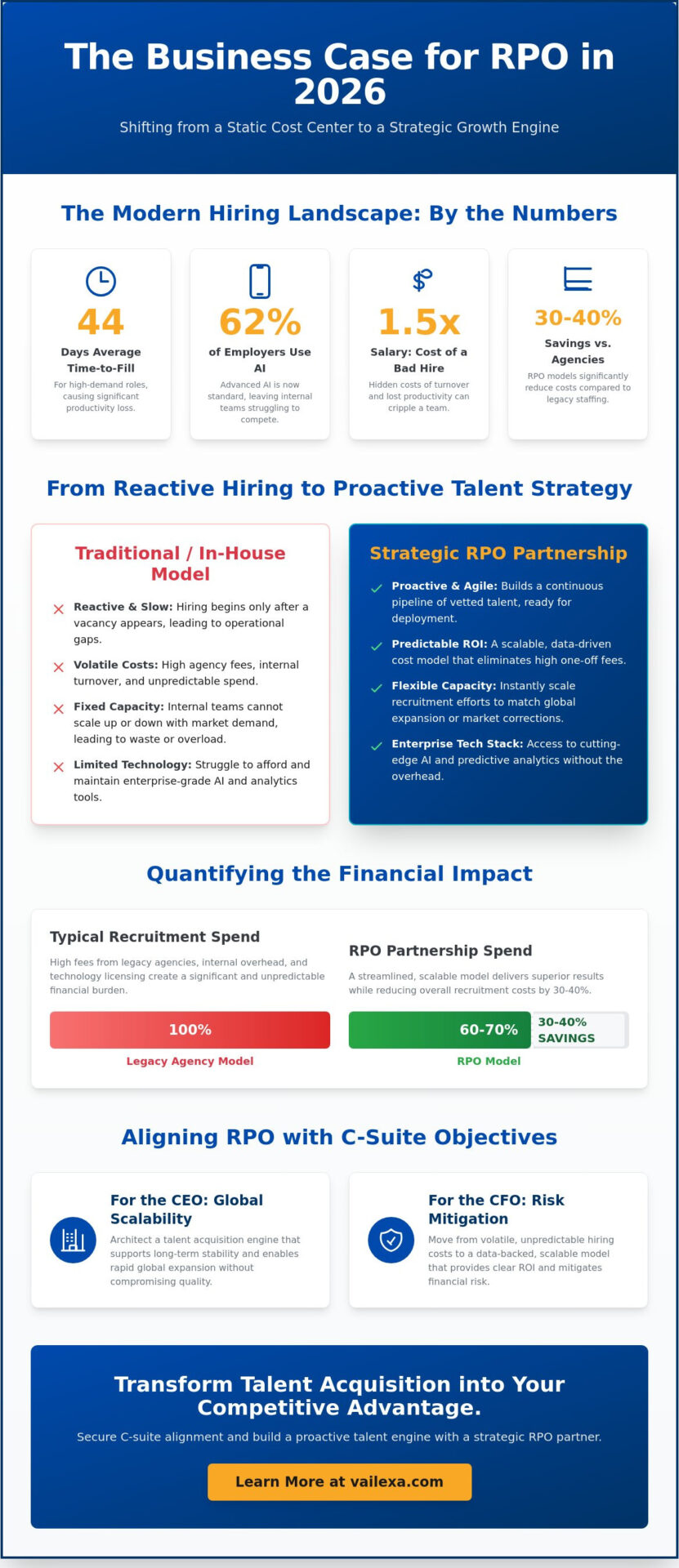
Quantifying the financial impact of talent acquisition requires a forensic look at both visible and invisible expenditures. Most organizations fixate on the direct cost-per-hire, which averages around $4,700 in the U.S. according to data from 2026. This figure is deceptive. It ignores the indirect drain on resources; specifically the hundreds of management hours spent on screening and interviewing instead of driving revenue. Building a comprehensive business case for recruitment process outsourcing means moving from a narrow view of expenses to a Total Cost of Ownership (TCO) model. This holistic approach accounts for technology licenses, internal recruiter turnover, and the high-margin fees often paid to traditional staffing agencies.
RPO provides a significant financial lever through inherent scalability. Internal teams often face a ‘hire-and-fire’ cycle; they expand during growth spurts only to face layoffs when the market cools. This creates a legacy of severance costs and damaged employer branding. An RPO model eliminates this volatility. It allows you to flex your recruitment capacity up or down based on real-time demand, ensuring you only pay for the results you need. Research from Dover indicates that companies leveraging this model can save between 30% and 40% on recruiting costs compared to legacy agency models. If your organization aims to optimize these expenditures, exploring Strategic Workforce Planning is a logical next step.
Hard Metrics: Time, Cost, and Quality
Time is a depreciating asset in recruitment. With the average time-to-fill for high-demand roles sitting at 44 days as of May 2026, every day a seat remains empty is a day of lost productivity. RPO providers use enterprise-grade AI to compress these timelines, maintaining operational momentum without sacrificing quality. This focus on quality-of-hire is the ultimate ROI driver. By utilizing data-driven assessments, RPO mitigates the ‘hidden cost’ of bad hires, which can often exceed 1.5 times the employee’s annual salary when considering turnover and retraining expenses.
The Opportunity Cost of Vacant Leadership
Unfilled executive or specialized roles represent a direct hit to the bottom line. The daily revenue loss from a vacant leadership position can be staggering, especially in sectors where speed-to-market is everything. RPO ensures a continuous pipeline of ‘ready-now’ talent, shifting the paradigm from reactive searching to proactive placement. Understanding the nuances of contingent vs permanent staff is vital here; a hybrid approach often provides the best cost-to-value ratio for specialized projects. By reducing reliance on expensive, high-margin third-party agencies, RPO redirects that capital into long-term organizational growth.
Securing Executive Buy-In: Aligning RPO with C-Suite Objectives
Securing approval for a transformative talent strategy requires more than a simple list of benefits. You must present a business case for recruitment process outsourcing that resonates with the specific pressures and performance indicators of each executive stakeholder. A generic pitch often fails because it ignores the nuanced priorities that drive boardroom decisions. To win support, you must frame the transition as a solution to existing organizational friction rather than just an operational change.
The CFO prioritizes predictability and risk mitigation. In a traditional model, recruitment costs are often volatile and difficult to forecast due to fluctuating agency fees and internal turnover. RPO replaces this uncertainty with a structured financial model, providing a clear line of sight into total talent expenditure. By converting variable costs into a manageable, results-oriented budget, you offer the CFO the fiscal composure they require to maintain long-term stability. This financial transparency is a cornerstone of a modern, data-driven organization.
For the CEO, the primary concern is speed-to-market and competitive edge. As the global RPO market is projected to reach $13.55 billion in 2026, it’s clear that your competitors are already leveraging these models to accelerate their growth. Speed is the CEO’s currency. By integrating global talent solutions, the CEO ensures that the organization can enter new markets with the precise human capital required for immediate impact, effectively future-proofing the company against talent shortages.
The Language of the Boardroom
Success at the board level depends on framing RPO as a high-level risk management strategy. It isn’t just about hiring; it’s about ensuring the company has the right skills to execute its three-year plan. This includes using RPO as a catalyst for diversity and inclusion consulting goals, ensuring that talent acquisition isn’t just fast, but also equitable and aligned with modern corporate governance standards. Data-driven insights from the RPO partnership provide the board with the evidence they need to verify that talent strategy is directly supporting business growth.
Overcoming Internal Resistance
The most common hurdle is the ‘loss of control’ myth. Internal HR teams may fear that outsourcing diminishes their influence or threatens their roles. You must position the RPO provider as a partner that handles the heavy lifting of sourcing and administrative logistics, which frees your internal HR leaders for higher-value strategic work. Modern RPO amplifies internal potential rather than replacing it. Through collaborative governance and shared data, you maintain brand consistency while gaining the specialized AI expertise that 62% of employers now demand. This partnership empowers your team to focus on culture, retention, and leadership development while we manage the complexities of the global talent market.
The Technology Advantage: AI Staffing and Data Analytics in RPO
Technology in 2026 is no longer a peripheral tool; it’s the central nervous system of effective talent acquisition. While many internal departments struggle with the high licensing costs and integration hurdles of fragmented software, RPO providers offer immediate access to unified, enterprise-grade AI recruiting stacks. This technological leap is a primary pillar in the modern business case for recruitment process outsourcing. It allows for a level of search accuracy and speed that manual processes simply cannot replicate. By utilizing these advanced tools, you ensure your organization doesn’t just participate in the market, but actively shapes its own talent destiny with composure and precision.
The shift toward AI-driven recruitment is already a documented reality for global leaders. According to research from MSH Talent, 62% of employers anticipate using AI for most or all stages of the hiring process by May 2026. RPO partners bridge the ‘AI Talent Gap’ by deploying specialized sourcing techniques that identify candidates with the exact technical competencies your business requires. This tech-enabled journey also significantly enhances the candidate experience. With an 86% increase in video interview usage since 2020, the ability to provide a seamless, digital-first interaction is essential for attracting top-tier talent. To see how these sophisticated tools work in practice, explore our AI Staffing Solutions.
Predictive Talent Mapping
Data analytics allow us to move beyond reactive job postings and toward a model of strategic foresight. We use predictive talent mapping to identify emerging workforce trends before they create a bottleneck in your operations. In a borderless digital economy, this global view is vital for maintaining a competitive edge. By integrating AI staffing solutions, we identify ‘passive’ high-performers who are often invisible to traditional internal teams, ensuring your pipeline is always populated with elite potential ready for deployment.
Data-Driven Diversity and Inclusion
Sophisticated technology also serves as a powerful guardian of organizational standards and equity. AI-assisted screening helps remove unconscious bias from the initial stages of recruitment, building diverse pipelines that are proven to drive organizational innovation. We leverage RPO to meet complex global D&I mandates through precise, measurable data rather than anecdotal goals. This approach ensures that inclusive hiring is a documented reality that strengthens your employer brand and aligns with the highest corporate governance standards.
Selecting Your Partner: Why Vailexa’s RPO Model Wins
Choosing the right partner is the final, decisive element in your business case for recruitment process outsourcing. A commoditized, one-size-fits-all approach often fails because it ignores the specific cultural and technical nuances that define your organization. Vailexa avoids these pitfalls by offering a bespoke model that prioritizes customization over mass-market solutions. We combine an expansive global reach with specialized AI staffing expertise to ensure your talent engine is both broad in scope and precise in execution. This isn’t just about outsourcing a process; it’s about securing a high-level strategic partner dedicated to your excellence.
Our commitment to transparency distinguishes us as an authoritative guide in the recruitment space. While legacy providers might offer opaque, monthly reports, we provide real-time data and executive-level insights that allow you to track every critical metric. This level of visibility ensures that your investment is always aligned with your broader corporate objectives. We don’t just fill roles. We execute a Strategic Workforce Planning approach that builds for your future needs rather than just reacting to your present vacancies. Customization is the antidote to mediocrity in talent acquisition.
The Vailexa Methodology
We employ a 360-degree methodology that encompasses everything from talent mapping to high-level executive search. By integrating with your internal culture, our team acts as a seamless brand ambassador that protects and enhances your employer brand in the global market. This integration is particularly effective for technical teams, where our specialized data analytics staffing capabilities ensure that you’re hiring the top tier of quantitative talent. We focus on the human element of growth, ensuring that every hire is a cultural and strategic fit.
Your Roadmap to RPO Implementation
Successful implementation begins with a structured 90-day transition plan designed to minimize friction. This initial phase focuses on deep integration, establishing collaborative governance, and securing quick wins to build organizational momentum. We move beyond basic metrics like ‘fills’ to focus on true business impact, such as quality-of-hire and long-term retention. Our process is methodical and purposeful, providing the reliability you need to scale with confidence. If you’re ready to transform your talent acquisition into a scalable competitive advantage, Consult with a Vailexa RPO Architect today.
Transforming Talent into a Scalable Competitive Advantage
The transition toward a specialized, tech-enabled recruitment model is no longer optional for organizations aiming for global growth in 2026. By prioritizing quality-of-hire and financial predictability, you move beyond the limitations of legacy internal structures. A data-backed business case for recruitment process outsourcing establishes the foundation for this transformation, ensuring your talent strategy is an active driver of revenue rather than a passive expense. You’ve seen how the fusion of AI and global reach can compress hiring timelines and mitigate the risks of market volatility.
Vailexa stands ready as your authoritative strategic guide. We combine global reach with localized AI staffing expertise and a proven track record in strategic workforce planning to deliver measurable results. Our integration of data-driven D&I consulting ensures that your growth is both equitable and innovative. Don’t let market volatility dictate your pace. Build your bespoke RPO business case with a Vailexa expert and secure the elite human capital your future demands. Your journey toward organizational excellence begins with a single strategic decision; we’re here to ensure it’s the right one.
Frequently Asked Questions
What is the primary difference between RPO and traditional staffing agencies?
Staffing agencies typically focus on transactional, one-off placements, while RPO provides end-to-end management of your entire recruitment process. An RPO partner functions as a sophisticated extension of your internal team, integrating with your culture and technology stack. This deep alignment allows for strategic workforce planning that traditional agencies simply don’t offer. By managing the full lifecycle, RPO delivers long-term stability and consistent quality across all hiring initiatives.
How much does recruitment process outsourcing typically cost?
RPO costs are structured around your specific hiring volume, the complexity of the roles required, and the scope of services. Common models include a fixed monthly management fee, a cost-per-hire arrangement, or a hybrid structure that provides budget predictability. While traditional agencies often charge high-margin percentages per placement, RPO focuses on reducing the total cost of ownership. This financial structure is a central pillar in the business case for recruitment process outsourcing.
Can RPO help with high-level executive search and specialized AI roles?
Modern RPO models are specifically designed to handle executive search and highly specialized technical roles, such as AI and data analytics. Providers leverage advanced AI staffing solutions and global talent mapping to identify passive high-performers who aren’t found through traditional job boards. This specialized expertise ensures that even your most critical leadership and niche technical positions are filled with candidates who possess the precise competencies required for organizational growth.
Will our company lose control over our employer brand with RPO?
Your organization maintains full control over the employer brand as the RPO provider acts as a seamless ambassador of your values. Every candidate interaction is conducted under your company’s banner, ensuring a unified and polished market presence. RPO actually strengthens your brand by providing a more professional, consistent candidate journey. This collaborative governance model ensures that your organizational standards are upheld across every touchpoint in the recruitment lifecycle.
How do we measure the success and ROI of an RPO engagement?
Success is measured through a sophisticated blend of operational metrics and strategic business impact. Key performance indicators include time-to-fill, quality-of-hire, and candidate satisfaction scores, alongside a forensic analysis of total cost savings compared to legacy agency spend. By tracking these data points, you can clearly demonstrate the ROI of the business case for recruitment process outsourcing to your board. These insights enable proactive adjustments to your talent strategy.
Is RPO suitable for small-to-medium enterprises (SMEs) or only global corporations?
RPO is a scalable solution that provides significant value to both fast-growing SMEs and established global corporations. For smaller enterprises, it offers immediate access to enterprise-grade recruiting technology and specialized expertise without the overhead of building a massive internal department. Global organizations benefit from the ability to scale hiring capacity across different regions while maintaining consistent standards. The model’s inherent flexibility ensures it adapts to your specific organizational size.
How does RPO improve the candidate experience?
RPO enhances the candidate experience by deploying tech-enabled journeys that are fast, transparent, and engaging. With the rise of video interviews and AI-driven scheduling, candidates receive immediate feedback and a more streamlined application process. This professionalized approach reduces friction and ensures that top-tier talent remains interested in your organization. A positive, candidate-centric experience is a key differentiator in attracting elite professionals in a competitive market.
What happens to our internal recruitment team if we switch to RPO?
Your internal recruitment team is empowered to shift their focus from administrative logistics to high-value strategic initiatives. The RPO partner handles the heavy lifting of sourcing, screening, and scheduling, which allows your internal experts to concentrate on culture, retention, and leadership development. This partnership amplifies your team’s potential rather than replacing it. It creates a collaborative environment where internal and external experts work together toward long-term organizational stability.