
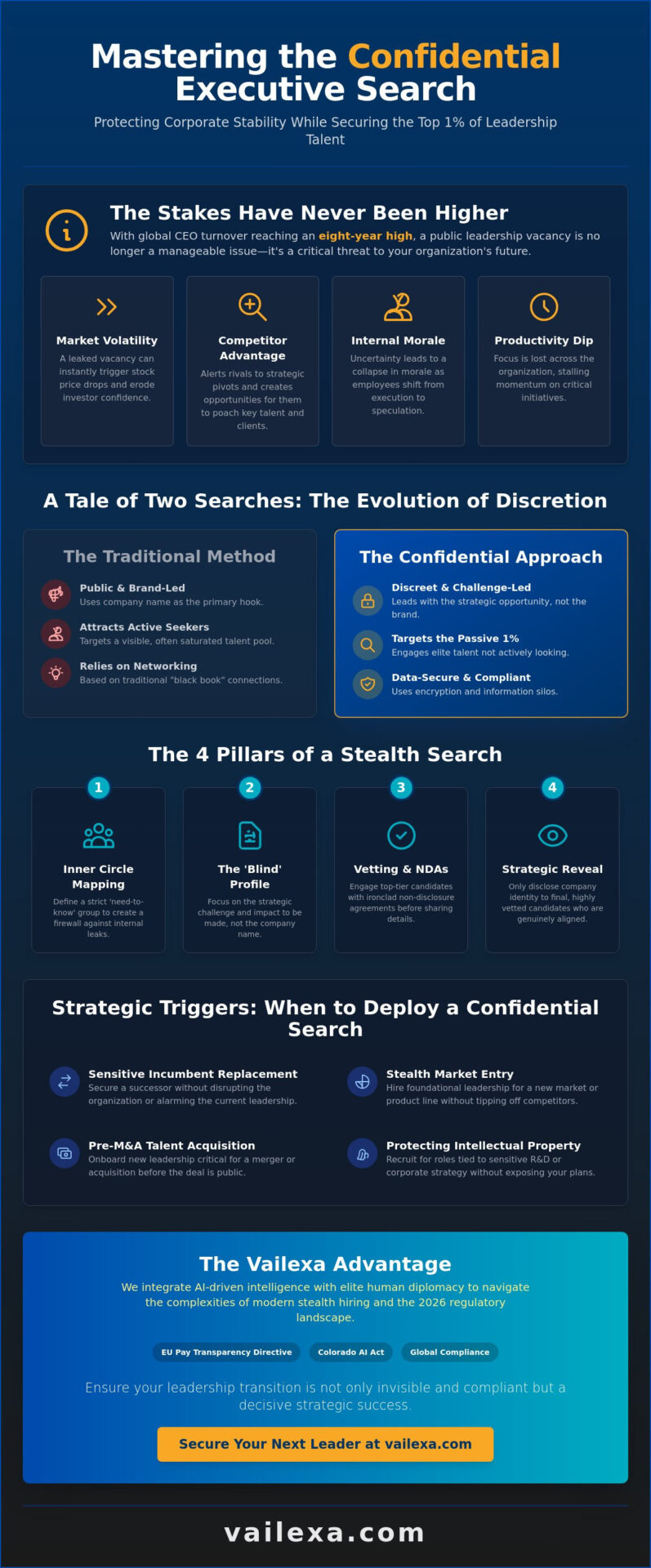
With global CEO turnover reaching an eight-year high in 2025, the margin for error in leadership transitions has effectively vanished. A confidential executive search is no longer a luxury for the paranoid. It is a critical defensive maneuver for any board looking to protect its market valuation. You recognize that the mere whisper of a C-suite vacancy can trigger a collapse in internal morale or tip off competitors to your next strategic pivot.
Maintaining this level of discretion requires a sophisticated methodology that balances total privacy with aggressive talent acquisition. We promise to help you master the complexities of stealth hiring to protect your stability and secure the top 1% of talent who aren’t actively looking. We will examine how to navigate the 2026 regulatory landscape, including the EU Pay Transparency Directive and the Colorado AI Act, to ensure your search remains both compliant and invisible.
Key Takeaways
- Understand how modern leadership acquisition has shifted from traditional networking to a data-driven strategy that prioritizes organizational stability.
- Discover the mechanics of “blind” job profiles and stakeholder mapping to engage top-tier talent without compromising your corporate identity.
- Learn the strategic triggers for a confidential executive search, including sensitive incumbent replacements and stealth market entries.
- Gain practical techniques to neutralize internal rumors and maintain compliance with evolving 2026 labor laws during high-stakes transitions.
- Explore how the integration of AI-driven insights and human diplomacy provides access to the global 1% of passive executive talent.
Understanding Confidential Executive Search: The High-Stakes World of Discreet Hiring
A confidential executive search is a surgical recruitment methodology designed to identify and secure top-tier leadership without alerting the broader market. While traditional Executive Search relies on visible branding and public positioning to attract talent, the confidential model operates in the shadows. It isn’t merely about keeping a secret; it’s a strategic workforce planning tool used to protect an organization’s most sensitive assets and long-term trajectory.
The evolution of this practice reflects the broader digital transformation of corporate strategy. Historically, discretion relied on “black book” networking and whispered conversations in private clubs. Today, it has matured into a data-secure discipline where encryption and rigorous information silos replace the rolodex. This shift ensures that even as search firms leverage global talent pools, the identity of the hiring organization remains protected until the final stages of candidate vetting. Modern stealth searches prioritize precision over volume, ensuring that only the most qualified and vetted individuals are ever aware the role exists.
Maintaining a silent approach is often a requirement for public entities and high-growth firms alike. A leaked C-suite vacancy can trigger immediate volatility in stock prices or erode investor confidence. When shareholders sense a leadership vacuum, they often react with caution, which can stall capital raises or complicate ongoing mergers. By executing a stealth search, boards ensure that the transition is presented as a completed, well-vetted success rather than an ongoing crisis that invites speculation.
The Core Principles of Executive Discretion
Discretion is built upon a strict “need-to-know” information flow among stakeholders. In a standard headhunt, the company name is the primary hook used to attract interest. In a confidential mandate, the search partner leads with the challenge and the strategic opportunity rather than the brand. This requires early-stage candidates to sign ironclad non-disclosure agreements (NDAs) before any identifying details are shared. This protocol protects the brand identity while allowing the search firm to pitch the role to elite prospects who value their own privacy just as much as the hiring organization does.
The Economic Impact of a Public Leadership Crisis
The cost of a leaked transition extends far beyond market valuation. When a vacancy becomes public knowledge, it often serves as a beacon for competitors to poach high-performing middle management or key clients who fear instability. Productivity often dips as employees shift their focus from execution to speculation. To mitigate these risks, sophisticated firms utilize the executive search process as a foundational framework, layering on specific stealth protocols to ensure the transition remains seamless. A well-managed, quiet search keeps the organization’s strategic momentum intact while the next leader is secured behind the scenes.
The Mechanics of Discretion: How Stealth Headhunting Operates Globally
Executing a confidential executive search requires more than just a closed-door policy. It demands a rigorous operational architecture. The process begins with meticulous pre-search alignment and stakeholder mapping. This phase identifies the exact “inner circle” within your organization permitted to know about the search, effectively creating a firewall against internal leaks. By defining these boundaries early, you ensure that the search firm acts as a seamless and secure extension of your board’s vision. This level of strategic intelligence is the backbone of a successful confidential executive search, allowing for progress without the risk of exposure.
A pivotal tool in this discreet toolkit is the “blind” job profile. Unlike a standard job description that leans heavily on brand prestige, a blind profile focuses exclusively on the strategic challenges and the specific impact the new leader must achieve. It describes the “problem to be solved” rather than the “company to join.” This approach allows us to gauge the interest and alignment of elite talent based on the mission’s scope. It filters for candidates driven by the work itself, ensuring that when the brand is finally revealed, the foundation of interest is already solid and professional.
Candidate Outreach and Vetting Protocols
The vetting process often utilizes “Double-Blind” protocols during the initial screening stages. In these sessions, both the candidate’s and the client’s identities are shielded until mutual interest and high-level alignment are confirmed. Verifying credentials in such a sensitive environment is a specialized art. We conduct background checks through discreet, third-party channels that do not alert current employers or professional references. This “soft approach” relies on high-touch human outreach and secure communication channels, ensuring the candidate’s professional reputation remains untarnished while we verify their suitability for your most critical roles.
Global Talent Mapping and Intelligence
Strategic success depends on proactive talent mapping. This involves identifying potential successors and cross-industry leaders long before a vacancy is officially declared. By looking outside your immediate competitor circles, we find “passive” talent in adjacent sectors who possess the transferable skills required for sensitive transformations. Operating globally means managing complex time zones and cultural nuances with precision. If you are ready to secure your next leader without the market noise, our team can help you design a bespoke search strategy that prioritizes both organizational stability and total privacy.
Strategic Use Cases: When to Deploy a Confidential Search Strategy
Choosing to launch a confidential executive search is a calculated decision based on organizational timing and market sensitivity. It isn’t a one-size-fits-all solution. Instead, it serves as a precise tool for specific high-stakes scenarios where exposure would be detrimental to your strategic momentum. While many boards view secrecy as a defensive measure, the most successful organizations use it as an offensive tactic to secure a competitive advantage.
Replacing an incumbent leader is perhaps the most delicate application of this strategy. Managing the balance between current leadership and a future vision requires absolute discretion to prevent a “lame duck” period that could paralyze decision-making. Similarly, when an organization prepares for a strategic market entry, building a leadership team for a “stealth mode” business unit is essential. If you publicly recruit for these roles, you essentially hand your roadmap to your competitors. A discreet approach ensures you can build your foundation in silence, revealing your hand only when you are ready to execute.
Mergers and acquisitions (M&A) present another critical use case. Securing integration leaders before a deal is public knowledge allows for a seamless transition the moment the ink dries. Furthermore, in R&D-heavy industries, hiring for specialized roles without signaling your innovation path protects your intellectual property. Recruiting a specific type of technical visionary can inadvertently broadcast your next product cycle. A confidential executive search allows you to acquire that elite talent without alerting the market to your technological shifts.
Replacement vs. Expansion: Choosing the Right Stealth Level
Not every search requires the same degree of invisibility. Total confidentiality is reserved for the most sensitive transitions, where even the internal HR team may be kept out of the loop to prevent leaks. Partial confidentiality often uses an external firm to buffer the brand name during initial screenings, revealing the identity only to finalists. In some transitional phases, contingent staffing can serve as a vital temporary bridge. This allows the organization to maintain operational continuity while the permanent, confidential search for a C-suite successor continues in the background.
Risk vs. Reward: A Decision-Maker’s Matrix
Determining the appropriate strategy requires assessing the “leak risk” of a public posting. For C-level roles, the impact of a search on internal succession planning is significant. If high-potential internal candidates see an external search, it can trigger unwanted attrition. While transparency is a core value for many modern brands, it is rarely the optimal strategy for top-tier leadership changes. The reward of a quiet, successful placement far outweighs the risk of market speculation and internal unrest.
Mitigating Risks: Protecting Organizational Stability During Leadership Transitions
Rumors are the primary enemy of a confidential executive search. When a search firm is seen on-site or internal stakeholders notice unusual patterns, the “Speculation Trap” begins. Managing this requires a pre-emptive communication strategy that protects current leadership while keeping the organization focused. If rumors start, frame the activity as part of a broader, long-term strategic workforce planning initiative. This keeps the narrative controlled. It prevents the internal morale collapse that often follows leaked transitions.
Legal compliance is a non-negotiable pillar of discreet hiring. Navigating non-compete clauses and regional labor laws requires surgical precision. Any legal misstep could force the search into the public record, which would immediately defeat the purpose of the stealth mandate. Simultaneously, you must maintain a high-caliber candidate experience. Elite talent expects a polished, high-touch process; secrecy must never feel like a lack of professionalism. Strategic timing ensures that the search completion aligns perfectly with the public announcement, allowing for a transition that feels intentional and secure.
Ensuring Diversity and Inclusion in Stealth Mode
Stealth searches can inadvertently lead to “echo chamber” hiring if recruiters rely solely on narrow, private networks. To counter this, we integrate diversity and inclusion consulting principles into the search architecture. By using blinded candidate slates, we focus on skills and competencies rather than traditional identifiers. This methodology allows you to measure the D&I impact of your confidential hires, ensuring your leadership team is as diverse as it is discreet. It proves that privacy doesn’t have to come at the expense of progress.
Technology and Data Security in Search
Standard communication tools are insufficient for high-stakes leadership acquisition. We utilize secure, encrypted data rooms for candidate portfolios and executive assessments to prevent sensitive data leakage. Protecting the digital footprint of the search firm is also essential to prevent competitors from reverse engineering your strategic shifts. Secure your organization’s future with a partner who understands the intersection of privacy and performance; contact our global workforce solutions team to begin your discreet search.
The Vailexa Advantage: Integrating Data Intelligence with Elite Executive Search
Success in a confidential executive search hinges on the synergy between advanced data analytics and the nuanced art of human diplomacy. We don’t believe in choosing between technology and intuition. Our hybrid model leverages proprietary AI-driven talent insights to identify high-potential candidates who remain invisible to traditional search firms. This technological edge is balanced by a high-level diplomatic approach; we ensure that every interaction reflects the gravity and sophistication of your organization’s board.
Our global reach isn’t just a matter of geography. It’s a result of rigorous strategic workforce planning. We access a worldwide network of leaders, transcending local market limitations to find the perfect alignment for your unique challenges. We act as an “Authoritative Strategic Guide,” functioning as a seamless extension of your board of directors. This partnership ensures that your most sensitive leadership needs are met with the weight and precision they deserve. For instance, we recently executed a confidential executive search for a global technology leader looking to replace a long-standing CEO. By maintaining absolute silence and utilizing our global talent mapping, we secured a successor who drove a significant increase in operational efficiency within their first year without disrupting market confidence.
Beyond the Placement: Long-Term Strategic Alignment
Our commitment to your organization doesn’t end when the contract is signed. We ensure every new leader is perfectly aligned with your five-year workforce planning model, focusing on long-term stability rather than short-term fixes. Onboarding a C-suite executive in secret requires a specialized protocol to prepare the organization for the eventual announcement. We facilitate this process, ensuring “Day 1” is a moment of confidence, not confusion. We also implement post-placement benchmarking to measure the concrete ROI of the confidential hire, tracking performance against the strategic goals established at the search’s onset.
Building Future-Proof Leadership Teams
Future-proofing your leadership requires a shift from looking at what an executive has done to what they are capable of doing next. We integrate AI staffing solutions to identify “future-ready” traits such as cognitive agility and digital fluency. In a confidential C-suite search, we prioritize “culture-add” over “culture-fit.” This ensures your new leader brings fresh perspectives that challenge the status quo while remaining aligned with your core values. By partnering with us for ongoing talent mapping and succession security, you protect your organization against future volatility and ensure a continuous pipeline of elite leadership talent.
Architecting Your Next Leadership Transformation
Discreet leadership acquisition is no longer just about maintaining silence; it’s about executing a surgical strike that protects your organization’s market value and strategic momentum. By integrating blind profiles, secure data rooms, and proactive global talent mapping, you ensure that your next C-suite transition is defined by stability rather than speculation. You’ve seen how this approach can secure elite talent while shielding your intellectual property and internal morale from the volatility of public recruitment.
The path to high-stakes leadership acquisition requires a partner who balances sophisticated human diplomacy with proprietary AI staffing insights. We provide global talent mapping across 40+ countries and specialized D&I consulting integration to ensure your leadership team is both diverse and future-ready. Don’t leave your most sensitive transitions to chance. Secure your leadership future with Vailexa’s confidential executive search expertise. We are ready to help you navigate these complexities with the precision and authority your board expects. Your organization’s legacy is built on the strength of its leaders; let’s ensure your next hire is a transformative success.
Frequently Asked Questions
What is the primary difference between a public and a confidential executive search?
The primary difference lies in the visibility of the employer’s brand during the initial outreach phase. While a standard search leverages corporate prestige to attract a high volume of applicants, a confidential executive search prioritizes anonymity. We lead with the strategic challenge and the scope of the role rather than the company name. This ensures that only candidates aligned with the mission’s requirements move forward into the vetting process.
How much longer does a confidential search take compared to a standard search?
A standard retained search takes an average of 123 days; a discreet mandate typically follows a similar timeline. However, the additional layers of vetting and phased disclosure can occasionally extend the process by two to four weeks. This investment in time ensures that the transition is handled with the surgical precision required to protect organizational stability. It allows for a more thorough mapping of passive talent pools.
How do you prevent candidates from leaking the company name during the process?
We prevent leaks by implementing a phased information disclosure protocol backed by ironclad non-disclosure agreements (NDAs). Candidates only learn the identity of the hiring organization once they’ve been thoroughly vetted for both skill and discretion. By maintaining a strict need-to-know information flow, we ensure that the brand identity remains protected until the final stages of the interview process.
Can we conduct a confidential search if we are a public company with disclosure requirements?
Public companies can conduct discreet searches by focusing on the “materiality” of the event. Boards often utilize these searches to identify a successor before a formal announcement is legally triggered. This proactive approach allows the organization to present a completed, well-vetted plan to the market. It minimizes the period of uncertainty that can negatively impact stock price and investor confidence.
Is it possible to maintain diversity goals during a confidential search?
Maintaining diversity goals is entirely possible through the use of blinded candidate slates and specialized D&I consulting. We focus on demonstrated competencies and transferable skills rather than traditional identifiers during the early stages. This methodology ensures that the search remains inclusive while operating under a stealth mandate. It proves that organizational privacy and progressive hiring standards can coexist effectively.
What happens if a current employee finds out about the search before it is finished?
If an employee discovers the search, the situation must be managed through a pre-planned communication strategy. We typically recommend framing the activity as a benchmarking exercise or part of long-term strategic workforce planning. This keeps the narrative controlled and prevents the speculation that leads to morale collapse. It demonstrates that the board is actively engaged in the organization’s future stability.
How do search firms verify a candidate’s background without alerting their current employer?
We utilize discreet, third-party verification services and non-work-related professional references to verify credentials. This process avoids any contact with the candidate’s current employer or direct reports during the early stages. By using these secure channels, we confirm the candidate’s history without jeopardizing their current professional standing. It’s a high-touch process that relies on established networks and secure data intelligence.
What are the typical costs associated with a confidential executive search?
Costs for these specialized searches typically reflect the increased complexity and the high level of human diplomacy required. While standard executive search fees are often a percentage of the executive’s first-year compensation, confidential mandates may involve additional premiums for specialized security protocols. These investments are justified by the protection of your market valuation and the prevention of a public leadership crisis.