
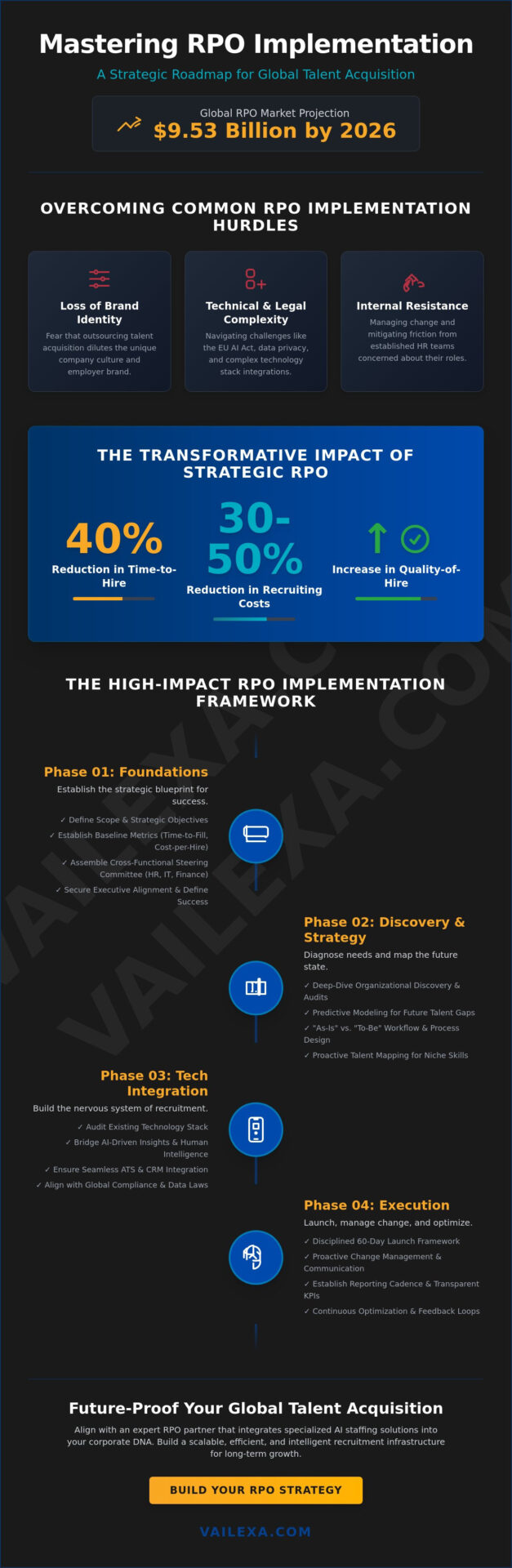
By 2026, the global RPO market is projected to reach $9.53 billion, yet many enterprises remain paralyzed by the fear that outsourcing talent acquisition means losing their unique brand identity. You know that scaling a global workforce requires more than just filling seats; it demands a sophisticated integration of intelligence and culture. This anxiety is often compounded by the technical complexities of the EU AI Act and the potential for internal resistance from established HR teams. However, a meticulously designed RPO implementation plan can transform these risks into a competitive advantage, turning a fragmented hiring process into a streamlined engine of growth.
We understand that your goal is a seamless transition that delivers immediate results without compromising your standards. In this article, you’ll master a high-level framework built for the demands of the modern corporate landscape. We’ll outline the essential phases of a successful rollout, from navigating pay equity enforcement to achieving a 40% reduction in time-to-hire. By the end of this roadmap, you’ll have the strategic insights needed to build a scalable recruitment infrastructure that ensures global talent excellence and long-term organizational stability.
Key Takeaways
- Master the foundational elements of a strategic RPO implementation plan to ensure your organization achieves immediate scalability and long-term cost-efficiency.
- Discover how predictive modeling and deep-dive audits transform standard process reviews into a sophisticated talent strategy mapping exercise.
- Position advanced technology as the nervous system of your recruitment process, bridging the gap between AI-driven insights and human intelligence.
- Implement a disciplined 60-day launch framework that proactively manages internal change and mitigates resistance from existing HR departments.
- Future-proof your global talent acquisition by aligning with an expert partner that integrates specialized AI staffing solutions into your corporate DNA.
The Foundations of a High-Impact RPO Implementation Plan
A high-impact RPO implementation plan serves as the definitive blueprint for organizational transformation. It transcends the traditional boundaries of service delivery, acting instead as a collaborative roadmap that aligns talent acquisition with long-term business goals. In the competitive environment of 2026, where the global RPO market value is surging toward $11 billion, enterprise leaders can’t settle for fragmented processes. Successful implementation requires a shift from reactive hiring to a proactive, data-centric methodology. By integrating Recruitment process outsourcing (RPO) into the corporate DNA, organizations secure a foundation of agility and precision.
Defining the Scope and Strategic Objectives
Clarity is the precursor to excellence. Before the first candidate is sourced, you must identify the specific business units or geographic regions that will spearhead the initial phase. Establishing baseline metrics is critical. You need a clear view of current time-to-fill and cost-per-hire to measure the RPO’s impact accurately. Executive alignment hinges on a shared understanding of the “why” behind the transition. Whether the driver is entering new markets or overcoming high turnover rates, every stakeholder must agree on the definition of success to ensure long-term stability.
The Steering Committee: Assembling Your Implementation Architects
Transformation doesn’t happen in a vacuum. A successful RPO implementation plan relies on a cross-functional steering committee composed of leaders from HR, IT, Finance, and Legal. This group acts as the strategic architect of the partnership. Their primary task is to define the boundaries between the provider’s responsibilities and internal team duties. You must establish a disciplined communication cadence. Regular check-ins and transparent reporting structures prevent information silos. This ensures that technology integration and compliance requirements are addressed with meticulous precision before the launch date.
Phases of Discovery and Talent Strategy Mapping
Discovery isn’t a formality. It’s the diagnostic phase that determines the health and longevity of your RPO implementation plan. While many providers treat this as a simple administrative checklist, true excellence requires a deep-dive organizational discovery. We analyze existing talent gaps through predictive modeling to anticipate future hiring needs before they become critical operational shortages. This stage involves a rigorous evaluation of your current employer brand perception across global markets. If your brand doesn’t resonate in a specific region, even the most efficient process will struggle to attract elite candidates. You must also Prepare for RPO Implementation by auditing your existing technology stack. Identifying integration friction points early prevents the technical failures that often derail large-scale outsourcing initiatives.
Process Auditing and Workflow Design
Mapping the “as-is” recruitment process reveals the specific bottlenecks that currently slow your time-to-hire. We design a “to-be” workflow that incorporates global best practices while maintaining the agility needed for enterprise-level shifts. This new design doesn’t just prioritize speed; it ensures that every step respects local compliance laws and global diversity standards. By removing redundancies and clarifying hand-off points, the workflow becomes a lean, high-performance engine that supports both internal teams and external partners.
Strategic Talent Mapping: Identifying Future Skill Needs
This is where strategic foresight replaces reactive sourcing. We leverage proactive talent mapping to identify high-potential candidate pools for niche roles in AI and data analytics long before a requisition is even opened. Understanding the competitive landscape for these specific skills allows you to position your organization as the employer of choice. This methodical approach ensures that your recruitment efforts are perfectly aligned with your long-term business growth and market expansion goals.
A successful RPO implementation plan relies on this level of granular detail. It’s about moving from “filling a gap” to “architecting a workforce.” By analyzing the competitive landscape and aligning it with your growth trajectory, you move beyond the limitations of traditional recruitment. This disciplined discovery phase ensures that your partnership is built on a foundation of data-driven insights rather than speculative assumptions, providing the clarity needed for a seamless transition.
Technology Integration: Bridging AI and Human Intelligence
Technology serves as the nervous system of a modern RPO implementation plan, providing the vital connectivity required for global talent excellence. It’s not merely about installing software; it’s about architecting a seamless data flow between the RPO provider and your internal ATS or HRIS. This integration ensures that every candidate interaction is captured with precision and every hiring manager has real-time visibility into the pipeline. Managing the complexities of global talent in 2026 requires a tech stack that is both powerful and compliant. The EU AI Act now classifies recruitment-based AI as high-risk, necessitating rigorous documentation and human oversight. A disciplined implementation ensures your tech stack complies with GDPR and CCPA while maintaining the highest standards of data security and organizational integrity.
The AI Staffing Advantage: Enhancing Sourcing Speed
Leveraging specialized AI Staffing Solutions allows recruiters to move with unprecedented speed without sacrificing quality. AI-powered screening tools significantly reduce time-to-hire for high-volume roles by identifying top-tier talent in seconds. These tools don’t replace human intuition; they augment it by filtering out the noise and highlighting candidates who possess both the required skills and the right cultural alignment. Predictive analytics can now identify potential flight risks or assess cultural fit by analyzing historical data patterns across similar industries. Vailexa’s expertise ensures your technology stack is optimized for these advanced capabilities, turning raw data into actionable intelligence that empowers your human recruiters to focus on high-touch candidate engagement.
Data Analytics and Real-Time Reporting Infrastructure
Transparency is the bedrock of a successful partnership. We build custom dashboards that provide a single source of truth for all talent acquisition data, tracking everything from implementation milestones to long-term recruitment health. This infrastructure allows for real-time reporting, ensuring that stakeholders can make data-driven decisions with confidence. By establishing clear KPIs and open data access, you eliminate the speculative hiring practices of the past. This level of visibility maintains trust and ensures that the RPO implementation plan remains on track to meet its strategic objectives. It also provides the Data Analytics Staffing insights needed for continuous process improvement, ensuring your recruitment engine remains agile in an ever-shifting global market.
Execution: The 60-Day Launch and Change Management Framework
The transition from planning to activation is the most volatile period in any RPO implementation plan. It’s where theoretical models meet operational reality. A disciplined 60-day countdown to “Go-Live” ensures that every technical and cultural prerequisite is met before the first requisition is opened. During this window, focus shifts from architecture to high-stakes activation. The first 30 days post-launch, often referred to as the “Hyper-Care” phase, are critical for resolving immediate friction and stabilizing the new environment. Success during this period isn’t just about filling roles. It’s about building organizational confidence through the meticulous resolution of early-stage challenges and the celebration of small, strategic victories.
A structured countdown typically follows these critical milestones:
- Day 60 to 45: Finalize governance structures and establish clear reporting hierarchies.
- Day 45 to 30: Complete internal team training and conduct stakeholder orientations.
- Day 30 to 15: Execute “dry run” scenarios for the integrated technology stack to ensure data integrity.
- Day 15 to 0: Finalize all internal communication assets and deploy the help-desk support team.
The Change Management Strategy: Winning Buy-In
Human resistance is often the primary hurdle to a successful RPO implementation plan. Internal HR teams and hiring managers may fear a loss of control or a dilution of the corporate brand. We mitigate these anxieties through a robust internal communication strategy that highlights the specific benefits of the partnership, such as the reduction of administrative burdens. Clear governance frameworks define exactly who owns each decision, ensuring that internal stakeholders feel empowered rather than displaced. Training sessions go beyond software tutorials; they’re designed to help your team transition into higher-value strategic roles.
Phase-One Launch: From Pilot to Enterprise-Wide Rollout
Scaling too quickly can amplify minor process flaws into major disruptions. We recommend starting with a pilot program in a specific department or geographic region to test the “to-be” workflow. This allows the steering committee to gather granular feedback and refine the process in a controlled environment. Once the pilot proves successful, we execute the full rollout with a dedicated support team on standby. When hiring managers see a 25% improvement in candidate quality within the first few weeks, resistance evaporates. This momentum turns the new model into the standard for recruitment excellence. As a premier Workforce Solutions Provider, we ensure your execution phase is defined by precision and psychological safety for your existing teams.
Vailexa’s Scalable RPO: Future-Proofing Your Talent Acquisition
Vailexa represents the evolution of the traditional recruitment partnership. We don’t just execute a service; we act as a strategic guide that embeds excellence into your corporate DNA. A successful RPO implementation plan is never a static document. It’s a living strategy that evolves alongside your organization. Our model is designed for enterprise agility, allowing you to pivot during market shifts without losing momentum. By blending specialized AI Staffing Solutions with a vast network of global talent, we provide the precision required to thrive in 2026. This isn’t just about filling vacancies. It’s about architecting a sustainable workforce that drives long-term value and operational stability.
Our approach ensures that your recruitment engine is resilient enough to withstand economic fluctuations while remaining sharp enough to seize emerging opportunities. We focus on long-term stability and data-driven insights, moving away from speculative hiring toward a future-proofed talent ecosystem. This commitment to quality is what distinguishes a visionary partner from a mere service provider.
Global Agility with Local Expertise
Scaling across borders requires more than just a broad reach. It demands a deep understanding of diverse regulatory landscapes and local market nuances. We navigate these complexities with ease, ensuring your hiring practices remain compliant with evolving standards like the EU AI Act or regional pay equity laws. Our “follow-the-sun” recruitment model ensures 24/7 talent engagement, allowing your organization to source elite candidates regardless of time zone. This global infrastructure is bolstered by our dedicated Diversity & Inclusion (D&I) Consulting. Since 78% of RPO clients identify employer branding as a critical deliverable, we focus on building inclusive teams that reflect your brand’s values and attract high-performing talent from every corner of the globe.
Next Steps: Initiating Your RPO Transformation
Transformation begins with a clear understanding of your current state. We invite you to a strategic consultation to conduct a comprehensive implementation audit. This assessment identifies the specific gaps in your current process and outlines a custom roadmap for your transition. To help you prepare, we offer a downloadable RPO implementation checklist that covers every critical milestone from discovery to go-live. Don’t let the fear of change or the complexity of technology integration hold your organization back. A well-executed RPO implementation plan is the most powerful tool in your strategic arsenal. It’s the bridge between where your talent acquisition is today and where it needs to be to achieve global excellence. Reach out to our team today to begin building your scalable recruitment infrastructure.
Architecting Your Future Global Workforce
Achieving recruitment excellence requires more than just replacing old processes with new vendors. It demands a disciplined RPO implementation plan that harmonizes global reach with specialized AI staffing insights. By prioritizing deep-dive discovery, seamless technology integration, and a structured change management framework, your organization moves beyond reactive hiring toward strategic workforce planning. You’ve seen how a methodical 60-day launch strategy mitigates internal resistance and builds the momentum needed for enterprise-level scale.
Vailexa provides the dedicated implementation specialists and proven track record necessary to navigate these complexities with precision. We empower your team to focus on high-value growth while we manage the intricate details of your talent ecosystem. It’s time to transform your recruitment into a lean, data-driven engine that thrives on a global stage. Partner with Vailexa for a Seamless RPO Transformation and secure the high-performing, inclusive teams your business deserves. Your roadmap to talent excellence starts here.
Frequently Asked Questions
How long does a typical RPO implementation plan take to execute?
A standard RPO implementation plan typically requires 60 to 90 days from initial discovery to full activation. This timeline allows for deep-dive audits, technology configuration, and comprehensive stakeholder training. While smaller projects might launch sooner, enterprise-level transformations demand a disciplined countdown to ensure data integrity and cultural alignment across multiple geographies. It’s a methodical process that prioritizes organizational stability over haste.
What are the most common pitfalls during RPO implementation?
The most frequent failures stem from inadequate change management and fragmented technology integration. Organizations often overlook the human element, leading to internal resistance from existing HR teams who fear a loss of control. Failing to establish a single source of truth for talent data also creates friction that can delay the realization of strategic goals. Precision in the planning phase is the only way to avoid these operational bottlenecks.
How do we ensure our employer brand remains intact after outsourcing?
Your brand identity remains central because the RPO provider operates as a seamless extension of your internal team. Recruiters represent your organization using your corporate email, logos, and cultural values during every candidate interaction. This white-label approach ensures that employer branding remains a primary deliverable. You maintain a consistent market presence while leveraging external expertise to enhance candidate perception and engagement across global talent pools.
What is the difference between a project-based and enterprise RPO implementation?
Project-based RPO addresses specific, short-term needs such as seasonal hiring spikes or new product launches. In contrast, an enterprise implementation involves a long-term, end-to-end transformation of the entire recruitment function. While project models offer rapid scalability for immediate gaps, enterprise solutions provide a comprehensive global talent infrastructure designed for permanent organizational stability and long-term efficiency. The choice depends on your specific scale and hiring volume.
Who should be part of the internal RPO steering committee?
A high-impact steering committee must include senior representatives from HR, IT, Finance, and Legal departments. These architects ensure that the partnership aligns with broader corporate strategy and satisfies rigorous compliance standards. Including diverse perspectives prevents information silos. It ensures that technology integration and budgetary objectives are addressed with meticulous precision from the start of the RPO implementation plan.
How is success measured in the first six months of an RPO partnership?
Success in the initial six months is measured by stabilization metrics and early performance gains. Key indicators include a reduction in time-to-hire and an improvement in candidate quality as reported by hiring managers. You should also track the successful adoption of new workflows and the seamless flow of data between the provider and your internal systems. These benchmarks confirm the partnership’s health and its long-term viability.
Can an RPO implementation plan be adjusted after the launch phase?
An effective RPO implementation plan is a living framework that requires regular refinement post-launch. As market conditions shift or business priorities pivot, the steering committee uses real-time data analytics to optimize workflows and sourcing strategies. This iterative approach ensures that the recruitment engine remains agile. It allows the organization to continue delivering high-performing talent even in a volatile global landscape.
What role does IT play in a modern RPO implementation?
IT serves as the technical architect, ensuring that the RPO technology stack integrates perfectly with existing internal systems. They manage the critical aspects of data security and global privacy compliance, particularly regarding GDPR and newer AI regulations. Their involvement is essential for establishing the connectivity that allows for transparent reporting and secure, real-time talent intelligence throughout the organization. Without IT’s expertise, the recruitment nervous system cannot function.