
Your staffing agency should be a launchpad for your career, not a bottleneck that restricts your access to the high-tier AI and data projects defining the 2026 market. If you find yourself grappling with delayed payments or a persistent lack of recruiter transparency, the decision to move isn’t just a preference; it’s a strategic necessity for your professional growth. Learning how to switch staffing agencies without breaching contracts or burning bridges is the hallmark of a savvy professional who values their reputation as much as their results.
We recognize that the fear of contract complications often keeps talented individuals stagnant in suboptimal partnerships. You deserve a global workforce partner that offers more than just a paycheck, providing instead the premium benefits and elite placements your expertise demands. This guide serves as your roadmap to a seamless transition, outlining a disciplined approach to securing higher pay and better alignment. You will learn how to audit your current obligations, vet high-caliber agencies, and execute a move that positions you at the forefront of industry innovation.
Key Takeaways
- Identify the critical thresholds for a transition by analyzing pay transparency and bill rate alignment in the 2026 workforce landscape.
- Deconstruct complex contractual obligations, including Right to Represent (RTR) agreements and buy-out clauses, to ensure a legally sound departure.
- Master a disciplined, step-by-step protocol for how to switch staffing agencies that prioritizes securing your next placement before initiating a formal resignation.
- Protect your professional integrity by reframing the pivot as a strategic business decision, avoiding the long-term risks associated with bridge-burning in a global talent market.
- Align your career trajectory with a global workforce solutions leader to gain exclusive access to high-tier AI and data analytics initiatives.
Evaluating the Strategic Need for an Agency Pivot
Transitioning from a standard employment agency to a high-level strategic partner is often the difference between professional stagnation and exponential career growth. You must distinguish between a fixable administrative glitch and a systemic failure of advocacy. A necessary switch is triggered when your current partner fails to provide transparency regarding bill rates or consistently excludes you from the high-tier AI and data initiatives that define the 2026 economy. If your recruiter can’t explain how your current role fits into a broader roadmap, you’re likely being treated as a commodity rather than a strategic asset. Learning how to switch staffing agencies starts with this critical audit of your current partnership’s value proposition.
Stagnation often manifests through high recruiter turnover or a visible lack of Diversity and Inclusion (D&I) support. When your primary point of contact changes every quarter, your career history and specialized skills are lost in the shuffle. This lack of continuity prevents deep talent mapping and limits your exposure to premium roles. In a market where AI adoption in hiring has reached 84%, an agency that relies on outdated, manual processes isn’t just behind the curve; they’re actively hindering your ability to compete for cutting-edge projects.
Identifying Performance Gaps in Your Current Partner
Communication latency is a primary indicator of a failing agency relationship. If payroll inquiries go unanswered for days or feedback after interviews is non-existent, the operational foundation is crumbling. Beyond basic responsiveness, evaluate their capacity for strategic workforce planning. A partner that doesn’t understand the long-term trajectory of your industry cannot position you for future success. Modern professionals require specialized AI staffing support to ensure their skills remain relevant as automated systems reshape job descriptions across the global workforce.
Benchmarking Your Market Value
Use talent mapping data to determine if you’re being underpaid relative to your peers. With the 2026 enforcement of the California Pay Equity Act (SB 642) and the EU Pay Transparency Directive, the era of hidden markups is ending. You have a right to know if your compensation reflects your true value. Market-aligned compensation is the intersection of skill scarcity and regional demand. If your current benefits package doesn’t meet global standards for contingent labor, such as the Delaware Paid Leave Program benefits, it’s time to consider how to switch staffing agencies to find a partner that prioritizes your financial and professional well-being.
Navigating Contractual Obligations and Non-Compete Clauses
Understanding the legal architecture of your engagement is non-negotiable before you initiate a move. Many professionals hesitate because they view contracts as impenetrable barriers. In reality, these documents are frameworks that define your mobility within the market. When you’re determining how to switch staffing agencies, your first task is a granular review of your existing agreement to identify “Buy-out” clauses. These provisions allow a client to transition your contract to a different provider, typically by paying a fee. While these fees are managed between the business entities, knowing they exist empowers you to discuss a provider change with your end-client without fearing a total contract breach.
The distinction between non-solicitation and non-compete agreements is equally vital. Non-solicitation generally prevents you from poaching other contractors or clients, whereas non-competes attempt to restrict where you can work next. In 2026, the legal landscape for these restrictions is shifting rapidly. While a proposed FTC rule banning non-competes was struck down by federal courts in late 2025, state-level protections have expanded. For instance, Illinois legislation now bans non-compete agreements for employees earning less than $300,000 annually. Washington State has also enacted a ban for most contractors, effective June 30, 2027, signaling a clear trend toward workforce mobility.
The “Right to Represent” (RTR) Framework
The Right to Represent (RTR) is a specific authorization granting an agency the exclusive right to submit your profile for a particular role. These agreements usually carry a duration of six months. If an agency fails to secure an interview or provide updates within a reasonable timeframe, you can rescind this right through a formal, written notice. This prevents you from being locked out of a role if a more capable workforce solutions provider has a stronger relationship with the same client. Managing these exclusivity periods professionally ensures you don’t limit your career trajectory due to agency underperformance.
Assessing Non-Compete Enforceability
Enforceability often hinges on whether the restriction is geographical or client-specific. In the tech sector, broad geographical bans are increasingly difficult for agencies to defend. If you find a superior opportunity, you might request a “Letter of Release” from your current agency manager. This document formally waives the agency’s right to enforce specific restrictive covenants. Always verify current regional labor laws before making a move, as many jurisdictions are prioritizing talent fluidity over restrictive legacy contracts. Mastering how to switch staffing agencies requires this level of due diligence to protect your professional standing.
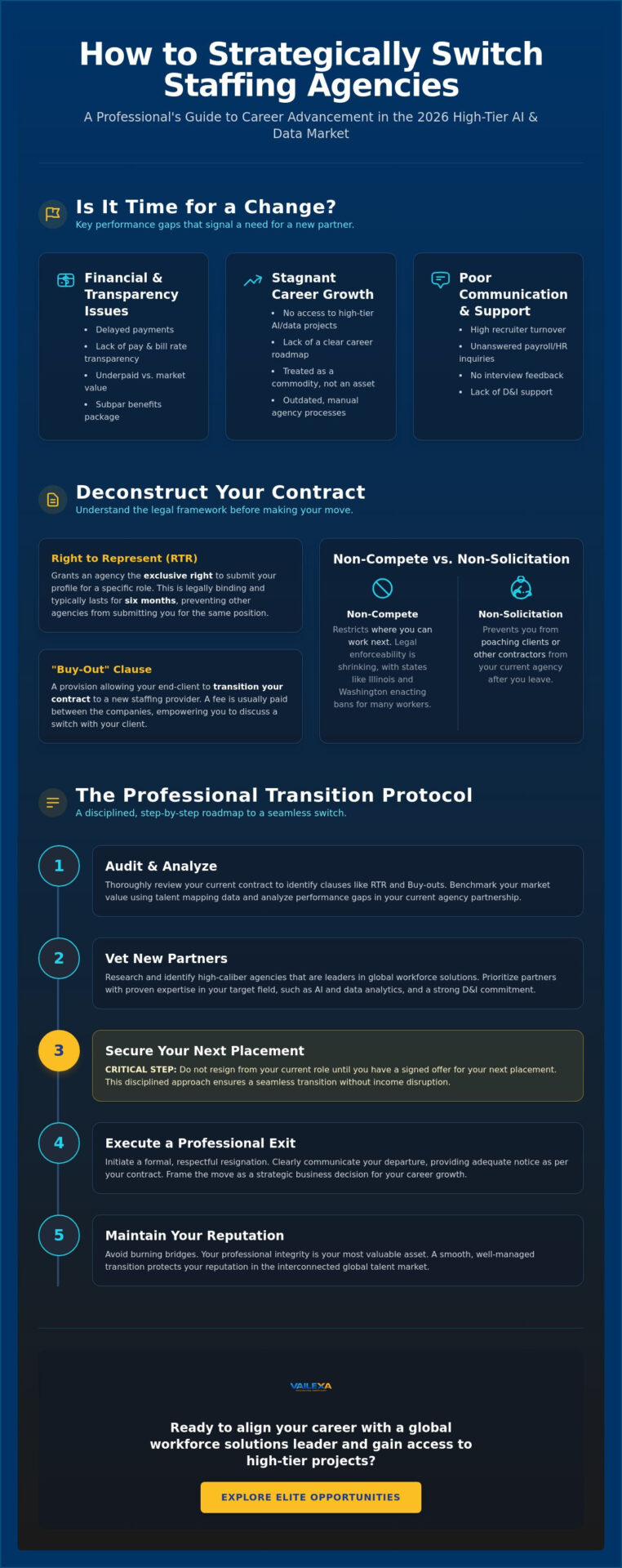
The Professional Roadmap: A Step-by-Step Transition Protocol
Executing a transition requires more than just a change of heart; it demands a disciplined sequence of actions that protect your income and your professional brand. When you’re determining how to switch staffing agencies, the most critical rule is to secure your next placement before initiating any formal exit. This isn’t just about financial security. It’s about maintaining leverage. In a market where the average cost per hire has reached $4,683, agencies are highly motivated to retain talent, and having a confirmed role elsewhere ensures you aren’t pressured into a counteroffer that doesn’t solve your underlying grievances.
Review your current contract for specific notice period requirements. While standard employment often suggests two weeks, contingent contracts in specialized sectors sometimes mandate thirty days or are tied to project milestones. Once you’ve established your timeline, draft a resignation email that avoids emotional language. Focus entirely on strategic alignment. Frame the move as a necessary step toward specific project types or global opportunities your current agency doesn’t support. This approach reframes your departure from a “quit” to a “pivot,” which is essential for long-term reputation management.
Securing the New Partnership
Success in the 2026 landscape hinges on partnering with a firm that possesses deep AI staffing solutions expertise. You need to know if they can navigate the 84% AI adoption rate in modern hiring processes. Ask your potential recruiter about their direct relationship with the end-client’s hiring managers. A secondary-tier agency often lacks the influence to advocate for your pay rate or project scope. Ensure they have the infrastructure to manage global payroll and compliance, especially with the increased complexity of regional laws like the Delaware Paid Leave Program or the EU Pay Transparency Directive.
Executing the Handover
The final phase of how to switch staffing agencies involves meticulous logistical management. Close out your final timesheet and expense report cycle immediately to avoid payment delays. While you must communicate with your end-client manager, do so within the bounds of your contract to avoid violating non-solicitation protocols. Tripartite transparency between the professional, the agencies, and the end-client is the only way to ensure project continuity and financial accuracy during a provider transition. This structured handover minimizes friction and reinforces your status as a high-level strategic professional.
Maintaining Professional Integrity and Reputation
The global staffing ecosystem is remarkably interconnected. Recruiters frequently transition between agencies, and hiring managers at major firms often share talent insights within their professional circles. Burning a bridge today can inadvertently disqualify you from a high-tier role years down the line. When you’re assessing how to switch staffing agencies, your primary objective should be a graceful exit that preserves your professional currency. Reputation isn’t just a social asset; it’s a critical component of your future executive search process success.
Reframing your departure as a strategic business decision rather than a personal grievance is essential. If your current agency offers a counter-offer, evaluate it with extreme discipline. While an immediate pay increase is tempting, it rarely resolves the underlying issues of recruiter opacity or limited project scope. If the agency couldn’t provide the right environment for your growth previously, a sudden financial incentive is unlikely to change their long-term operational model. Professional growth requires a partner that values transparency over temporary retention tactics.
The Art of the Professional Exit
Successful transitions rely on precise communication. Use scripts that emphasize your trajectory. Tell your recruiter, “I’ve appreciated our partnership, but my current career path requires alignment with specialized data analytics initiatives that your firm isn’t currently positioned to support.” This provides constructive feedback without assigning blame. Maintain your performance levels during your final weeks. The quality of your handover is the last impression you leave, and it often dictates the strength of your future references.
Leveraging Social Proof
Your digital footprint must reflect your new direction without creating unnecessary friction. Update your LinkedIn profile strategically. Focus on the skills you’ve acquired rather than the change in agency status to avoid alerting your current partner prematurely. Secure a recommendation from your current recruiter before the relationship shifts. A positive testimonial regarding your reliability and expertise is invaluable when you transition to a premium global talent partner. Managing these perceptions across global talent platforms ensures your professional brand remains untarnished and aspirational.
Aligning with a Global Workforce Solutions Leader
Choosing the right partner is the final, most impactful step in your journey to career elevation. While many agencies operate on a purely transactional basis, a global leader provides a sophisticated ecosystem that integrates contingent staffing with comprehensive Recruitment Process Outsourcing (RPO). This hybrid model ensures that you aren’t just filling a temporary gap; you’re becoming a vital part of a client’s long-term strategic vision. For professionals mastering how to switch staffing agencies, this alignment offers unparalleled access to exclusive, high-tier projects in AI and Data Analytics that generalist firms simply cannot access.
Vailexa prioritizes talent density and precision through advanced strategic workforce mapping. We understand that in 2026, the value of a professional is defined by their ability to navigate complex, data-driven environments. Our global reach is specifically designed to empower remote and offshore professionals, providing them with the infrastructure and compliance support needed to thrive in a borderless talent market. We don’t just place candidates; we architect career trajectories by matching specialized skills with high-growth organizational needs.
Why Vailexa is the Strategic Choice for 2026
Our methodology goes beyond traditional recruitment. We integrate Diversity & Inclusion (D&I) consulting into our core operations, ensuring that our talent is placed in inclusive, high-performing environments where excellence is the only standard. This commitment to cultural and operational alignment is why we maintain a leading position in specialized tech sectors. Unlike generalist providers, our expertise is firmly rooted in the technical nuances of modern industry, allowing us to advocate for your value with authority and data-backed insights. We focus on long-term talent strategy, ensuring your next move is a building block for sustained success.
Next Steps: Initiating Your Strategic Pivot
Transitioning to our exclusive contingent talent pool is a streamlined, professional process. When you’ve finalized your exit strategy and are ready for how to switch staffing agencies to a more sophisticated partner, our onboarding team provides a high-touch experience. During your first 30 days, you’ll receive a comprehensive orientation into our global ecosystem, including access to our proprietary talent mapping tools and project pipelines. This structured entry ensures that you hit the ground running, fully supported by a team that understands the weight of your expertise.
Elevate your career with Vailexa’s global workforce solutions today.
Seizing Your Strategic Advantage
Your career trajectory in 2026 depends on the caliber of the partners you choose. Mastering how to switch staffing agencies is ultimately an exercise in strategic self-advocacy, requiring a disciplined approach to contractual review and a commitment to maintaining professional integrity. By prioritizing transparency and securing alignment with the high-tier AI and data projects that drive modern industry, you transform a simple provider change into a significant professional pivot. You’ve learned how to navigate non-compete complexities and execute a handover that protects your reputation, ensuring your move is defined by growth rather than friction.
The transition to a more sophisticated workforce partner shouldn’t be a solitary endeavor. You deserve a collaborator with the infrastructure to support your global ambitions and the specialized expertise to recognize your unique value. With a global reach spanning 50+ countries and specialized talent pools in AI and Data Analytics, we provide the comprehensive RPO and executive search expertise required for elite placements. Partner with Vailexa for your next strategic career move and position yourself at the forefront of global innovation. Your next breakthrough is within reach.
Strategic Insights: Frequently Asked Questions
Can I switch staffing agencies while staying in the same job role?
Yes, you can transition between providers while remaining in your current role if the end-client supports the move. This process usually involves a “buy-out” clause where the new agency pays a fee to the original provider, or the client mandates a vendor change. It’s a strategic maneuver often used when a professional seeks better benefits or a more transparent relationship with a global workforce partner while maintaining project continuity.
Will switching agencies affect my eligibility for future permanent hire?
Switching agencies typically won’t impact your eligibility for a permanent role if handled with professional maturity. Most “temp-to-hire” agreements are structured between the agency and the client, rather than the individual worker. As long as you maintain your performance levels and fulfill your contractual notice period, the end-client will prioritize your technical contributions and cultural fit over which payroll entity you currently utilize.
What should I do if my current agency threatens legal action over a non-compete?
You should immediately review your contract against regional labor laws, as many jurisdictions have recently limited non-compete enforceability. For instance, Washington State and Illinois have enacted significant bans for various income levels as of 2026. If threatened, request a formal “Letter of Release” from your manager. Understanding the specific mobility rights of contingent workers in your sector is essential when learning how to switch staffing agencies safely.
How much notice is standard for a contingent worker switching agencies?
A notice period of two weeks is standard, though your specific contingent contract might mandate thirty days or completion of a project milestone. Adhering to these terms is vital for protecting your reputation in a high-stakes market. When planning how to switch staffing agencies, always verify if your agreement includes “milestone-based” exit clauses that could delay your transition until a specific deliverable is finalized and approved.
Does a new agency have to honour my existing pay rate?
A new agency isn’t legally required to honor your previous pay rate, but premium partners will typically match or exceed it to secure high-tier talent. This represents a critical negotiation point during your transition protocol. Use talent mapping data to ensure your new compensation reflects the 2026 market value for your specific expertise, especially if you’re transitioning into specialized AI or data analytics roles.
What is a “Right to Represent” agreement and how long does it last?
A “Right to Represent” (RTR) is a formal authorization giving an agency exclusivity to submit your profile for a specific role, typically lasting six months. It doesn’t prevent you from working with other agencies for different opportunities. If an agency fails to secure an interview or provide feedback within a reasonable window, you can rescind the RTR in writing to regain your professional mobility and seek better alignment.
Can I work for two different staffing agencies at the same time?
Yes, you can engage with multiple agencies simultaneously, provided there are no direct conflicts of interest or “exclusivity of service” clauses in your active contracts. This is a common practice for professionals managing multiple project-based assignments. Maintaining transparency with your partners ensures that your schedule remains manageable and your professional integrity stays intact, allowing you to leverage different agencies for their specific niche strengths.
How do I tell my end-client manager that I am switching agencies?
Focus your conversation on project continuity and strategic alignment rather than administrative grievances. Inform your manager that you’re transitioning to a partner that better supports your long-term career trajectory, such as one with specialized AI staffing solutions. Emphasize that your primary goal is a seamless handover. This ensures the client’s objectives are met without interruption, reinforcing your status as a disciplined and reliable executive-level professional.