
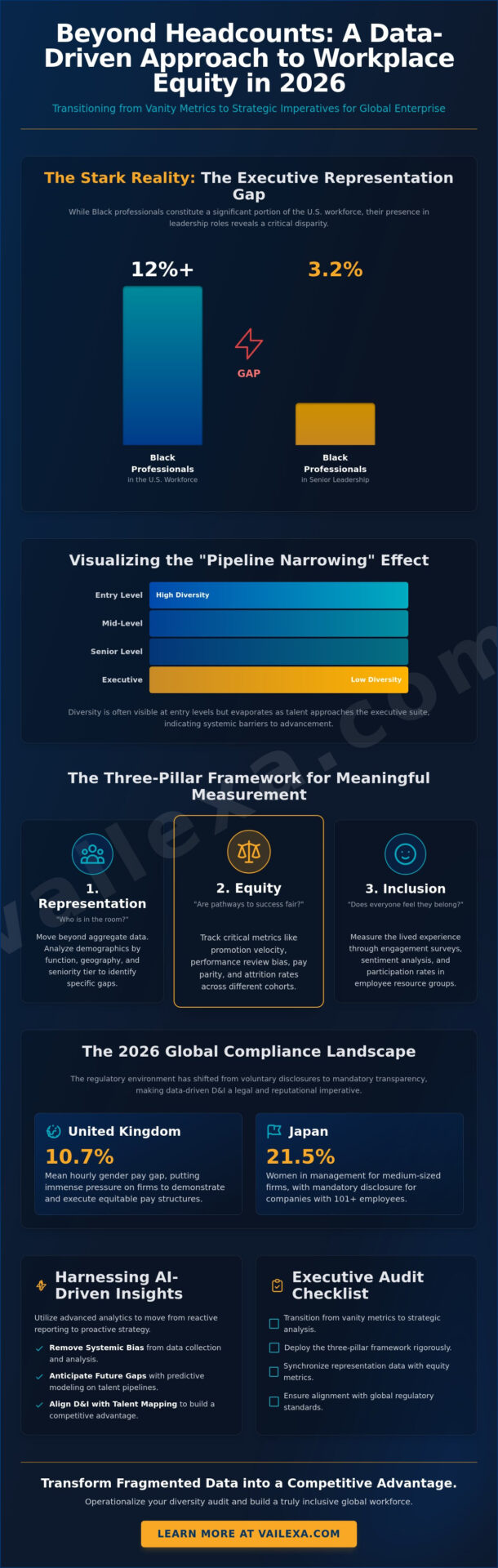
While the U.S. workforce includes over 12% Black professionals, they hold only 3.2% of executive and senior leadership positions in 2026. This stark gap persists despite years of intense corporate investment, proving that traditional methods of measuring diversity in the workplace often fail to capture the structural barriers preventing true equity. You likely feel the pressure of fragmented data across global regions and the constant challenge of proving to skeptical leadership that inclusion is more than a soft metric. It’s a common struggle to see spreadsheets signal progress while the actual organizational culture remains stagnant.
We’ve moved beyond the era of vanity metrics; today’s global enterprise requires a sophisticated, data-driven framework that aligns representation with lived experience and business outcomes. You’ll gain a comprehensive 2026 executive audit checklist designed to help you master this transition and build a roadmap for attracting top-tier talent. We’ll explore how to navigate the latest regulatory shifts, such as Executive Order 14398, and how to utilize advanced analytics to ensure your D&I strategy is both legally compliant and organizationally transformative.
Key Takeaways
- Transition from vanity metrics to a strategic imperative by analyzing the pipeline narrowing effect that restricts diverse talent from reaching executive tiers.
- Deploy a rigorous three-pillar framework that synchronizes demographic representation with equity metrics, including promotion velocity and performance review bias.
- Harness AI-driven insights to remove systemic bias from data collection. This allows your organization to accurately anticipate and address future representation gaps.
- Utilize our comprehensive executive checklist to establish a baseline for measuring diversity in the workplace while ensuring alignment with 2026 global regulatory standards.
- Transform fragmented data into a competitive advantage by aligning your inclusion metrics with strategic talent mapping and global workforce solutions.
Beyond Headcounts: Why Measuring Diversity in the Workplace is a Strategic Imperative
Measuring diversity in the workplace has evolved from a peripheral HR exercise into a core operational requirement for the modern global enterprise. True measurement involves the systematic tracking of representation, equity, and belonging across every organizational layer. Leaders who rely on superficial headcounts often overlook the “pipeline narrowing” effect. This occurs when diversity is visible at entry levels but evaporates as talent approaches the executive suite. A foundational understanding diversity, equity, and inclusion reveals that these three pillars must be measured in unison to provide a clear picture of organizational health.
In 2026, the shift toward data-driven accountability has transformed diversity and inclusion consulting into a strategic blueprint for survival. Organizations can’t improve what they don’t accurately quantify. High-resolution data allows firms to identify exactly where talent leaks occur and why specific cohorts fail to progress. This precision is the prerequisite for implementing effective inclusive hiring practices that actually deliver on the promise of a representative workforce. Stagnant data leads to stagnant growth.
The ROI of High-Resolution Diversity Data
Precise metrics correlate directly with higher innovation rates and the ability to capture new market segments. When organizations use granular data to improve inclusion, they significantly reduce the hidden costs associated with high attrition among underrepresented groups. Companies that track these nuances are better equipped to pivot in changing markets. Diversity ROI is the measurable correlation between a deeply inclusive culture and the resulting density of high-performing talent.
The 2026 Global Compliance Landscape
The regulatory environment for multinational enterprises has shifted from voluntary disclosures to mandatory transparency. Markets in the UK, Japan, and the U.S. now demand rigorous reporting on workforce demographics. For instance, Japan’s Act on Promotion of Women’s Participation now requires companies with 101 or more employees to disclose the proportion of women in management, which stood at 21.5% for medium-sized companies in early 2026. Simultaneously, the mean hourly gender pay gap in the UK reached 10.7%, forcing firms to address systemic inequities or face reputational damage. Leaders who embrace this transparency build a powerful employer brand that attracts elite talent; they view compliance as a mechanism for establishing themselves as an industry standard for excellence.
The Three-Pillar Framework: Representation, Equity, and Inclusion
Effective strategies for measuring diversity in the workplace require a shift from broad percentages to a granular, three-pillar framework. You can’t rely on a single data point to understand organizational health. This framework integrates Representation, Equity, and Inclusion into a cohesive narrative that guides executive decision-making. By Defining Workplace Diversity through these specific lenses, leaders can pinpoint exactly where their strategy succeeds or stalls. It’s about moving from a simple headcount to a sophisticated audit of your firm’s cultural and structural integrity.
The “Cross-Check” method is essential for verifying the validity of your data. If your representation numbers are climbing but your attrition rates among those same groups remain high, your culture is failing to retain the talent you’ve worked hard to attract. High representation paired with high turnover isn’t progress; it’s a revolving door that drains resources and damages your employer brand. True success is found where high representation meets low attrition and high engagement scores.
Representation: Slicing Data by Function and Tier
Aggregate data is the enemy of insight. When you group all underrepresented talent into a single bucket, you mask the specific challenges faced by different demographics. You must slice data by function, geography, and organizational tier to see the “leaky pipeline” in real time. For instance, while women hold 43% of board positions in FTSE 350 companies as of 2026, they hold only 15% of executive director roles. This disparity is only visible through disaggregated tracking. Utilizing professional Talent Mapping helps you visualize these gaps across your global footprint, ensuring your leadership pipeline is as diverse as your entry-level cohorts.
Equity and Inclusion: The Lived Experience
Equity focuses on outcomes rather than just intentions. You must measure promotion velocity and performance review bias to ensure the playing field is truly level for every employee. Inclusion, meanwhile, quantifies the lived experience through sentiment analysis and belonging indices. Modern markers now allow leaders to track these “soft” metrics with high precision. Partnering with specialized DEI consulting firms ensures you’re using the most current industry standards to gauge employee sentiment. If you’re ready to move beyond basic reporting, our Diversity & Inclusion (D&I) Consulting services can help you align these pillars with your broader strategic workforce planning.
Leveraging AI and Data Analytics for High-Precision Audits
Manual data entry is a relic of the past. In 2026, the complexity of global operations demands a transition to automated, high-precision systems that remove human subjectivity from the equation. High-precision tools have redefined the standard for measuring diversity in the workplace by identifying patterns of bias that often remain invisible to the naked eye. These systems don’t just report on the current state; they utilize predictive analytics to forecast future representation gaps based on current promotion velocities and hiring trends. This proactive stance allows executives to intervene before a lack of diversity becomes a systemic failure.
Achieving this level of technical sophistication requires more than just software. It necessitates specialized AI staffing solutions to ensure that the data experts managing these audits understand both the technology and the ethical implications of its use. As of August 2, 2026, the EU AI Act requires high-risk AI systems used in employment to undergo documented bias testing for conformity assessments. Organizations must now balance high-resolution demographic insights with strict adherence to data privacy and anti-discrimination laws. This intersection of technology and ethics is where true leadership is forged.
Automating the Diversity Audit
Implementing real-time pay equity monitoring and regression analysis allows for immediate course correction. Instead of waiting for an annual report, leaders can track Key Diversity Metrics like retention rates and promotion parity on a continuous dashboard. Sentiment analysis AI has also evolved to interpret the nuances of internal communications and feedback, providing a more accurate “inclusion capacity” score than traditional surveys. This automation ensures that your audit remains a dynamic workforce planning tool rather than a static compliance document. It’s about precision, not just participation.
The Human Component: Why Data Needs Context
Data provides the “what,” but human experts provide the “why.” AI serves as a powerful tool for auditors, yet it isn’t a replacement for the nuanced work of building an inclusive culture. While algorithms can flag a spike in attrition among specific demographics, qualitative “stay interviews” are essential to validate these findings and uncover the underlying cultural friction. Your data analytics team must understand global D&I standards to interpret regional data correctly. A nuanced approach ensures that your technological investments translate into genuine organizational progress and long-term stability.
The Executive Checklist for Measuring Diversity in the Workplace
Measuring diversity in the workplace requires a disciplined, multi-phase approach to ensure data translates into organizational movement. Moving from fragmented spreadsheets to a unified strategic narrative is the hallmark of a mature enterprise. This checklist provides the structural rigor needed to audit your current standing and architect a more inclusive future. It’s not merely about compliance; it’s about precision in execution. By following a methodical path, you transform raw numbers into a roadmap for sustainable growth.
- Phase 1: Baseline Assessment. Audit your current data collection methodologies and ensure alignment with 2026 legal standards. In the U.S., this includes verifying compliance with Executive Order 14398 to ensure DEI activities remain within anti-discrimination boundaries.
- Phase 2: Metric Selection. Define specific KPIs for representation, equity, and inclusion. These metrics must be measurable, time-bound, and directly linked to your broader business objectives.
- Phase 3: Data Disaggregation. Move beyond surface-level stats. Slice your data by department, seniority, and intersectional identities. For instance, while LGBTQ+ professionals make up 3.1% of entry-level roles, they represent only 1.6% of management; identifying these specific drop-offs is critical.
- Phase 4: Gap Analysis. Compare your internal findings against labor market baselines and competitor benchmarks. Understanding your position relative to the market is vital for maintaining a competitive edge in talent acquisition.
- Phase 5: Strategic Integration. Embed your findings into your strategic workforce planning. This ensures that diversity targets aren’t isolated goals but are integrated into your long-term hiring and retention strategy.
Baseline Audit: Are You Measuring the Right Things?
The integrity of your audit depends on the quality of your input. You must review self-identification participation rates to ensure your data reflects the actual workforce. If participation is low, it often signals a lack of trust in how data is utilized. Evaluate the reliability of historical promotion data to see if past successes were outliers or part of a sustainable trend. Aligning your internal definitions with global standards ensures that your reporting remains consistent across different regions and regulatory environments. High-quality data is the only foundation for high-quality decisions.
From Data to Action: The Strategic Roadmap
Data without a roadmap is just noise. Your organization needs realistic, data-backed diversity targets for the 2026 to 2030 period. These aren’t quotas; they’re benchmarks for excellence that reflect your commitment to talent density. Communicate your audit results to stakeholders with transparency and authority to build internal alignment. Establishing a recurring D&I Scorecard for quarterly executive review keeps inclusion at the forefront of the C-suite agenda. If you’re ready to professionalize your measurement framework, integrate these insights into your strategic workforce planning to drive measurable performance gains.
Operationalizing Your Diversity Audit with Vailexa
Completing a comprehensive audit is a significant milestone, yet the true value of measuring diversity in the workplace lies in what you do with the findings. Data without execution is merely an observation. Vailexa bridges the critical gap between diversity insights and high-performance talent acquisition by transforming your audit results into an actionable workforce strategy. We ensure that the gaps identified in your leadership pipeline or functional tiers are addressed through a disciplined, data-driven approach to global recruitment. Our role is to move your organization from awareness to tangible cultural and structural transformation.
As a premier global workforce solutions provider, Vailexa offers the advantage of intersectional talent mapping that transcends geographical borders. We understand that a D&I strategy in Tokyo requires a different tactical lens than one in London or New York. By integrating your specific D&I metrics into both your permanent recruitment and contingent staffing programs, we create a unified front for inclusive growth. This holistic integration ensures that every hiring decision, whether for a temporary project or a C-suite vacancy, contributes to your long-term representation and equity goals.
Specialized Consulting for Global Inclusion
Success in 2026 requires more than a one-size-fits-all checklist. We deliver customized D&I roadmaps tailored to your specific industry regulations and the unique demographic challenges of your operating regions. Beyond strategy, we provide access to specialized data analytics staffing to help you build a robust internal measurement infrastructure. This allows your team to maintain the high-precision monitoring required for modern compliance and performance tracking. Vailexa acts as a strategic architect for inclusive growth, designing the systems that sustain diversity long after the initial audit is complete.
Securing the Future of Inclusive Talent
Our Recruitment Process Outsourcing (RPO) and executive search services are engineered to prioritize diversity without compromising on the speed or quality your business demands. We leverage an expansive global network to fill the specific diversity gaps identified during your audit, ensuring you have access to elite talent that may be invisible to traditional search methods. This proactive talent mapping reduces the time-to-hire for underrepresented groups and strengthens your employer brand across all markets. It’s about building a resilient, representative workforce that is equipped for the complexities of the future.
The transition from vanity metrics to strategic excellence requires a partner who understands the weight of organizational standards. Schedule a consultation with our team today to transform your diversity data into a powerful competitive asset and begin your journey toward a truly inclusive global enterprise.
Architecting a Future of Strategic Equity
The evolution of measuring diversity in the workplace demands a transition from passive observation to active, data-driven leadership. By adopting the three-pillar framework of representation, equity, and inclusion, your organization can move beyond surface-level metrics to address the systemic barriers that hinder talent density. Utilizing high-precision AI analytics ensures that your audits are both legally compliant and operationally transformative. This rigorous approach provides the clarity needed to align workforce demographics with long-term business objectives and global regulatory standards.
Vailexa serves as a global expert in D&I consulting and a trusted strategic partner for Fortune 500 workforce planning. Our specialized AI and Data Analytics staffing expertise allows us to bridge the gap between complex data sets and high-performance talent acquisition. We invite you to Partner with Vailexa for Strategic D&I Consulting and Inclusive Talent Solutions to professionalize your measurement framework and secure a representative leadership pipeline. Your commitment to precision today will define your organization’s excellence and long-term stability in an increasingly complex global market.
Frequently Asked Questions
What are the most important DEI metrics to track in 2026?
The most critical metrics in 2026 shift from mere representation to outcome-based indicators like pay parity, promotion velocity, and retention rates across intersectional groups. Organizations must also track “inclusion capacity” to understand how well the culture supports different perspectives and working styles. By focusing on these high-resolution data points, you can identify structural bottlenecks that simple headcounts often ignore.
How do you measure inclusion if it’s a subjective feeling?
Inclusion is quantified through sentiment analysis and belonging indices that transform subjective feedback into measurable data. You can measure psychological safety and perceived equity by using targeted survey questions and AI-driven sentiment tools that interpret the nuances of employee feedback. This allows you to track the lived experience of your workforce with the same precision as your financial KPIs.
Is it legal to collect demographic data for diversity measurement?
Collecting demographic data is legal and often mandatory for compliance; however, it must be handled with strict adherence to regional privacy laws and anti-discrimination mandates. In the U.S., recent updates like Executive Order 14398 require organizations to certify that their measurement practices don’t lead to discriminatory outcomes. You should always consult with legal experts to ensure your data collection methods align with current local and international regulations.
What is the difference between diversity reporting and a diversity audit?
Diversity reporting is a descriptive summary of your current workforce demographics, whereas a diversity audit is a strategic evaluation of your entire D&I ecosystem. While reporting tells you what your numbers are, an audit investigates the “why” behind those numbers. Audits identify the root causes of inequity and provide a roadmap for structural improvement, making them essential for measuring diversity in the workplace effectively.
How often should a company conduct a diversity measurement audit?
A comprehensive diversity audit should be conducted annually to align with strategic planning cycles and regulatory reporting requirements. However, high-performing organizations perform quarterly “pulse checks” on key metrics like promotion parity and attrition. This consistent cadence allows leadership to make real-time adjustments before cultural or structural issues become entrenched.
Can AI really help in measuring diversity without introducing new biases?
AI can significantly enhance measurement accuracy by removing human subjectivity from initial data collection and analysis. To prevent the introduction of algorithmic bias, organizations must comply with regulations like the EU AI Act of 2026, which requires documented bias testing for high-risk systems. When managed by experts, AI provides the high-precision insights necessary for a modern diversity audit.
How do we measure the diversity of our contingent workforce?
Measuring the diversity of your contingent workforce requires integrating demographic tracking into your Vendor Management Systems (VMS) or partnering with a global workforce solutions provider. This holistic approach ensures that your D&I strategy covers your entire talent ecosystem, not just permanent employees. It allows for a more accurate assessment of your organization’s total inclusion capacity and brand impact.
What is the “Gartner Inclusion Index” and should we use it?
The Gartner Inclusion Index is a framework that measures seven key dimensions of inclusion, including fair treatment and psychological safety. It’s a valuable tool for benchmarking your organization against industry standards and identifying specific areas for cultural development. While it provides a strong foundation, you should customize these markers to reflect the unique geographic and functional needs of your global enterprise.