
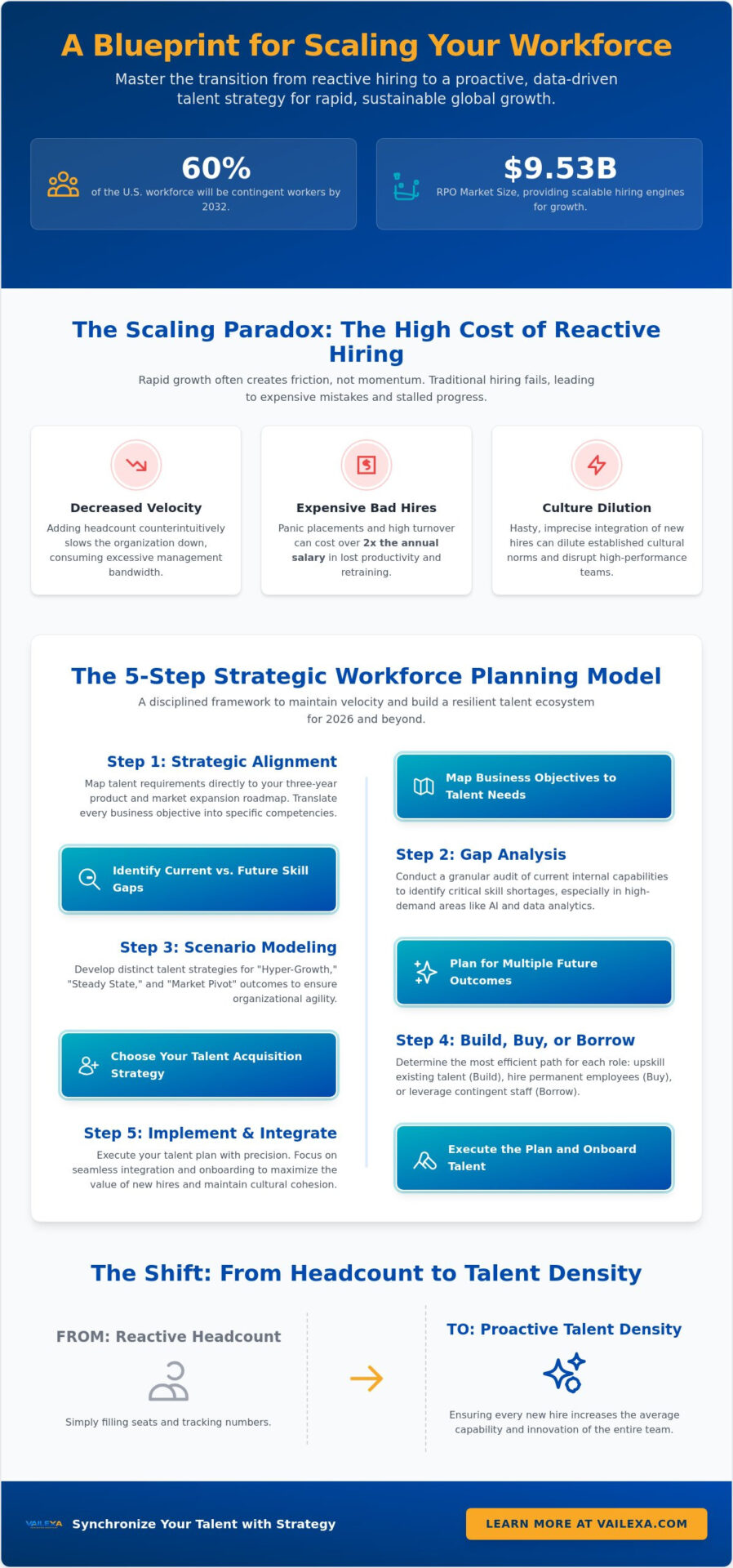
By 2032, contingent workers are projected to comprise 60% of the U.S. workforce, a shift that demands a complete reimagining of traditional growth models. If you’ve felt the frantic pressure of reactive recruitment during a growth spurt, you’re not alone. Most leaders find that workforce planning for scaling companies often breaks down exactly when it’s needed most, leading to expensive bad hires and stalled momentum. It’s frustrating to watch specialized AI or data roles remain vacant while your competitors accelerate. You need a talent infrastructure that’s as agile as your business goals.
We’re here to help you master the transition from chaotic hiring to a proactive, data-driven talent strategy. This blueprint provides a framework for rapid, sustainable global growth that leverages the $9.53 billion RPO market and sophisticated contingent models. You’ll learn how to build a predictable talent pipeline, reduce time-to-hire for niche technical roles, and implement a flexible workforce solution that scales in real time. We will explore the integration of AI-driven talent mapping and the shift toward skills-based planning to ensure your organization remains resilient in a complex 2026 regulatory environment.
Key Takeaways
- Identify the symptoms of the “Scaling Paradox” to prevent rapid hiring from diluting your corporate culture and slowing organizational velocity.
- Execute a five-step model for workforce planning for scaling companies that synchronizes your talent strategy with a long-term product and market roadmap.
- Deploy contingent staffing as a strategic tool for global agility, accelerating your speed-to-value in new markets without the delays of permanent recruitment.
- Discover how Recruitment Process Outsourcing (RPO) serves as a scalable hiring engine, providing the specialized infrastructure necessary for rapid expansion.
- Master the transition from reactive “firefighting” recruitment to a proactive model that prioritizes high-demand skills in AI and data analytics.
The Scaling Paradox: Why Rapid Growth Breaks Traditional Hiring
Organizations often reach a threshold where rapid expansion creates friction rather than momentum. This is the Scaling Paradox. It’s the counterintuitive point where adding headcount actually decreases organizational velocity. Traditional hiring methods, designed for stable environments, often fail under the weight of 2x or 3x annual growth. Instead of propelling the mission forward, new hires can consume excessive management bandwidth and dilute established cultural norms if they aren’t integrated with precision.
This “Reactive Scaling,” often referred to as muda or waste, manifests through ballooning acquisition costs and a lack of role clarity. Tactical headcount tracking is no longer sufficient for the demands of the modern enterprise. True workforce planning for scaling companies requires a shift from simply filling seats to architecting a comprehensive talent ecosystem. By 2026, market volatility and the rapid evolution of specialized AI roles demand a fluid workforce model that prioritizes agility over fixed, rigid structures. Success in this environment depends on your ability to treat talent as a dynamic resource rather than a static expense.
The High Cost of Reactive Recruitment
Emergency hiring is a silent ROI killer. When companies engage in “panic placements” to fill immediate gaps, they often sacrifice quality for speed. The hidden costs of high turnover in tech and data teams are staggering, frequently exceeding double the annual salary of the departing specialist when lost productivity and retraining are factored in. Beyond the financial loss, bad hires disrupt the synergy of high-performance squads and delay critical product releases. Strategic human resource planning provides the necessary framework to mitigate these risks by forecasting needs before they become emergencies. Workforce planning is the alignment of human capital with long-term business architecture.
Moving from Headcount to Talent Density
Hyper-growth environments don’t just need more people; they need better alignment. Shifting focus from raw headcount to talent density ensures that every new hire increases the average capability of the team. Leaders must prioritize “multiplier” roles, those elite positions that enhance the productivity and innovation of everyone around them. This transition requires a move toward strategic workforce planning as the foundation for sustainable excellence. By mapping talent density against your three-year roadmap, you ensure that workforce planning for scaling companies remains a competitive advantage rather than a logistical burden. It’s about building a leaner, more capable core that can flex with market demands.
The 5-Step Strategic Workforce Planning Model for 2026
Scaling requires more than optimism. It demands a rigorous, repeatable framework that anticipates friction before it stalls your roadmap. Effective workforce planning for scaling companies moves beyond simple budget approvals to create a dynamic blueprint that aligns human capability with market opportunity. This five-step model provides the structural discipline necessary to maintain velocity without sacrificing organizational health.
- Step 1: Strategic Alignment. Begin by mapping your talent requirements directly to your three-year product and market expansion roadmap. Every high-level business objective must be translated into the specific competencies required to achieve it.
- Step 2: Gap Analysis. Conduct a granular audit of your current internal capabilities to identify critical shortages. In the 2026 landscape, this often centers on AI staffing solutions and data analytics expertise, where the delta between demand and supply is most acute.
- Step 3: Scenario Modeling. Move away from static forecasts. Develop distinct talent strategies for “Hyper-Growth,” “Steady State,” and “Market Pivot” outcomes to ensure your organization remains agile regardless of external shifts.
- Step 4: Build, Buy, or Borrow. Determine the most efficient path for each role. This involves deciding whether to upskill existing talent (Build), engage in permanent recruitment (Buy), or leverage contingent staffing (Borrow) for immediate specialized needs.
- Step 5: Execution & Monitoring. Implement real-time workforce analytics to track progress. Successful leaders adjust their plans monthly, using data-driven insights to refine hiring targets and deployment strategies as the market evolves.
Scenario-Based Planning for Market Volatility
Fixed annual plans often fail because they lack the flexibility to handle sudden surges or unforeseen regulatory shifts. By building a “resilience buffer” into your workforce strategy, you create the capacity to absorb shocks without derailing your primary objectives. This approach allows you to pivot resources toward emerging opportunities, such as new AI-driven product lines, while maintaining operational stability. Integrating a workforce solutions provider into this phase ensures you have the external intelligence needed to model these scenarios accurately.
The Role of Talent Mapping in Future-Proofing
Talent mapping serves as a proactive intelligence tool, allowing you to visualize the competitive landscape before a vacancy even exists. By identifying and engaging with external talent pools early, you significantly reduce the time-to-hire for critical leadership and niche technical roles. For instance, mapping a global data science team allows you to understand where the highest concentrations of specialized talent reside, enabling a more targeted and efficient recruitment effort. This proactive stance ensures that workforce planning for scaling companies remains an offensive strategy rather than a defensive reaction.
Leveraging Global Agility: Contingent Staffing as a Scaling Catalyst
Scaling organizations often view contingent labor as a mere stopgap. This is a strategic oversight that limits organizational potential. In a market where speed defines the victor, contingent staffing acts as a high-velocity catalyst for rapid market entry. Strategic leaders recognize that while permanent recruitment anchors the cultural core, the speed-to-value provided by a flexible workforce is the true engine of expansion. Sourcing a permanent hire in a specialized AI field can take 90 to 120 days. A contingent specialist can often be integrated within two weeks. For companies in hyper-growth, those 100 days represent lost market share and delayed innovation.
Elastic staffing allows teams to expand during intense project-based spikes, such as a major software release or a global data migration. This model ensures that workforce planning for scaling companies isn’t just about total headcount, but about maintaining available “burst capacity.” Critics often argue that contingent labor is too expensive. However, when you factor in the total cost of ownership, including benefits, payroll taxes, and the long-term liability of permanent staff during market downturns, the contingent model often proves more cost-effective for high-intensity growth phases. It’s a calculated investment in agility.
Contingent vs. Permanent: A Strategic Balance
Deciding between these two paths requires a nuanced framework. Use permanent hires for roles that define your intellectual property or long-term leadership. Conversely, choose contingent contractors for specialized technical execution or when testing new geographical markets. A hybrid model protects your organization from the Scaling Paradox by preventing over-hiring during peak cycles. For a detailed breakdown of the financial implications, review our contingent vs permanent staff cost analysis to see how these choices impact your bottom line.
Global Compliance in a Scaling Workforce
Scaling across borders introduces significant regulatory complexity. The U.S. Department of Labor’s proposed rules on worker classification and the EU Pay Transparency Directive, effective June 7, 2026, create a minefield for the unprepared. Misclassification risks can lead to severe penalties and reputational damage that stalls growth. Partnering with a global workforce solutions provider ensures that your international expansion remains compliant with local labor laws. Additionally, integrating diversity and inclusion consulting into your global strategy ensures that your fluid workforce remains representative and high-performing. Effective workforce planning for scaling companies must account for these legal and cultural nuances to thrive on a global stage.
Implementing Data-Driven RPO for Rapid Organizational Growth
Recruitment Process Outsourcing (RPO) acts as the “Engine-as-a-Service” that transforms a strategic blueprint into a functional reality. While the five-step model provides the necessary strategy, an RPO partnership delivers the enterprise-grade infrastructure that internal HR departments often struggle to build from scratch. This model offers a plug-and-play recruitment framework that streamlines every stage of the talent funnel. For organizations where workforce planning for scaling companies is the primary objective, RPO provides the specialized mapping and sourcing capabilities required to outpace the market. It’s the difference between reactive firefighting and having a pre-built pipeline ready for immediate activation.
The true power of modern RPO lies in its data-driven foundation. Sophisticated providers move beyond surface-level metrics like cost-per-hire to focus on the Quality of Hire and long-term retention rates. In a 2026 landscape where the RPO sector is expanding toward $9.53 billion, the ability to use predictive analytics to forecast talent availability is a major competitive edge. This model protects your financial health through total elasticity. An RPO scales down just as easily as it scales up, ensuring you only invest in recruitment capacity when it’s actively driving your growth objectives. This flexibility is essential for maintaining a lean, high-velocity organization during market shifts.
Building a Scalable Recruitment Engine
Internal recruitment teams often hit a functional wall once hiring volume exceeds 50 placements per year. At this point, the administrative load of screening and scheduling often buries strategic initiatives. RPO partners solve this bottleneck by deploying specialized sourcers who live in niche tech and data talent pools. Integrating AI-driven sourcing tools within this framework allows these teams to find passive candidates with surgical precision. This specialized approach is vital for securing the AI and data specialists that define today’s market leaders, ensuring that workforce planning for scaling companies remains proactive rather than defensive.
Executive Search for Scaling Leadership
Finding VPs and C-suite leaders during hyper-growth is a unique challenge that standard recruiting methods can’t solve. A single foundational hire can fundamental change your entire organizational trajectory. These high-stakes roles demand a rigorous executive search process built for C-suite excellence. A specialized search ensures your top leadership has the specific experience to guide a global organization through rapid pivots and regulatory complexities. If you’re ready to stabilize your hiring engine and secure elite talent, partner with Vailexa for integrated RPO and workforce solutions.
Partnering for Scale: How Vailexa Synchronizes Talent with Strategy
Scaling a global enterprise requires more than just a list of open requisitions. It demands a sophisticated architectural approach that aligns human capital with overarching business objectives. Vailexa stands as a global architect of scalable workforce solutions, providing the structural integrity necessary for rapid expansion. We move beyond the traditional role of a service provider to act as a high-level strategic partner. Our methodology ensures that workforce planning for scaling companies is no longer a source of friction, but a primary driver of organizational velocity. We specialize in transforming the chaotic pressure of hyper-growth into a disciplined, predictable talent engine.
Our approach is rooted in the precise application of data-driven insights. By leveraging advanced talent mapping and predictive analytics, we identify future skills gaps before they impact your product roadmap. This proactive stance allows your leadership to make informed investments in human capital with total confidence. Whether your growth requires permanent recruitment to anchor your core team or a flexible RPO model to manage seasonal surges, we provide the expertise to execute without compromise. We turn talent acquisition into a measurable competitive advantage that scales in perfect synchronization with your market ambitions.
The Vailexa Difference: Global Reach, Local Expertise
Modern growth often requires navigating a complex web of international labor markets and rapidly evolving technologies. Vailexa offers a unique combination of AI staffing expertise and global RPO capabilities, allowing us to source elite technical talent in any jurisdiction. We manage the intricate details of global contingent staffing and permanent recruitment, ensuring your expansion remains compliant and culturally aligned. Our team understands the nuances of the 2026 regulatory environment, from pay transparency mandates to shifting worker classifications. We invite you to engage in a strategic consultation to refine your 2026 growth roadmap and secure the specialized talent your mission requires.
Ready to Scale Without Compromise?
Growth shouldn’t come at the expense of quality or culture. We provide a workforce plan that grows with you, offering the elasticity to expand or pivot as your strategic needs evolve. By eliminating the bottlenecks of reactive hiring, we empower your organization to focus on innovation and market leadership. It’s time to move past the Scaling Paradox and build a workforce designed for the future. Contact Vailexa to optimize your workforce planning for scaling and transform your talent strategy into a sustainable engine for global success.
Commanding Your Growth: The Strategic Shift to 2026 Excellence
The transition from reactive hiring to strategic human capital architecture is the defining challenge for today’s leaders. You’ve explored how the Scaling Paradox can erode organizational velocity and how a rigorous five-step model restores operational clarity. By integrating contingent agility with data-driven RPO, you transform talent from a logistical bottleneck into a high-performance engine. Mastering workforce planning for scaling companies is the definitive shift from chasing growth to commanding it with precision.
Vailexa provides the global reach and specialized expertise in AI and Data Analytics required to navigate this evolving landscape. Our end-to-end RPO and contingent staffing solutions, supported by strategic talent mapping and D&I consulting, ensure your expansion remains both ethical and efficient. Don’t let your roadmap be dictated by talent scarcity. Partner with Vailexa to build your 2026 workforce strategy and secure the elite talent your vision demands. Your future is built on the people you hire today. Let’s build it with excellence.
Frequently Asked Questions
What is the difference between headcount planning and strategic workforce planning?
Headcount planning is a tactical exercise focused on budget and volume; strategic workforce planning for scaling companies is an architectural process that aligns talent capabilities with long-term business objectives. While headcount planning simply counts seats, the strategic approach analyzes skill gaps and talent density to ensure every hire acts as a multiplier. This method ensures your human capital supports your three-year roadmap rather than just reacting to immediate vacancies.
How often should a scaling company update its workforce plan?
Scaling companies should update their workforce plans monthly to maintain agility in a volatile market. Annual or even bi-annual reviews are insufficient for organizations experiencing 2x or 3x growth. Regular updates allow leadership to adjust hiring targets based on real-time performance data and shifting product priorities. This rhythmic monitoring ensures that your talent strategy remains synchronized with your actual organizational velocity and market demands.
When should a scaling company consider Recruitment Process Outsourcing (RPO)?
Consider Recruitment Process Outsourcing (RPO) when your hiring volume exceeds 50 placements per year or when internal HR teams encounter significant bottlenecks. RPO provides a plug-and-play infrastructure that scales with your demand, offering specialized sourcing for niche technical roles that internal teams often lack. It’s a strategic move to stabilize your recruitment engine while protecting your internal bandwidth for high-level organizational development and cultural integration.
How can AI staffing solutions accelerate the scaling process?
AI staffing solutions accelerate scaling by using predictive analytics to identify and engage specialized talent before a vacancy becomes a crisis. These tools automate the administrative burden of sourcing and screening, allowing your team to focus on high-touch candidate engagement. By leveraging talent intelligence platforms, you can pinpoint niche AI and data analytics experts in competitive global markets, significantly reducing your overall time-to-hire for mission-critical roles.
What are the risks of scaling a workforce too quickly without a plan?
Scaling too quickly without a plan leads to cultural dilution and a significant increase in the cost of bad hires. This reactive scaling often results in the Scaling Paradox, where adding more people actually slows down your organizational velocity due to management overhead and role ambiguity. Without a structured framework, you risk ballooning acquisition costs and high turnover rates that can stall your market momentum and damage your employer brand.
How does contingent staffing help in mitigating the risks of rapid expansion?
Contingent staffing provides the burst capacity necessary to handle project-based spikes without the long-term liability of permanent headcount. It allows for rapid market entry and immediate speed-to-value, especially when testing new geographical regions or launching specific tech initiatives. This flexible model protects the organization from over-hiring during peak cycles and ensures your workforce planning for scaling companies remains both agile and financially sustainable.
What role does talent mapping play in executive-level recruitment for growth?
Talent mapping serves as a proactive intelligence tool that identifies elite foundational leaders before a search officially begins. By visualizing the external competitive landscape, you reduce the time-to-hire for VPs and C-suite executives who possess the specific experience needed for hyper-growth. This process ensures that your high-stakes leadership placements are aligned with your future roadmap, providing the strategic stability required to guide a rapidly expanding global workforce.
How can we maintain diversity and inclusion while hiring at high volume?
Maintaining diversity and inclusion during high-volume hiring requires the integration of structured D&I consulting into your core recruitment framework. You must move beyond programmatic perks to build intentional talent pipelines that prioritize representation at every level. By using data-driven insights and unbiased AI sourcing tools, you can ensure that your rapid expansion reinforces your cultural values and attracts a broad spectrum of specialized global talent.